


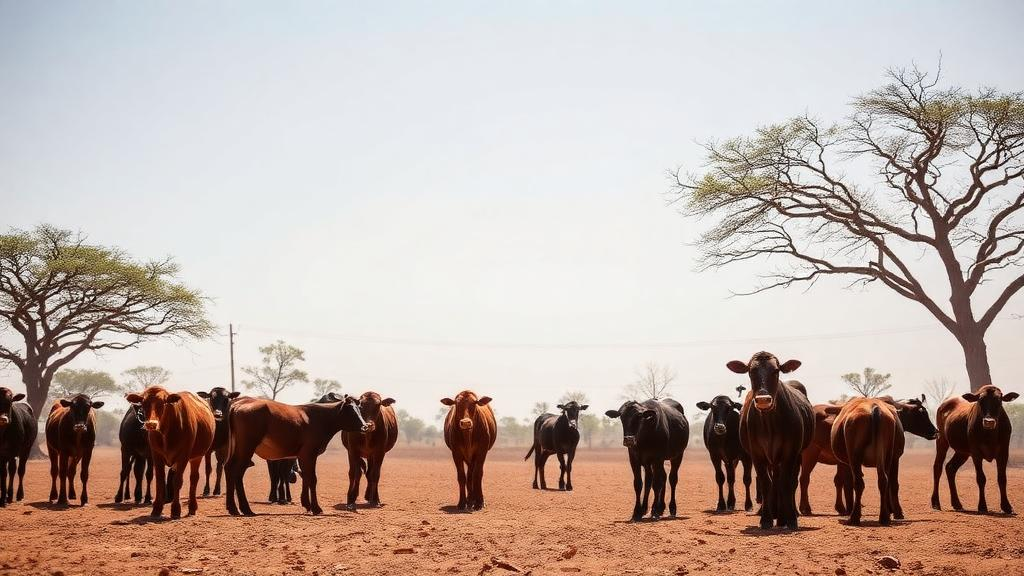
In the arid rangelands of northern Kenya, a pioneering insurance scheme that promises to shield herders from catastrophic drought may be quietly undermining the very households it was designed to protect. A new study published in Frontiers in Environmental Economics examines the Index-Based Livestock Insurance program, known as IBLI, which pays out automatically when satellite measurements of vegetation fall below critical thresholds. The research, led by Simon Maina of New Mexico State University together with colleagues, finds that across eight counties and three consecutive years, herders were persistently exposed to what economists call downside basis risk: the frustrating scenario in which real losses occur but the satellite signal never triggers compensation. The consequences, the authors argue, extend far beyond missed payments, shaping how pastoralist families consume, save, and plan for the future.
IBLI was introduced in Kenya in 2010 through a partnership between the Government of Kenya, the World Bank, and research institutions including the International Livestock Research Institute. Its central innovation was to abandon the costly, labor-intensive model of traditional indemnity insurance, in which assessors must verify every claim on the ground. Instead, the program relies on the Normalized Difference Vegetation Index, or NDVI, a measure of green vegetation computed from satellite imagery. When NDVI values across a defined insurance unit drop below a preset threshold, payouts are triggered automatically. The design eliminates moral hazard and adverse selection, slashes administrative costs, and offers a transparency that conventional livestock insurance in remote regions has rarely achieved. For pastoralists whose herds constitute both their income and their savings, the promise was transformative.
Yet the scheme carries an inherent vulnerability. Because payouts depend on a satellite-derived index rather than on actual losses experienced by individual households, a gap can open between what herders suffer and what insurers pay. Economists distinguish two forms of this basis risk. Upside basis risk occurs when payouts arrive despite no real loss, a windfall that can only improve welfare. Downside basis risk is the opposite and far more damaging case: a family watches animals die in a drought, yet the index signals that forage remained sufficient, and no indemnity arrives. It is this second form that the new study places at the center of its analysis, arguing that repeated experience of unpaid losses may reshape household behavior in ways that erode the program’s welfare benefits.
To quantify the problem, the researchers assembled data from the IBLI program covering 2019 through 2021 across Garissa, Isiolo, Mandera, Marsabit, Samburu, Tana River, Turkana, and Wajir counties. Forage availability was proxied using MODIS satellite NDVI imagery at a resolution of 250 meters, aggregated into ten-day composites and then averaged to the county level, which corresponds to the insurance unit. Rainfall came from the Climate Hazards Group InfraRed Precipitation with Station data, a gridded dataset at roughly five-kilometer resolution that is widely used for drought monitoring. After quality control, standardization into anomalies relative to historical means, and alignment across 5,706 observations, the team employed a two-stage empirical strategy to measure how closely the vegetation index tracks the rainfall that drives forage growth.
The first stage used quantile regression, a technique chosen for its robustness to outliers and its ability to capture relationships at different points of the conditional distribution. Rather than modeling average vegetation conditions, the researchers focused on the fifth percentile of standardized NDVI, because IBLI is designed to protect herders against the catastrophic tail of forage scarcity, not against ordinary variation. In 2019, the relationship between precipitation and forage was strong and statistically significant: an additional unit of current-season rainfall was associated with a 0.049-unit increase in standardized NDVI, with lagged rainfall from two years earlier contributing a further 0.057 units, both showing diminishing returns at higher rainfall levels. By 2021, however, neither current nor lagged precipitation showed a statistically significant relationship with vegetation, a temporal instability that itself carries implications for how reliably any rainfall- or vegetation-based index can predict localized drought losses.
The second stage applied a modified variance-of-error approach, treating the unexplained residual divergence between NDVI and precipitation as an indirect measure of basis risk. The results were striking in their consistency. Every county, in every year of the study period, exhibited positive values of the basis-risk parameter, indicating downside basis risk throughout the region. Garissa recorded the largest average mismatch at 0.2508 over the full period, followed by Isiolo at 0.1755 and Wajir at 0.1105, while Mandera showed the smallest at 0.0381. The distributions of both NDVI and precipitation were positively skewed, meaning adverse events occurred more frequently than the favorable anomalies that would generate payouts without losses. In plain terms, herders across northern Kenya repeatedly bore losses that the insurance index failed to capture.
To translate these measurements into welfare terms, the authors built a theoretical framework grounded in expected utility theory, modeling a risk-averse pastoralist whose wealth evolves across four mutually exclusive states of nature: loss with a matching signal, loss without a signal, no loss with a signal, and no loss without a signal. Because basis risk is unobservable to insurers, it cannot be written into contracts, but herders learn about it through experience. The framework predicts an important asymmetry. Households that receive payouts without losses, the upside case, may increase spending on welfare-enhancing goods such as food, education, healthcare, and leisure. Households that suffer losses without compensation, the downside case, are predicted to cut back on precisely those expenditures as a coping mechanism, deplete savings, and forgo interest income, with the anticipation of future downside risk potentially discouraging deposits in financial institutions altogether.
An illustrative calculation for Wajir County, using a representative herder with an initial endowment of 15 Tropical Livestock Units, the minimum herd size generally considered necessary to sustain a pastoral livelihood, demonstrates the mechanism. In each year from 2019 to 2021, the insured loss implied by the index fell short of the actual loss, satisfying the theoretical condition for a welfare loss. The authors are careful to frame this as an application of the theoretical model rather than a causal county-level estimate, and they acknowledge a central limitation: the study lacks household-level data on livestock mortality, indemnity payments, and consumption at the spatial and temporal resolution needed to validate the proxy directly. The NDVI-precipitation divergence may also reflect ecological heterogeneity, grazing management, and measurement error rather than insurance shortfalls alone.
Even with those caveats, the findings challenge a body of earlier research that reported welfare gains from IBLI, including evidence from Mongolia showing that payouts facilitated rapid herd recovery and Kenyan studies identifying income stabilization and shifts toward higher-return herding strategies. The new analysis suggests that persistent downside basis risk may offset those benefits, imposing psychological and economic burdens that can outweigh the nominal value of coverage even when premiums are heavily subsidized. The study also connects to a growing experimental literature showing that farmers are acutely sensitive to basis risk, that demand for index insurance falls as basis risk rises, and that ambiguity aversion can delay or reduce adoption, particularly among households unfamiliar with the technology.
The policy implications are concrete. The authors argue that subsidy structures should be revisited so that participation reflects deliberate choices rather than blanket incentives, that index precision must improve, and that behavioral considerations deserve a place in program design. Notably, they cite evidence that rainfall-based indices with higher spatial resolution exhibit lower basis risk than NDVI-based systems, suggesting a possible path forward. They also point to the institutional context: communal grazing regimes can blunt individual-level incentives, and strengthening land tenure and grazing rights could improve both targeting and uptake. As climate variability intensifies across the Horn of Africa, the study’s central message is sobering but constructive. Index insurance can still deliver on its promise, but only if the gap between what satellites see and what herders live through is narrowed, and only if insurers recognize that households are not passive policyholders but adaptive learners who update their trust with every unpaid loss.
Subject of Research: Basis risk and welfare effects of satellite-based index livestock insurance for pastoralists in northern Kenya
Article Title: Welfare effects of behavioral responses to basis risk in remote-sensing livestock insurance in northern Kenya
Article References: Maina, S., Miller, M., Torell, G. L., Hanan, N. P., Anchang, J., & Kahiu, N. (2026). Welfare effects of behavioral responses to basis risk in remote-sensing livestock insurance in northern Kenya. Frontiers in Environmental Economics, 5, Article 1750935. https://doi.org/10.3389/frevc.2026.1750935
Image Credits: AI Generated
DOI: 10.3389/frevc.2026.1750935
Keywords: index-based livestock insurance, basis risk, NDVI, pastoralism, northern Kenya, drought, remote sensing, welfare economics, consumption smoothing, climate variability, behavioral economics, rangelands
Cite Scienmag News
Violet Maxwell. (October 15, 2026). Satellite Insurance Falls Short for Kenyan Herders as Drought Losses Go Unpaid. Scienmag. https://scienmag.com/satellite-insurance-falls-short-for-kenyan-herders-as-drought-losses-go-unpaid/
Violet Maxwell. "Satellite Insurance Falls Short for Kenyan Herders as Drought Losses Go Unpaid." Scienmag, 15 October 2026, https://scienmag.com/satellite-insurance-falls-short-for-kenyan-herders-as-drought-losses-go-unpaid/. Accessed 15 October 2026.
Violet Maxwell. "Satellite Insurance Falls Short for Kenyan Herders as Drought Losses Go Unpaid." Scienmag. October 15, 2026. https://scienmag.com/satellite-insurance-falls-short-for-kenyan-herders-as-drought-losses-go-unpaid/


