


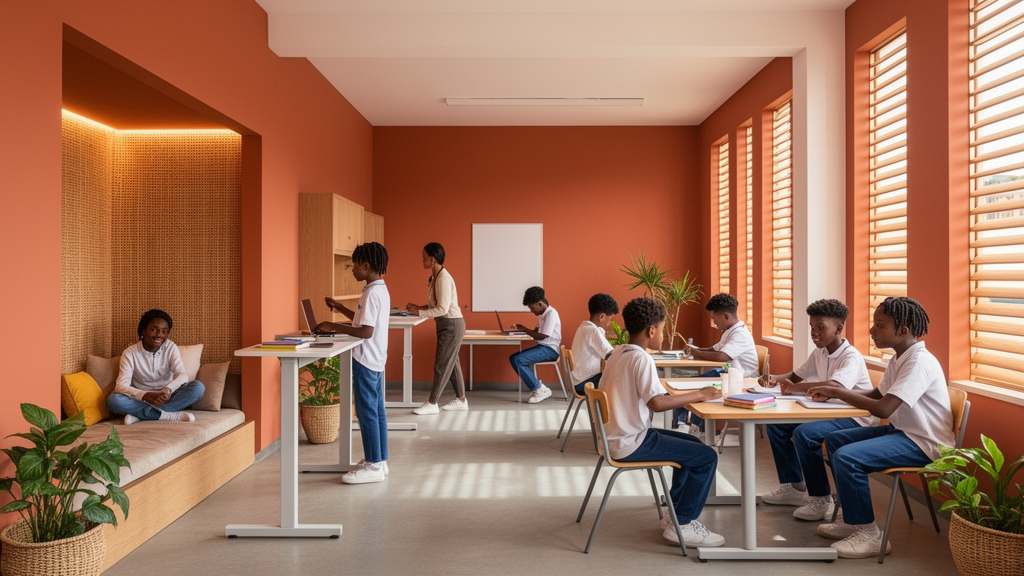
Every secondary school building makes sensory demands on the teenagers inside it. Corridors roar with movement, classrooms hum with fluorescent light and overlapping speech, and the transitions between spaces arrive without warning. For neurodivergent adolescents — autistic students, and students with ADHD, dyslexia, dyspraxia, or other sensory-processing differences — these demands are not background noise but active barriers to attention, participation and wellbeing. A new integrative review published in Frontiers in Built Environment argues that the way architects conceptualize those demands has been fundamentally wrong, and it proposes a replacement framework tested against the international evidence and adapted for one of the most resource-constrained school systems in the world.
The study, conducted by Omoniyi Ogheneruemu Olagunju and Ayomide Teslim Ogundele of the Department of Architecture at Covenant University in Ota, Nigeria, set out to test a deceptively simple architectural proposition: that a school campus could be organized as a graduated sequence of spaces, running from high-stimulation public zones at one end to quiet, restorative settings at the other, with transition zones acting as sensory buffers between them. The idea originated in earlier unpublished postgraduate design work, and the researchers were careful to treat it not as evidence but as a hypothesis — an a priori proposition to be audited against what the literature actually shows.
To do that, the team followed Whittemore and Knafl’s integrative-review methodology, embedding a systematic search across six databases — Scopus, Web of Science Core Collection, ERIC, PsycINFO, MEDLINE/PubMed and the Avery Index to Architectural Periodicals — covering January 2000 through 15 July 2026. Study selection was reported using PRISMA 2020 principles. Across two identification streams, 73 reports were assessed and 26 evidence sources were included: 15 empirical and review sources from the systematic database stream, plus two theoretical sources, seven Nigeria- and Ota-specific contextual sources, and two practice-oriented sources identified through supplementary searching. Primary studies were appraised with the Mixed Methods Appraisal Tool, and reviews with item-level judgments drawn from AMSTAR 2, with methodological quality deliberately kept separate from how directly each source matched secondary-school-age neurodivergent learners.
The central finding is a rejection. The evidence did not support treating stimulus intensity as a single high-to-low axis. Environmental demands — acoustic, visual, movement, social, thermal, olfactory and tactile — vary independently of one another. A school cafeteria is plausibly high in social, movement and acoustic demand simultaneously while remaining only moderate in visual complexity; a science laboratory may be high in olfactory and tactile demand and task predictability but moderate in social demand. Collapsing both into one stimulus score would misrepresent them both. Worse, a strict gradient risks recreating the very homogenization of neurodivergence the review critiques: hyposensitive learners may actively seek stronger input, while hypersensitive learners need attenuation, so the desirable level of stimulation is learner-dependent, not spatially fixed.
In place of the single axis, the researchers reformulated their framework as a multidimensional demand-profile network. Each setting is characterized by a configuration of demands across separable dimensions, and the framework adds three constructs the original proposition lacked: transition magnitude, defined as the degree of change in demand encountered when moving between adjoining settings; predictability and legibility, treated not as another demand but as a cross-cutting characteristic describing how well a learner can anticipate and prepare for those demands; and learner-perceived control, elevated to a central moderating mechanism. The evidence for control is among the strongest in the review: experiments with autistic children aged 4 to 12 showed increased attention and fewer repetitive behaviors when the children could manipulate multi-sensory-environment equipment, and studies of autistic pupils aged 11 to 15 found that self-directed use of such environments supported wellbeing and the management of sensory overwhelm.
The review is transparent about where its evidence is strongest and weakest. Direct, participatory studies of autistic adolescents in mainstream secondary schools — including a synthesis of 36 qualitative studies identifying environments that suit me and agency to meet my needs as core themes, and photo-voice work in which students described the sensory environment as unnatural — anchor the framework firmly in autism research. By contrast, direct built-environment evidence for ADHD is comparatively limited, and evidence for dyslexia and dyspraxia rests largely on practice-oriented sources about glare, high-contrast lighting and daylight, which the authors classify as low-confidence illustrative context rather than tested design rules. The framework is therefore described as autism-anchored in evidential support and neuroinclusive in ambition, with transfer to other neurodivergent groups treated as provisional.
The researchers also mapped their contribution against existing frameworks rather than assuming novelty. Mostafa’s Autism ASPECTSS Design Index names acoustics, spatial sequencing, escape space, compartmentalization, transition spaces, sensory zoning and safety, and has been tested through post-occupancy evaluation; Universal Design for Learning addresses instructional rather than spatial variability; Attention Restoration Theory, operationalized through biophilic design, supplies a restoration mechanism but was not developed for neurodivergent adolescents. What the Sensory-Gradient Framework adds, the authors argue, is not any single design quality but the combination of campus-scale adjacency and sequencing, transition magnitude as an explicit and measurable design variable, and learner-perceived control as a central moderating mechanism, applied simultaneously across campus, building and room scales — and formalized as seven testable propositions rather than fixed prescriptions.
What makes the study unusual is where it lands the framework. Ota, in Ogun State, sits in Nigeria’s tropical wet-and-dry climate zone, where mechanical climate control cannot be assumed and passive design is a necessity rather than a preference. Nigerian studies confirm that orientation, shading and cross-ventilation improve classroom thermal conditions, while Ota-specific rainfall measurements document high rain rates that interact directly with acoustic exposure. The framework’s contextual application therefore surfaces genuine trade-offs: cross-ventilation that reduces cooling load also admits traffic and rain noise; generous daylighting that reduces dependence on flickering artificial light risks glare and high contrast; verandas and covered walkways needed for rain protection can become high-noise corridors unless deliberately differentiated with pause points and staggered circulation.
Resource constraints shape the application further. A survey of 47 staff across three Lagos special-needs schools found gaps in spatial flexibility, accessibility and sensory design, with sensory and physical impairments rated the most severe student challenge, and studies of Nigerian public buildings corroborate a persistent gap between inclusive-education policy commitments and physical-infrastructure delivery. The authors are explicit that architecture alone cannot deliver neuroinclusive outcomes when staffing, maintenance or space-management practices undermine it — a retreat space cannot function as a regulatory resource if it is routinely repurposed as overflow teaching space. In cash-constrained schools, they propose low-cost operational equivalents: furniture-based zoning, temporary screens, timetabling that staggers high-density transitions, low-maintenance planting for shade and visual buffering, and route choice created through supervision and scheduling rather than new construction.
The authors stress that the resulting framework is evidence-informed and testable rather than empirically validated, and they frame a research agenda accordingly: co-design with neurodivergent Nigerian secondary-school students, post-occupancy evaluation of schools that operationalize the framework, direct measurement of acoustic, lighting, thermal, movement and social-demand conditions in Ota-area schools, and prospective testing of whether transition magnitude, predictability and perceived control predict regulatory outcomes. For a field that has largely been built from evidence gathered in high-income, temperate-climate settings, the study’s insistence that sensory design must be reconciled with passive cooling, daylight, rain noise and institutional reality in sub-Saharan Africa may prove its most consequential contribution — a reminder that inclusive architecture is not a universal template but a negotiation between evidence, climate and constraint.
Subject of Research: A sensory-gradient framework for neuroinclusive secondary-school design tested against evidence and contextualized for tropical Nigeria
Article Title: Toward a sensory-gradient framework for neuroinclusive secondary-school design: an integrative review and contextualization for a tropical Nigerian setting
Article References: Toward a sensory-gradient framework for neuroinclusive secondary-school design: an integrative review and contextualization for a tropical Nigerian setting. (n.d.). https://doi.org/10.3389/fbuil.2026.1964960
Image Credits: AI Generated
DOI: 10.3389/fbuil.2026.1964960
Keywords: neuroinclusive design, autism, ADHD, dyslexia, dyspraxia, sensory processing, school architecture, Nigeria, passive design, integrative review, transition magnitude, learner control
Cite Scienmag News
Violet Maxwell. (October 15, 2026). School Design for Neurodivergent Teens Gets a Radical Rethink in Nigeria. Scienmag. https://scienmag.com/school-design-for-neurodivergent-teens-gets-a-radical-rethink-in-nigeria/
Violet Maxwell. "School Design for Neurodivergent Teens Gets a Radical Rethink in Nigeria." Scienmag, 15 October 2026, https://scienmag.com/school-design-for-neurodivergent-teens-gets-a-radical-rethink-in-nigeria/. Accessed 15 October 2026.
Violet Maxwell. "School Design for Neurodivergent Teens Gets a Radical Rethink in Nigeria." Scienmag. October 15, 2026. https://scienmag.com/school-design-for-neurodivergent-teens-gets-a-radical-rethink-in-nigeria/


