


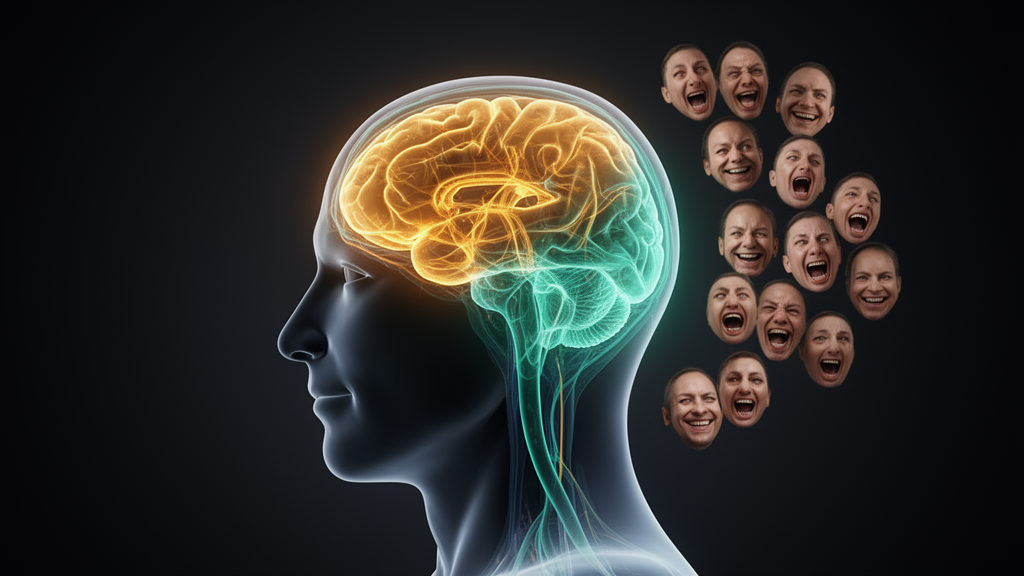
Psychopathy and sadism have long been confused with one another, and for understandable reasons. Both are dark personality traits associated with a lack of empathy, callousness, and a willingness to harm other people. Both appear in the same taxonomies of malevolent personality, and recent psychometric work has even questioned whether the questionnaires designed to measure them are capturing genuinely distinct constructs. Yet a new study published in Current Psychology by Janko Međedović of the Institute of Criminological and Sociological Research in Belgrade and Goran Knežević of the University of Belgrade suggests that, beneath the surface similarity, the two traits operate in strikingly different ways when people are asked to control their reactions to emotional faces. The findings, based on a sample of 663 participants, offer some of the clearest behavioral evidence yet that psychopathy and sadism are not merely redundant labels for the same underlying disposition.
The researchers focused on a cognitive function known as response inhibition, the capacity to suppress an action that has already been set in motion. Response inhibition is a core component of executive functioning, the family of mental abilities that also includes planning, working memory, and cognitive flexibility. When inhibition fails in everyday life, the result can be impulsive aggression, risky decision-making, or the inability to stop oneself from acting on a fleeting urge. Previous meta-analyses have established that people high in psychopathic traits tend to perform worse on inhibition tasks, but far less was known about how sadism relates to this same capacity, and almost nothing was known about how the two traits compare when the stimuli in question are emotionally charged rather than neutral.
To probe this question, the team used a go/no-go task, one of the most widely used paradigms in cognitive psychology for measuring inhibitory control. In this task, participants are presented with a rapid stream of images and instructed to respond quickly to certain categories of stimuli while withholding their response to others. What made this version distinctive was its emotional content: the stimuli were photographs of facially expressed emotions, drawn from four categories that Paul Ekman’s classic work identified as universal: happiness, sadness, anger, and fear. Faces are a particularly revealing class of stimulus because they carry rich social and affective information, and both psychopathy and sadism have been theorized to involve abnormalities in processing exactly this kind of signal.
The task yielded three key performance measures. Commission errors occurred when participants pressed the button even though they should have withheld their response, a classic sign of failed inhibition. Omission errors occurred when participants failed to respond to a stimulus that required a response, which can reflect lapses in attention or difficulties in recognizing the emotional category of the face. Reaction time, finally, captured how quickly participants responded when they did press the button, providing a window into the speed of their processing. By analyzing all three measures together, the researchers could distinguish between different underlying deficits that might otherwise look identical in the data.
The first round of analysis was deliberately simple. In bivariate correlations, both psychopathy and sadism were positively associated with both types of errors, meaning that people higher in either trait made more mistakes of both kinds on the task. Psychopathy, however, showed a negative association with reaction time: the more psychopathic the participant, the faster they responded overall. At first glance, this pattern makes the two traits look alike, echoing the concerns raised by researchers who have argued that psychopathy and sadism scales may be measuring the same thing. But the similarity dissolved once the authors moved to analyses that could separate the unique contribution of each trait.
Using canonical correlation analysis, a statistical technique that examines the relationship between two sets of variables simultaneously, and then a structural model that allowed psychopathy and sadism to compete as predictors of the same task outcomes, the picture changed dramatically. Psychopathy positively predicted commission errors, indicating decreased response inhibition and, plausibly, lower accuracy in recognizing the emotional expressions themselves. At the same time, psychopathy negatively predicted reaction time, meaning that individuals high in psychopathic traits were not slower but faster than average. Sadism told a different story entirely: it positively predicted omission errors, pointing toward potential attentional deficits, and it marginally positively predicted reaction time, suggesting slower rather than faster processing of the emotional faces.
These divergent signatures are more than statistical curiosities; they speak to fundamentally different psychological mechanisms. The psychopathy profile, marked by impulsive commission errors combined with rapid responding, is consistent with a long line of research on response modulation in psychopathy. According to influential models developed by Joseph Newman and colleagues, individuals with psychopathic traits show early selective attention abnormalities: they focus so narrowly on goal-relevant information that peripheral emotional signals fail to modulate their behavior, allowing them to barrel forward regardless of the affective consequences. The fast reaction times observed here fit neatly with this account of a quick, emotionally underdamped processing style that barrels past inhibitory brakes. The finding also echoes meta-analytic evidence that psychopathy is associated with pervasive deficits in recognizing facial and vocal emotional expressions, particularly fear and sadness, a literature going back to Blair’s foundational studies of reduced sensitivity to others’ fearful expressions.
Sadism, by contrast, produced a pattern suggestive of slowed, attentionally compromised processing rather than impulsive speed. The positive prediction of omission errors implies that highly sadistic participants sometimes failed to register or respond to the emotional faces at all, while the marginal slowing of reaction times hints that when they did respond, they took longer to do so. This is consistent with earlier work by Međedović showing aberrations in emotional processing of violence-dependent stimuli as a core feature of sadism, and with studies linking everyday sadism to blunted startle reactivity. Where the psychopathic individual may race past emotional information, the sadistic individual may linger in a state of attenuated, inefficient engagement with it, a difference that could reflect different motivations for causing harm: impulsive instrumental exploitation on one side and a more deliberate, attention-grabbing preoccupation with others’ distress on the other.
The authors also made a methodologically important decision about how to measure psychopathy. Many psychopathy inventories include a lifestyle facet characterized by impulsivity and disinhibition, and it is this facet that shows the strongest associations with inhibition in the existing literature. But, as the researchers note, that association is largely tautological, since a disinhibition trait is by definition a lack of behavioral control. Including it alongside other psychopathy facets would risk crowding out predictors with genuine explanatory value. Instead, the team used the Psychopathic Personality Traits Scale, which separates psychopathy into a lack of cognitive and affective empathy, manipulation, and egocentricity, components that conceptually align with the Dark Triad of psychopathy, Machiavellianism, and narcissism. The results may therefore have implications for dark personality traits more broadly, suggesting that the emotional processing signature of psychopathy is carried by its interpersonal and affective core rather than by its impulsive periphery.
The study is not without limits. The sample was drawn from a general rather than clinical or forensic population, so the traits were assessed at subclinical levels, and the go/no-go task, while well validated, captures only one slice of the complex interplay between emotion and cognitive control. Nonetheless, the implications are considerable. For clinicians and forensic professionals, the results suggest that psychopathy and sadism should not be treated as interchangeable constructs when assessing risk or designing interventions: a fast, inhibition-impaired processing style calls for different management strategies than a slow, attentionally deficient one. For personality science, the findings push back against recent claims that psychopathy and sadism scales are redundant, demonstrating that the two traits dissociate cleanly at the level of objective behavioral performance. And for anyone intrigued by the dark side of human nature, the study offers a vivid illustration of a broader principle: two traits can wear the same mask of callousness while operating on entirely different machinery underneath.
Subject of Research: Differences between psychopathy and sadism in response inhibition to emotional facial stimuli measured with a go/no-go task
Article Title: Similarities and differences between psychopathy and sadism in response inhibition to affective stimuli
Article References: Međedović, J., & Knežević, G. (2026). Similarities and differences between psychopathy and sadism in response inhibition to affective stimuli. Current Psychology, 45(17), Article 1452. https://doi.org/10.1007/s12144-026-10020-z
Image Credits: AI Generated
DOI: 10.1007/s12144-026-10020-z
Keywords: psychopathy, sadism, response inhibition, go/no-go task, emotion recognition, facial expressions, executive function, dark triad, empathy, attention, personality traits, aggression
Cite Scienmag News
Cassandra Pierce. (October 15, 2026). Psychopathy and Sadism Diverge in How the Brain Holds Back Responses to Emotional Faces. Scienmag. https://scienmag.com/psychopathy-and-sadism-diverge-in-how-the-brain-holds-back-responses-to-emotional-faces/
Cassandra Pierce. "Psychopathy and Sadism Diverge in How the Brain Holds Back Responses to Emotional Faces." Scienmag, 15 October 2026, https://scienmag.com/psychopathy-and-sadism-diverge-in-how-the-brain-holds-back-responses-to-emotional-faces/. Accessed 15 October 2026.
Cassandra Pierce. "Psychopathy and Sadism Diverge in How the Brain Holds Back Responses to Emotional Faces." Scienmag. October 15, 2026. https://scienmag.com/psychopathy-and-sadism-diverge-in-how-the-brain-holds-back-responses-to-emotional-faces/


