


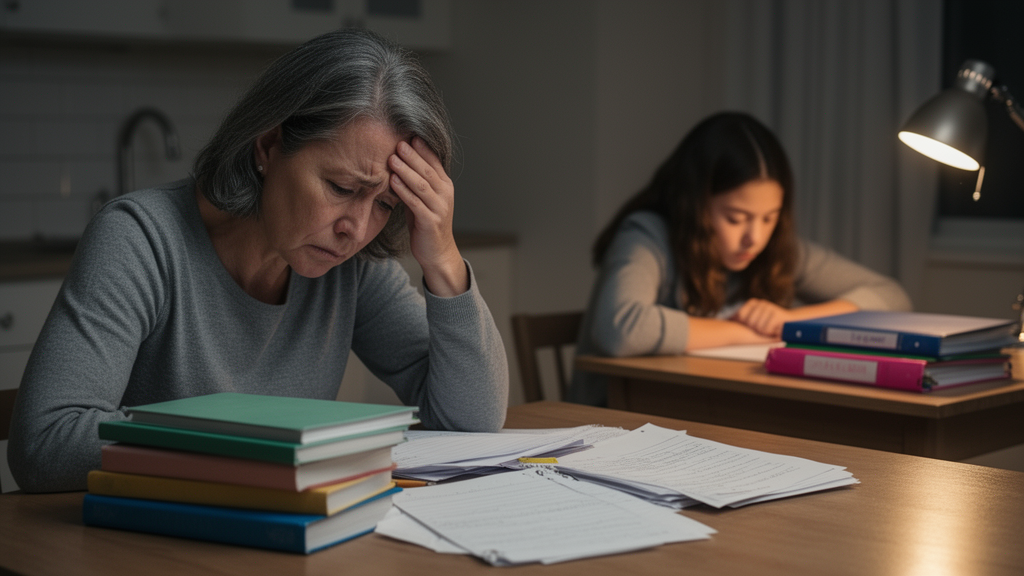
In the hyper-competitive world of Chinese schooling, a distinctive form of worry has taken hold among mothers and fathers: parental educational anxiety, the gnawing fear that one’s child will fall behind in an unforgiving academic race. A new longitudinal study published in BMC Psychology suggests that this anxiety may not stay contained within the parents’ own minds. Instead, it appears to seep into how adolescents judge their own academic abilities, and through that channel, into a state of exhaustion and disengagement that researchers call learning weariness. The work, led by Xinhang Gao and Lei Han of Shandong Normal University together with colleagues, tracked 266 early adolescents and one of their parents across a full year, offering one of the more careful attempts to untangle the direction of influence between family stress and student burnout.
The study’s design is its central strength. Rather than measuring everything at a single moment, the researchers surveyed the same families twice, one year apart, between October 2021 and October 2022. The adolescents, who averaged just under twelve years of age and included 44.4 percent girls, reported on their academic self-efficacy and their levels of learning weariness. Their parents, nearly four in five of whom were mothers with an average age of about thirty-nine, reported on their own educational anxiety. This two-wave structure allowed the team to run what statisticians call a half-longitudinal mediation analysis, in which the predictor is measured at the first time point and the proposed mediator and outcome at the second, a setup that begins to address the question of what comes first.
Learning weariness, the outcome at the heart of the study, describes a student’s overall negative reaction to academic pursuits: a blend of emotional exhaustion, cynicism toward schoolwork, and a diminished sense of accomplishment. It is the academic cousin of occupational burnout, and in East Asian education systems, where students routinely face intense examination pressure, it has become a growing public health concern. Parental educational anxiety, meanwhile, is a phenomenon that researchers link directly to the competitive landscape of Chinese education, in which scarce access to elite schools and universities turns every test score into a family stakes event. The question the researchers posed was deceptively simple: does anxious parenting drive children toward burnout, do weary children make their parents more anxious, or do the two feed each other in a loop?
To answer it, the team built three competing structural equation models, a family of statistical techniques that tests whether observed data are consistent with hypothesized networks of cause-like pathways among latent variables. The first possibility was a parent-effect model, in which parental anxiety at time one predicts changes in adolescent outcomes at time two. The second was a child-effect model, running in the opposite direction. The third was a bidirectional model, allowing both streams of influence simultaneously. By comparing how well each model fit the data, using standard fit indices such as the comparative fit index, the Tucker-Lewis index, the root mean square error of approximation, and the standardized root mean square residual, the researchers could ask which account of the family dynamic was the most parsimonious.
The results were striking in what they did and did not show. Contrary to the intuitive picture of anxious parents directly wearing down their children, the analysis detected no direct unidirectional or bidirectional association between parental educational anxiety and adolescent learning weariness. The two constructs were connected, but only indirectly, through a third variable: academic self-efficacy, a student’s belief in his or her own capability to organize and execute the actions required to succeed academically. In the retained parent-effect model, higher parental educational anxiety at the first wave was prospectively associated with lower academic self-efficacy, which in turn was associated with higher learning weariness a year later. In other words, the pathway from parental worry to child burnout ran through the child’s own confidence, not through the worry itself acting directly.
That indirect pathway, however, comes with an important scientific caveat that the authors themselves emphasize: it was small and statistically fragile across different model specifications. Fragility in this context means that the estimate, while consistently positive in direction, was sensitive to the exact analytical choices made, and its confidence intervals did not always inspire full confidence. The researchers are careful not to overclaim. They describe the parent-effect model as providing the most parsimonious account of a fragile but consistently positive indirect association, a phrasing that signals genuine uncertainty beneath an otherwise tidy headline finding. For readers, the takeaway is that the evidence points in a particular direction but does not amount to proof.
Equally important is what the study could not establish. The reverse pathways, in which weary or less confident adolescents would prospectively heighten their parents’ educational anxiety, were not statistically detected in this sample. But the authors caution that low statistical power precluded definitive conclusions about directionality. With 266 families, the study was powered to detect only relatively robust effects, and small cross-lagged pathways of the kind often found in family dynamics research can easily slip below the detection threshold. This means the absence of child-effect findings should not be read as evidence that children never influence their parents. It simply means that, in this dataset, such influences could not be reliably seen, and the door remains open for larger studies to test the question again.
The theoretical implications are nonetheless meaningful. Much prior research on academic development has treated family influence as a one-way street, examining how parental factors shape adolescent outcomes. By explicitly modeling reciprocal dynamics, this study joins a smaller tradition that asks whether the traffic flows both ways. Its answer, provisionally, is that the parent-to-child route through academic self-efficacy is the story the data tell most coherently. This aligns with a broader psychological framework in which children’s beliefs about their own competence act as a transmission belt between the emotional climate of the home and their engagement with school. A parent’s anxiety, on this account, does not exhaust a child directly; it erodes the child’s confidence, and the eroded confidence does the exhausting.
For practitioners and policymakers, the findings suggest a specific point of intervention. If parental educational anxiety contributes to adolescent burnout primarily by undermining academic self-efficacy, then programs that help parents manage their own educational worries, and separately, programs that build students’ sense of academic competence, could both interrupt the chain. Family education initiatives in China have already begun to address parental anxiety, and this study offers empirical support for that direction, while also highlighting self-efficacy as a promising lever for school-based interventions aimed at alleviating learning weariness. The authors frame their work as informing future research and intervention development aimed at improving the quality of family education.
The study also carries methodological lessons for the field. Its authors were transparent about the fragility of their indirect effect and about the retrospective ethics review that approved the protocol after the fact, noting that written informed consent was obtained from all parents, assent from all adolescents, and that participation was voluntary and anonymous. Such candor about statistical uncertainty is increasingly valued in psychological science, where small longitudinal effects are notoriously difficult to replicate. For now, the picture that emerges is nuanced: in these Chinese families, parental anxiety about education left a measurable, if delicate, fingerprint on adolescent burnout one year later, traveling through the quiet medium of a child’s self-belief. Confirming, strengthening, or overturning that fingerprint will require larger samples, more measurement waves, and the kind of patience that, fittingly, anxious parents everywhere might do well to practice.
Subject of Research: Longitudinal links between parental educational anxiety, academic self-efficacy and learning weariness in Chinese early adolescents
Article Title: Anxious parents and weary children: Longitudinal association between parental educational anxiety, academic self-efficacy and learning weariness in Chinese early adolescents
Article References: Gao, X., Ge, J., Zhang, J., & Han, L. (2026). Anxious parents and weary children: Longitudinal association between parental educational anxiety, academic self-efficacy and learning weariness in Chinese early adolescents. BMC Psychology. https://doi.org/10.1186/s40359-026-05787-6
Image Credits: AI Generated
DOI: 10.1186/s40359-026-05787-6
Keywords: parental educational anxiety, academic self-efficacy, learning weariness, early adolescents, longitudinal study, structural equation modeling, Chinese education, family dynamics, academic burnout, BMC Psychology, mediation analysis, educational psychology
Cite Scienmag News
Glenn Wilkins. (October 15, 2026). Parental Anxiety About Schooling May Feed Teen Burnout Through a Fragile Chain. Scienmag. https://scienmag.com/parental-anxiety-about-schooling-may-feed-teen-burnout-through-a-fragile-chain/
Glenn Wilkins. "Parental Anxiety About Schooling May Feed Teen Burnout Through a Fragile Chain." Scienmag, 15 October 2026, https://scienmag.com/parental-anxiety-about-schooling-may-feed-teen-burnout-through-a-fragile-chain/. Accessed 15 October 2026.
Glenn Wilkins. "Parental Anxiety About Schooling May Feed Teen Burnout Through a Fragile Chain." Scienmag. October 15, 2026. https://scienmag.com/parental-anxiety-about-schooling-may-feed-teen-burnout-through-a-fragile-chain/


