


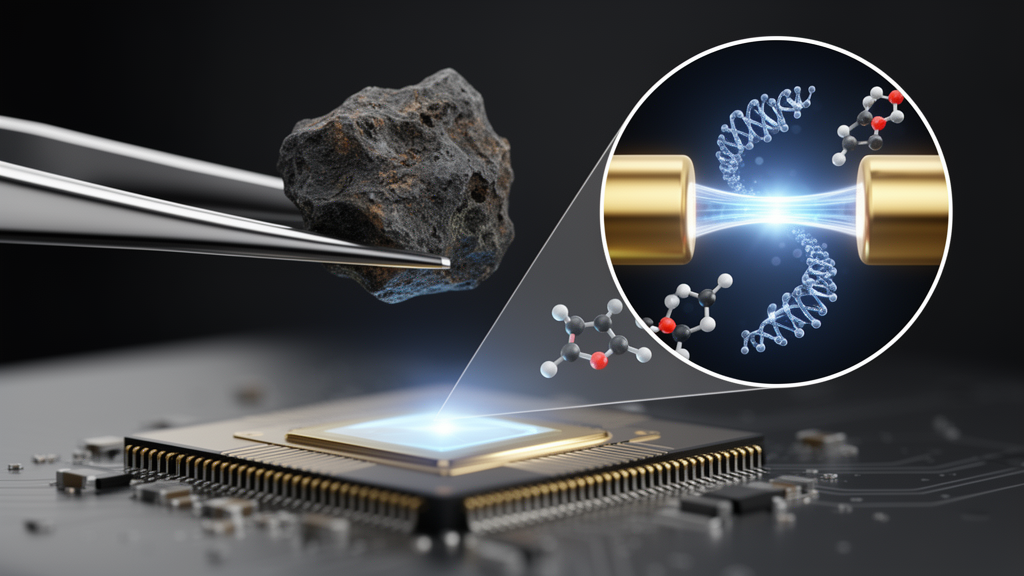
Every living thing on Earth is subtly lopsided. The amino acids that build our proteins are almost exclusively left-handed, while the sugars in our DNA twist to the right. Yet when chemists synthesize amino acids in a flask mimicking the early solar system, both mirror-image forms emerge in equal amounts. That mismatch between biology and abiotic chemistry has long tantalized scientists searching for life beyond Earth: if a sample from Mars or an asteroid showed a strong preference for one handedness, it might whisper of biology. Now, a team of researchers in Japan and the United States reports a device that can tell left from right, one molecule at a time, using nothing but a whisper of quantum electricity.
The new study, published in Nature Communications, describes how a nanogap sensor built from two atomically sharp gold electrodes can electrically distinguish individual L- and D-form amino acids without optical instruments, chemical labels, or chiral recognition molecules. The work, led by Masateru Taniguchi of Osaka University together with Christopher Carr of the Georgia Institute of Technology and collaborators at NASA Goddard Space Flight Center, MIT, and the University of Chicago, even applied the technique to extracts of the famous Murchison meteorite and soils from Chile’s Atacama Desert, two of astrobiology’s most treasured testing grounds.
The heart of the device is a mechanically controllable break junction, a setup in which a thin gold wire is stretched until it snaps, leaving two electrodes pointed so finely that their tips end in single atoms. The gap between them is tuned to roughly half a nanometer, about the width of a single amino acid, and held there with sub-nanometer precision by piezoelectric feedback for hours at a time. Under a modest voltage of 0.1 volts, electrons do something distinctly quantum mechanical: they tunnel across the empty gap. When a single amino acid molecule drifts into that gap, it briefly bridges the tunneling path, and the current spikes in a characteristic way.
Each molecule that passes through produces a spike-like blip in the current-versus-time record, defined by a peak current and a duration. For tryptophan, the amino acid with the largest electron-rich ring system and therefore the highest single-molecule conductance, the peak currents for the L- and D-forms clustered around 35.7 and 36.9 picoamps, distributions that overlap almost completely. On paper, that seems like bad news: the simplest electrical fingerprints cannot tell the mirror images apart. But the researchers noticed something subtler in the full shape of the waveforms. The L-form signals spread differently in time than the D-form signals, hinting that the two enantiomers interact transiently with the chiral, high-index crystal facets of the gold tips in measurably different ways.
To exploit those differences, the team turned to machine learning. Each detected waveform was converted into a fifteen-dimensional feature vector, including the peak current, the duration, and twelve normalized shape descriptors that divide the signal into twelve equal time slices. An XGBoost classifier, trained on data from pure amino acid standards, could then assign handedness to individual waveforms. For tryptophan, the F1-score reached 0.827, far above the 0.5 expected from random guessing between two choices. Across all nineteen chiral amino acids tested, the average score was 0.876, ranging from 0.784 for glutamine to 0.974 for isoleucine. Crucially, when training and test data came from entirely different nanogap chips, mimicking how a sensor trained on Earth would be flown to another planet, the accuracy barely changed.
Because a five-minute measurement yields hundreds of waveforms, the statistics compound rapidly. If a single waveform is classified correctly with 90 percent probability, then aggregating just sixteen waveforms pushes the confidence above 99.9 percent. The team extended this logic to mixtures: four amino acids with different chiral compositions were identified with scores above 0.65, and a five-component mixture containing both enantiomers of histidine, plus alanine, glutamine, and serine, was quantified with errors mostly within 25 percent. Even a deliberately contaminated seven-species mixture including two DNA building blocks was resolved with an F1-score of 0.761, a nod to the messy reality of real environmental samples.
The true test came with natural materials. The researchers obtained a two-gram interior fragment of the Murchison meteorite, a carbon-rich space rock that fell in Australia in 1969 and has been a cornerstone of prebiotic chemistry research ever since. They also analyzed soils collected in 2022 from two hyperarid Atacama Desert sites, North of Antofagasta and Diego de Almagro, some of the driest, most Mars-like terrain on Earth. Amino acids were extracted with hot water, hydrolyzed with acid vapor, purified on ion-exchange resin, and then measured both by the nanogap sensor and by conventional liquid chromatography-mass spectrometry, the gold-standard reference method.
Because environmental extracts contain countless unknown molecules, the team applied a confidence filter: only waveforms whose maximum predicted probability across an eleven-species target panel exceeded 0.5 were retained as high-confidence assignments. The filter worked strikingly well on the process blank, rejecting 93.2 percent of its events, while retaining nearly half of the events from the Murchison extract. The confidence-filtered composition of the meteorite sample, dominated by glycine at 47.9 percent followed by alanine, glutamic acid, and serine, captured the major patterns seen by mass spectrometry, though some analyte-specific differences remained. For the Atacama samples, agreement was more partial, and the authors are candid that background signals and low-abundance events still shape the results.
The researchers also compared D/L ratios for alanine, valine, and aspartic acid between the two methods. For aspartic acid in the Murchison extract, the nanogap-derived ratio agreed well with mass spectrometry, while alanine and valine showed larger discrepancies. The authors stress that the current results should be read as targeted, high-confidence estimates within a predefined panel rather than comprehensive chiral profiles, and that future work will need matrix-matched calibration, larger event statistics, and open-set recognition methods that can flag molecules outside the training library altogether.
Still, the implications are striking. Conventional mass spectrometry cannot perform chiral discrimination at the single-molecule level, and laboratory instruments are far too heavy and fragile for a lander. The nanogap chip, by contrast, is compact, reagent-free, and heat-resistant to over 300 degrees Celsius, meaning it could survive a spacecraft journey without cooling. A target detection limit of about one nanomolar concentration has been proposed for life-detection instruments on future missions to ocean worlds like Europa and Enceladus, and the calibration-based detection limit of the nanogap system, 0.03 nanomolar under controlled conditions, sits comfortably below that bar. The timing is also propitious: recent analyses of samples returned from the asteroids Ryugu and Bennu found amino acid enantiomeric ratios consistent with racemic mixtures, suggesting that earlier reports of left-handed excess in meteorites likely reflected terrestrial contamination. Reliable, compact chiral analysis has never mattered more. If the combination of molecular abundance, tunneling conductance, and enantiomeric excess can one day be measured in situ on another world, scientists may finally hold a practical tool for asking the oldest question there is: are we alone?
Subject of Research: Single-molecule electrical chiral discrimination of amino acids for astrobiological biosignature detection
Article Title: Chiral discrimination of amino acids in meteorite and desert soil extracts via single-molecule nanogap conductance
Article References: Ohshiro, T., Komoto, Y., Takaai, T., Yoshida, T., Washio, T., Ramírez-Colón, J. L., Mclain, H. L., Duzdevich, D., Zuber, M. T., Carr, C. E., & Taniguchi, M. (2026). Chiral discrimination of amino acids in meteorite and desert soil extracts via single-molecule nanogap conductance. Nature Communications, 17(1), Article 10274. https://doi.org/10.1038/s41467-026-77947-6
Image Credits: AI Generated
DOI: 10.1038/s41467-026-77947-6
Keywords: astrobiology, biosignatures, chirality, amino acids, quantum tunneling, nanogap sensors, single-molecule detection, machine learning, Murchison meteorite, Atacama Desert, life detection, prebiotic chemistry
Cite Scienmag News
Katie Riggs. (October 15, 2026). Quantum Tunneling Sensor Reads the Handedness of Single Amino Acids in Meteorites. Scienmag. https://scienmag.com/quantum-tunneling-sensor-reads-the-handedness-of-single-amino-acids-in-meteorites/
Katie Riggs. "Quantum Tunneling Sensor Reads the Handedness of Single Amino Acids in Meteorites." Scienmag, 15 October 2026, https://scienmag.com/quantum-tunneling-sensor-reads-the-handedness-of-single-amino-acids-in-meteorites/. Accessed 15 October 2026.
Katie Riggs. "Quantum Tunneling Sensor Reads the Handedness of Single Amino Acids in Meteorites." Scienmag. October 15, 2026. https://scienmag.com/quantum-tunneling-sensor-reads-the-handedness-of-single-amino-acids-in-meteorites/


