


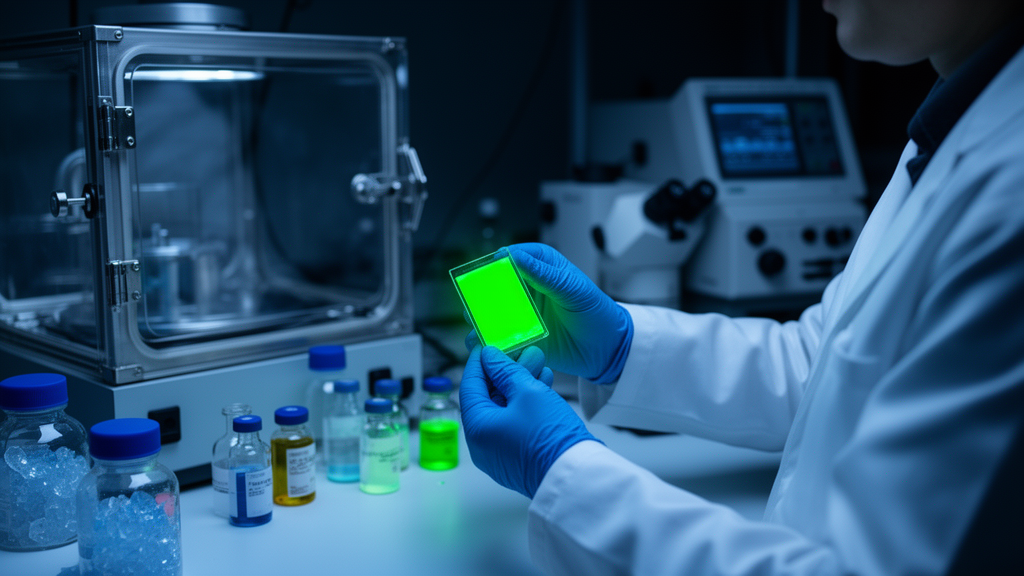
Perovskite light-emitting diodes have spent the past decade racing from laboratory curiosity to one of the most exciting display and lighting technologies on the horizon, but a frustrating mystery has shadowed their progress. Researchers routinely sprinkle small molecules called additives into the precursor solutions from which perovskite films are made, and these additives reliably boost performance. Yet almost nobody asked what those molecules actually do once they dissolve into the complex chemical soup of a perovskite precursor. A team led by researchers at Purdue University, working with collaborators at Emory University, Princeton University and the University of Michigan, has now pulled back the curtain on that hidden chemistry, and the answer turns out to be both surprising and enormously practical.
The additive in question, 5-aminovaleric acid, or 5AVA, is one of the most widely used molecules in the perovskite optoelectronics field. It belongs to a family of amino-acid-based additives that help regulate how perovskite crystals form and suppress the defects that would otherwise trap charge carriers and waste energy as heat instead of light. For years, researchers treated 5AVA as if it simply arrived intact in the final film, passivating surfaces and grain boundaries through its acid and amine functional groups. The new study, published in Nature, demonstrates that this picture is fundamentally incomplete. During the preconditioning stage, when precursor solutions are heated or aged before film deposition, 5AVA undergoes competing chemical reactions that transform it into entirely different species.
Using high-performance liquid chromatography coupled with mass spectrometry, the team resolved two distinct reaction products hiding inside the precursor solution. The first is a beneficial organoamidinium zwitterion, a molecule carrying both positive and negative charges in a balanced internal arrangement, which the researchers identified as 5IMAP. The second is a detrimental lactam, a cyclic amide the team calls 2PP, which acts as a Lewis base and interferes with the perovskite’s electronic properties. The discovery that a single additive splits into one helpful and one harmful product explains why results with 5AVA have been so variable across laboratories: the balance between the two reaction pathways depends sensitively on how the precursor solution is handled, including temperature and heating duration.
The technical significance of this reaction dichotomy is difficult to overstate. When researchers add 5AVA to a precursor, they are effectively running an uncontrolled chemical synthesis whose outcome depends on preparation history. Films made from solutions heated for long periods contain different proportions of 5IMAP and 2PP than films made from freshly prepared or briefly heated solutions, and the resulting devices inherit that variability. Electroluminescence spectra and external quantum efficiency histograms collected across dozens of devices show clear differences depending on whether precursors were held at room temperature, heated briefly, or heated for extended times. In other words, part of the celebrated benefit attributed to 5AVA was actually the benefit of its conversion product, 5IMAP, diluted and confounded by an unwanted by-product.
Having identified the chemistry, the researchers did something elegantly decisive: they bypassed it. Rather than relying on 5AVA to generate 5IMAP in situ, they synthesized the purified zwitterion directly and incorporated it into the perovskite precursor as a defined chemical species. This decoupling of the additive’s intrinsic passivation function from the noise of competing reactions produced immediate dividends. Perovskite films prepared with purified 5IMAP achieved a mean peak photoluminescence quantum yield of 97.2 percent, a value approaching the theoretical unity at which essentially every absorbed photon is re-emitted as light. That figure reflects an extraordinary suppression of non-radiative recombination pathways, the defect-mediated processes that normally siphon away a substantial fraction of charge carriers in perovskite films.
The device results are equally striking. Light-emitting diodes built with 5IMAP-engineered perovskite films reached a champion external quantum efficiency of 37.1 percent, with a mean peak value of 32.8 percent across devices. External quantum efficiency measures the fraction of electrons injected into the device that emerge as photons, and values above 30 percent place these near-infrared-emitting devices among the most efficient perovskite LEDs ever reported. Time-resolved photoluminescence measurements, conducted in collaboration with Libai Huang’s group at Purdue, supported the conclusion that the amidinium species passivates defect sites in a way that extends charge-carrier lifetimes and channels recombination into the radiative channel. Cross-sectional transmission electron microscopy confirmed that the films retain the layered device architecture needed for efficient charge injection.
What makes the amidinium so effective? The study’s comparative experiments provide a clue. When the researchers incorporated the detrimental lactam 2PP directly into films, device performance degraded relative to both 5AVA and 5IMAP formulations, confirming its harmful role. The zwitterionic character of 5IMAP, with its internal charge balance, appears to offer favorable coordination to undercoordinated lead sites at grain boundaries and surfaces without the disadvantages that the Lewis-basic lactam introduces. The team also explored a series of related amidinium compounds with different alkyl spacer lengths, spanning four to six carbon atoms, and found that the intermediate-length 5IMAP performed best, likely because shorter and longer spacers provide less favorable coordination geometry and precursor solubility for effective defect passivation.
Crucially, the researchers showed that reaction-pathway control is not a one-off trick tied to a single molecule. They extended the concept to other amino-acid-derived additives, converting 4-aminobutyric acid and 6-aminocaproic acid into their corresponding amidinium species, 4IMAB and 6IMAH, all of which functioned as passivation-capable additives. They then carried the strategy across emission colors, demonstrating improved performance in red-emitting devices based on a cesium-iodide-modified perovskite composition and in green-emitting devices based on formamidinium lead bromide, in each case outperforming the parent amino acid. Even more broadly, they converted a diamine additive into an amidinium-containing species through reaction with formamidinium bromide and observed substantially enhanced luminance and efficiency, suggesting that amidinium formation may be a general design principle rather than a molecular accident.
The broader implications reach across the entire field of perovskite optoelectronics. Additive engineering has long been practiced as a somewhat empirical discipline, in which researchers screen molecules for their effects on films and devices without fully accounting for solution-phase reactivity. This work establishes that the precursor solution is not a passive holding tank but an active chemical reactor, and that controlling reactions within it is as important as controlling crystallization on the substrate. The finding resonates with earlier observations that amine additives can age and alter perovskite precursors, and it provides a concrete framework for turning that liability into an asset: identify the reactive transformations, isolate the beneficial products, and design additives that deliver them directly.
For the display industry, where perovskite LEDs are being pursued as candidates for next-generation screens with vivid colors and low manufacturing costs, the message is that reproducibility may hinge on chemistry that has been invisible until now. Solution preparation protocols, aging times and thermal histories that were previously considered minor procedural details are revealed as variables that steer competing reaction networks. By making those networks visible and controllable, the Purdue-led team has transformed a source of irreproducibility into a rational design tool, and the near-unity photoluminescence yields and record-setting efficiencies they achieved suggest that the hidden chemistry of perovskite precursors still holds many more surprises worth uncovering.
Subject of Research: Solution-phase reaction pathways of amino-acid additives in perovskite light-emitting diodes
Article Title: Hidden reaction pathways inform additive engineering for perovskite LEDs
Article References: Hidden reaction pathways inform additive engineering for perovskite LEDs. (n.d.). https://doi.org/10.1038/s41586-026-11120-3
Image Credits: AI Generated
DOI: 10.1038/s41586-026-11120-3
Keywords: perovskite LEDs, additive engineering, 5-aminovaleric acid, organoamidinium zwitterion, defect passivation, photoluminescence quantum yield, external quantum efficiency, precursor chemistry, lactam by-product, solution processing, display technology, Nature
Cite Scienmag News
Denise Maddox. (October 15, 2026). Chemists Uncover Hidden Reactions That Supercharge Perovskite LEDs. Scienmag. https://scienmag.com/chemists-uncover-hidden-reactions-that-supercharge-perovskite-leds/
Denise Maddox. "Chemists Uncover Hidden Reactions That Supercharge Perovskite LEDs." Scienmag, 15 October 2026, https://scienmag.com/chemists-uncover-hidden-reactions-that-supercharge-perovskite-leds/. Accessed 15 October 2026.
Denise Maddox. "Chemists Uncover Hidden Reactions That Supercharge Perovskite LEDs." Scienmag. October 15, 2026. https://scienmag.com/chemists-uncover-hidden-reactions-that-supercharge-perovskite-leds/


