


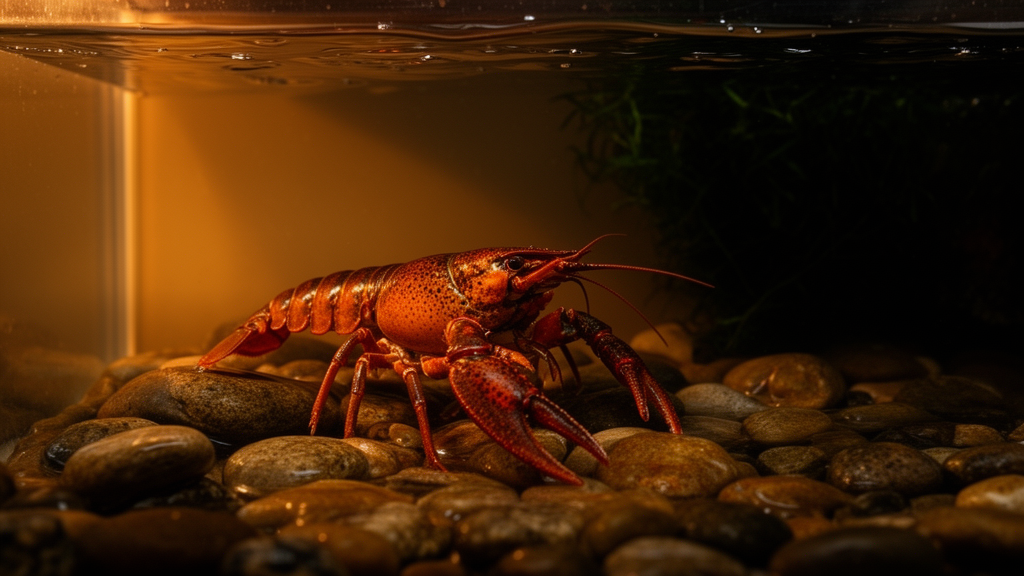
Red swamp crayfish are big business. According to the Food and Agriculture Organization of the United Nations, 96.8 percent of the roughly 2.47 million tonnes of crayfish farmed worldwide in 2020 was produced in China, where the species Procambarus clarkii ranks as the second-largest freshwater-farmed crustacean by production. Yet despite its commercial weight, the crayfish lacks the sophisticated artificial breeding and factory farming models that underpin white shrimp culture, and its farmed growth is severely constrained by a simple biological fact: once sexual maturity sets in, growth stalls. During the breeding period crayfish burrow into pond sediment, and farmers must harvest their stock between April and June before the hot months of July through September, when rising water temperatures push many animals into sexual maturity and undermine the entire production cycle.
Now a research team at Guangdong Haid Group has shown that a surprisingly simple environmental lever—dimming the lights—can help break that constraint. Writing in Frontiers in Physiology, the researchers report that in crayfish held at a sweltering 36 degrees Celsius, reducing light intensity to roughly half of full brightness significantly improved weight gain and survival while slightly delaying gonad development. The finding matters because gonad development in crustaceans diverts energy away from somatic growth, so any intervention that keeps animals in a growth-oriented physiological state, without invasive surgery or hormonal treatment, could translate directly into better yields for an industry worth billions.
The study rested on two linked experiments. First, the team reared juvenile female crayfish, each weighing about 6.2 grams, at six temperatures ranging from 16 to 36 degrees Celsius for 60 days, using a gradual ramping method that raised water temperature by roughly 2 degrees every 24 hours until each group reached its designated target. The temperatures were chosen to mirror the natural seasonal warming that crayfish pond water experiences from spring into summer in Hubei Province, China. Second, at the hottest temperature of 36 degrees, the researchers exposed crayfish to three light regimes created by layering shading netting over fluorescent lamps: a control at 800 to 1,000 lux representing 100 percent relative light intensity, a moderate treatment at 400 to 500 lux representing 50 percent, and a dim treatment at 150 to 200 lux representing 20 percent, all under a 12-hour light and 12-hour dark cycle designed to simulate the shade found in ponds during high-temperature periods.
The temperature experiment told a clear story of trade-offs. Crayfish weight increased significantly as water warmed, but declined above 28 degrees and dropped significantly at 36 degrees. Survival followed a similar pattern: at temperatures above 28 degrees, the survival rate fell significantly, from 96.7 percent down to 72.2 percent. Gonad development, meanwhile, accelerated with heat. Below 24 degrees, more than 85 percent of gonads remained at the non-developmental stage, with no signs of maturation. Above 28 degrees, between 10 and 30 percent of gonads were fully mature, and at 36 degrees, few undeveloped animals remained. In other words, the very temperatures that push crayfish toward sexual maturity also compromise their survival, creating a dilemma for farmers facing ever-hotter summers.
Behind these visible changes lay a molecular cascade. The researchers measured vitellogenin, or VTG, the yolk precursor protein that crustaceans synthesize and transport to developing oocytes, in the hemolymph, the crustacean equivalent of blood. VTG concentrations rose steadily with temperature and were significantly higher at 32 and 36 degrees than at lower temperatures. Gene expression of vtg in both the hepatopancreas, the digestive organ that serves as the primary VTG factory, and the ovary climbed in parallel, with expression at 32 to 36 degrees running 10 to 40 times higher than below 24 degrees. Notably, vtg expression in the hepatopancreas exceeded that in the ovary at every temperature, indicating that the hepatopancreas is the dominant source of the vitellogenin circulating in the blood.
The endocrine regulators told an equally revealing story. Crustaceans control gonad development through a unique neuroendocrine system centered on the X-organ-sinus gland complex in the eyestalk, which secretes members of the crustacean hyperglycemic hormone family. Two members are especially important: vitellogenesis-inhibiting hormone, or VIH, which suppresses yolk protein synthesis, and molt-inhibiting hormone, or MIH, which restrains molting and thus growth. Above 24 degrees, VIH expression fell significantly while MIH expression rose significantly, consistent with the observed acceleration of gonad maturation. The researchers are careful to note that these correlations do not by themselves prove causation, but the pattern aligns with earlier work on the Japanese marsh shrimp, in which gonad-inhibiting hormone expression declined as temperatures rose.
The light experiment then showed that this endocrine machinery responds to brightness as well as heat. At 50 percent relative light intensity, crayfish gained significantly more weight and survived at higher rates than controls under full light, while their gonad development was slightly lower. Nearly half of the gonads in the moderate-light group remained at early developmental stages, about twice the proportion seen in controls. The 20 percent light treatment, by contrast, produced gonad compositions similar to the control group, suggesting that the benefit of shading has a sweet spot rather than a simple dose-response. Hemolymph VTG concentrations were significantly lower in both shaded groups than in the controls, and vtg expression declined significantly in the ovary under reduced light, although hepatopancreatic vtg expression did not differ significantly between treatments.
The endocrine data under reduced light pointed in the same direction. As light intensity decreased, VIH expression in the eyestalk rose significantly, while MIH expression showed no significant change between treatments. The researchers speculate that at high temperatures, VIH in red swamp crayfish is particularly sensitive to reductions in light intensity, and that this sensitivity restrains ovarian VTG synthesis, slowing the accumulation of yolk precursor in the developing eggs. Because the ovary can synthesize VTG locally as well as receive it from the hepatopancreas, the selective decline in ovarian vtg expression under dim light suggests that shading acts on the ovary’s own contribution to vitellogenesis rather than on the systemic supply from the hepatopancreas.
The broader context sharpens the significance of these results. Crustacean farmers have long manipulated the eyestalk endocrine system to control reproduction, most commonly through eyestalk ablation, a surgical procedure that removes the source of inhibitory hormones and promotes molting and gonad development. But ablation is invasive and stressful, and the search for non-invasive alternatives has driven interest in environmental regulation. Light is known to influence the light-sensitive eyestalk tissue, and photoperiod effects on crustacean reproduction are well documented, but the specific role of light intensity has remained poorly studied. This work adds intensity to the toolkit, showing that the same neuroendocrine pathway that ablation disrupts can be nudged in the opposite direction simply by changing how bright the water is.
For an industry confronting warming waters, the practical implications are immediate. In pond culture, crayfish must be harvested before sexual maturity because from July to September, high temperatures drive many animals into reproduction, and the increasing average temperature in the Yangtze River basin year by year is expected to exacerbate the problem. The study suggests that during hot periods, farmers could reduce light intensity to around 50 percent of ambient, perhaps through shade netting similar to the polyethylene layers used in the experiment, and thereby promote growth and survival while delaying the onset of gonad development and reducing the rate of VTG accumulation in the ovaries. The authors caution that their conclusions are restricted to growth and ovarian developmental endpoints, since spawning, fecundity, and gamete quality were not measured, and the effects were demonstrated under controlled experimental conditions rather than full-scale pond systems. Still, the idea that a sheet of shade netting could rewire the endocrine balance between growth and reproduction in one of the world’s most farmed crustaceans is a striking reminder that sometimes the most powerful aquaculture interventions are not chemical or surgical at all, but simply a matter of changing the environment the animals live in.
Subject of Research: Controlled gonad development: effects of environmental factors on sexual maturity in red swamp crayfish, Procambarus clarkii
Article Title: Controlled gonad development: effects of environmental factors on sexual maturity in red swamp crayfish, Procambarus clarkii
Article References: Jiao, J.-G., Yun, B., & Qian, X.-Q. (2026). Controlled gonad development: effects of environmental factors on sexual maturity in red swamp crayfish, Procambarus clarkii. Frontiers in Physiology, 17, Article 1956361. https://doi.org/10.3389/fphys.2026.1956361
Image Credits: AI Generated
DOI: 10.3389/fphys.2026.1956361
Keywords: aquaculture, crayfish, light intensity, temperature, vitellogenin, endocrinology, Frontiers in Physiology, Controlled, gonad, development, effects, environmental
Cite Scienmag News
Juliet Wilcox. (October 15, 2026). Dim the lights, grow faster: how shade and heat control crayfish sexual maturity. Scienmag. https://scienmag.com/dim-the-lights-grow-faster-how-shade-and-heat-control-crayfish-sexual-maturity/
Juliet Wilcox. "Dim the lights, grow faster: how shade and heat control crayfish sexual maturity." Scienmag, 15 October 2026, https://scienmag.com/dim-the-lights-grow-faster-how-shade-and-heat-control-crayfish-sexual-maturity/. Accessed 15 October 2026.
Juliet Wilcox. "Dim the lights, grow faster: how shade and heat control crayfish sexual maturity." Scienmag. October 15, 2026. https://scienmag.com/dim-the-lights-grow-faster-how-shade-and-heat-control-crayfish-sexual-maturity/


