

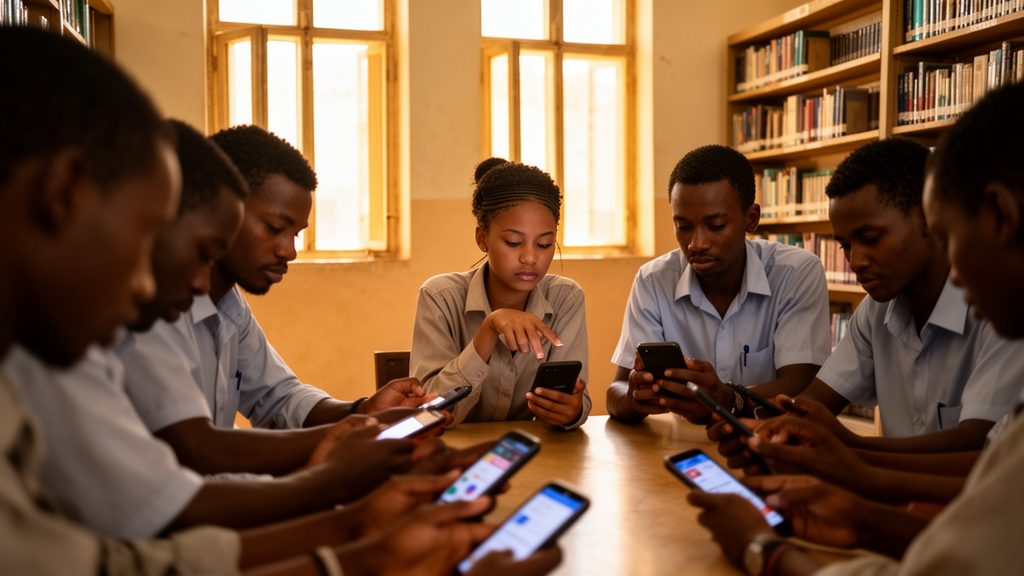
Somalia’s university students are among the most digitally connected young people in the Horn of Africa, scrolling through news on Facebook and WhatsApp for hours each day. They know, overwhelmingly, that false information can wound their society. What they demonstrably cannot do, a new study finds, is verify what they see — and when tested against real Somali misinformation, their discernment fell below the level that random guessing would have produced.
The study, published in Frontiers in Communication by Abdullahi Mohamud Mohamed of the Institute of Communication Studies at Communication University of China, surveyed 393 students at three universities spanning Somalia’s principal regions: Somali National University in Mogadishu, the University of Hargeisa in Somaliland, and East African University in Garowe, Puntland. It combined an online questionnaire with semi-structured interviews and, crucially, a five-item performance task in which fifteen students were shown real posts drawn from Somali Facebook, WhatsApp and Telegram circulation and asked to judge whether each was reliable or misleading. The design was cross-sectional and purposively sampled, so the findings describe the participating students rather than Somali university students as a population — but the pattern they reveal is stark.
On paper, the students looked reasonably well equipped. They rated their general media literacy at 3.82 on a five-point scale, with strong internal consistency, and their awareness that unverified information harms society scored highest of all, at 4.15. Understanding of how fake news circulates on social media (3.84) and confidence in distinguishing reliable from unreliable information (3.72) followed close behind. Then the gradient set in. Actively seeking information from multiple outlets scored 3.58. Checking a story across traditional sources scored 3.12. Verifying before sharing scored 3.08 — the most dispersed item in the instrument. And awareness of which websites are most likely to spread fake news scored lowest of all, at 2.91. The distance between knowing misinformation is harmful and reporting any habit of checking it exceeded a full scale point.
The performance task turned that self-reported gap into a measured one. Because each judgement was binary, chance performance was 50 per cent. Across the 75 judgements made by the fifteen participants, 32 were correct — 42.7 per cent overall. On the four misinformation items alone, accuracy fell to 35 per cent, well below the guessing benchmark. Yet the same participants rated their confidence in detecting misinformation at 3.61 out of five, equivalent to roughly 72 per cent. The gap between what students believed they could do and what they did was around 30 to 37 percentage points.
The error profile is more revealing than the aggregate. Participants performed best on a verified factual item from an established outlet, but their success rested on recognising a familiar logo, not on any checking procedure — a useful heuristic that offers no protection against false content carrying a familiar look. The health rumour was judged somewhat more accurately, but almost entirely by medical students drawing on subject knowledge that does not transfer to other domains. The two weakest results, both at 27 per cent, involved an out-of-context image re-shared as current conflict footage and a clan-targeted rumour designed to inflame division. Only four of the fifteen participants used any systematic verification tool — cross-referencing, reverse image search, or a fact-checking site — on any of the five posts. Nearly all accepted the decontextualised image as genuine without questioning its origin or date.
That image result matches what the recent literature on visual disinformation would predict. Researchers have argued that images carry a presumption of evidence that text has to earn: they are judged faster, remembered longer, and granted credibility on sight. The cheapest form of visual falsehood is not a deepfake but an authentic photograph stripped of its date and place — and in Somalia, where conflict footage circulates constantly, that exploit costs almost nothing to whoever reposts it. The clan-targeted rumour, meanwhile, points to a second weakness of particular consequence: participants’ explanations of their judgements on that post referred to identity rather than evidence, and identity-based reasoning appeared to switch off evaluation altogether.
Within the survey sample, media literacy was strongly and positively associated with self-reported misinformation-fighting competency, r = .62, p < .001, with the two indices sharing 38.4 per cent of their variance. Given the cross-sectional design and non-probability sampling, this is a statistical association among these respondents rather than a causal or population-level relationship, and some inflation from shared method and conceptual overlap between the instruments is likely. Still, the coefficient is large by conventional benchmarks, and it coexists with the 0.37-point gap between the index means: students feel more competent with media in general than with the specific task of resisting false content. The study distinguishes declarative literacy — knowing what misinformation is and that it harms — from procedural literacy, the ability and disposition to verify. The declarative component scored well. The procedural component lagged.
Interviews suggested why the gap persists, and the explanations are distinctly Somali. Students described a forwarding culture in WhatsApp groups that rewards being first over being right: people share something interesting or outrageous immediately, without taking a moment to think. They described a clear functional division of platforms, in which Facebook serves as the default news infrastructure — used by 87.3 per cent of respondents — while WhatsApp carries private rumour, TikTok provides entertainment, and YouTube is for learning. Facebook’s centrality is consequential because it is the platform on which Somali political and clan contestation is most visibly conducted, and page identity, rather than claim verification, was students’ dominant credibility cue. Most strikingly, students described clan affiliation operating as an informal credibility filter: information originating from one’s own clan or close network was accepted faster and questioned less, and emotionally charged content tied to clan identity was believed and forwarded because it arrived through trusted channels.
That clan filter is not irrational in a country where formal institutions have been absent or contested since the collapse of central government in 1991, and where credibility has traditionally been vested in persons and lineages rather than institutions. Social platforms have not displaced these networks; they have digitised them. A WhatsApp group of kin reproduces online the trust structures that governed oral communication — with the difference that content can now be fabricated, decontextualised and forwarded to thousands in minutes. In a society where a single rumour framed through clan identity can reactivate old grievances, and where fact-checking capacity is limited to a small number of organisations and Somali is a low-resource language for which automated detection tools barely exist, the social cost of error is high. The study aligns this finding with work from South Sudan suggesting that in post-conflict settings, literacy efforts must engage intergroup trust directly rather than treat misinformation as a knowledge deficit alone.
The students themselves were clear about what they wanted. Fourteen of the fifteen interviewees called for workshops and seminars on misinformation; twelve wanted media literacy embedded as a compulsory part of the curriculum —
Subject of Research: Media literacy and misinformation resilience among university students in Somalia
Article Title: Aware but not verifying: media literacy, verification behaviour, and misinformation resilience at three universities in Somalia
Article References: Aware but not verifying: media literacy, verification behaviour, and misinformation resilience at three universities in Somalia. (n.d.). https://doi.org/10.3389/fcomm.2026.1986584
Image Credits: AI Generated
DOI: 10.3389/fcomm.2026.1986584
Keywords: media literacy, misinformation, Somalia, verification behaviour, university students, clan credibility filter, visual disinformation, Frontiers in Communication, Aware, verifying, media, literacy
Cite Scienmag News
Scienmag. (October 15, 2026). Aware but not verifying: Somali students know misinformation harms, yet rarely check. https://scienmag.com/aware-but-not-verifying-somali-students-know-misinformation-harms-yet-rarely-check/
Scienmag. "Aware but not verifying: Somali students know misinformation harms, yet rarely check." Scienmag, 15 October 2026, https://scienmag.com/aware-but-not-verifying-somali-students-know-misinformation-harms-yet-rarely-check/. Accessed 15 October 2026.
Scienmag. "Aware but not verifying: Somali students know misinformation harms, yet rarely check." Scienmag. October 15, 2026. https://scienmag.com/aware-but-not-verifying-somali-students-know-misinformation-harms-yet-rarely-check/


