


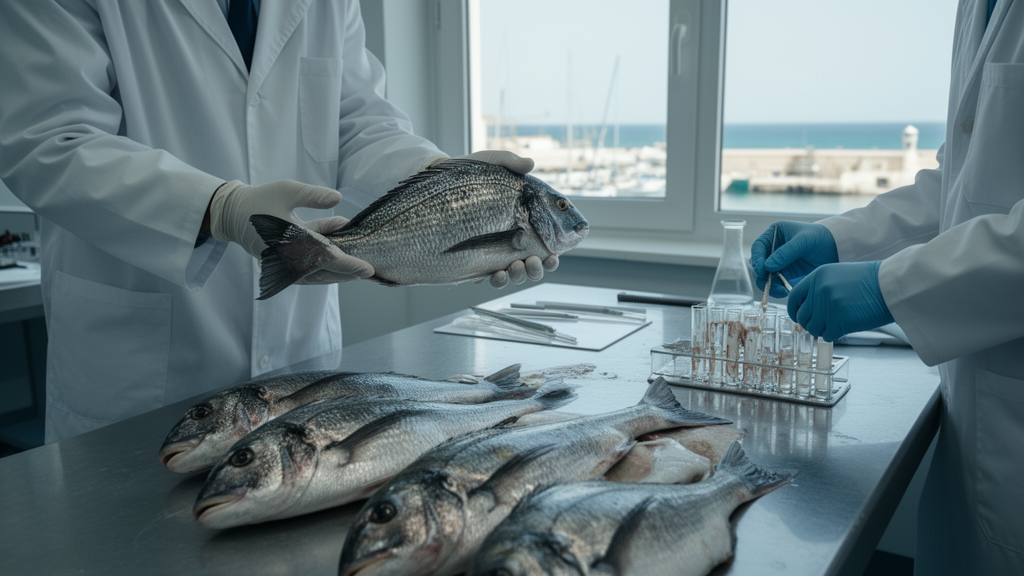
Along the central coast of Algeria, four of the most popular sea bream species on local dinner tables are quietly accumulating a cocktail of heavy metals in their muscle tissue, and the larger the fish, the heavier the load. That is the central finding of a new study published in Environmental Monitoring and Assessment, in which researchers measured mercury, arsenic, and chromium in wild sparid fish and uncovered strikingly consistent relationships between body size and metal concentrations. The good news for consumers is that every mean concentration recorded fell within the safety limits set by international food authorities, but the study offers a vivid reminder that the fish we eat are living chemical recorders of their environment, and that size matters when it comes to what ends up on the plate.
The research team, led by Mohammed Amine Ansel of Chadli Bendjedid University in El Tarf, together with Raouf Zaidi and Amina Tania Dahel, focused on four wild species from the Sparidae family: the gilthead seabream (Sparus aurata), the red porgy (Pagrus pagrus), the common pandora (Pagellus erythrinus), and the axillary seabream (Pagellus acarne). These bottom- and mid-water feeders are staples of Mediterranean fisheries and are widely consumed along the North African coast, making them ideal sentinels for both environmental contamination and human exposure. Rather than sampling whole fish, the researchers concentrated on muscle tissue, the part of the animal that actually reaches the consumer, which makes their measurements directly relevant to dietary risk assessment.
Three elements took center stage in the analysis: mercury (Hg), arsenic (As), and chromium (Cr). Each has a distinct toxicological profile. Mercury, particularly in its organic methylmercury form, is a potent neurotoxin that binds strongly to muscle proteins and biomagnifies through marine food webs. Arsenic in seafood occurs mostly as organic compounds that are generally less hazardous than inorganic arsenic, though total arsenic levels remain a standard monitoring benchmark. Chromium’s toxicity depends heavily on its oxidation state, with hexavalent chromium being far more dangerous than the trivalent form, yet total chromium measurements still serve as a useful indicator of industrial influence on coastal waters. By quantifying all three in the edible portion of the fish, the team built a picture of contamination that speaks directly to public health.
The results revealed a remarkably uniform hierarchy. Across all four species, mean concentrations followed the same descending order: arsenic highest, mercury intermediate, and chromium lowest. Concentration ranges, expressed in milligrams per kilogram of wet weight, spanned 1.323 to 3.396 for arsenic, 0.102 to 2.004 for mercury, and 0.232 to 0.915 for chromium. This consistent pattern suggests that the underlying drivers of accumulation, from uptake pathways in the marine environment to the chemical affinity of each element for muscle tissue, operate similarly across these closely related species, a finding that simplifies the task of predicting contamination in sparids generally.
Species-level differences added a second layer of insight. The gilthead seabream recorded the highest mean chromium concentration, at 0.65 plus or minus 0.02 milligrams per kilogram, while the red porgy emerged as the species of greatest concern for the two more notorious contaminants, posting the highest mean levels of both mercury (0.98 plus or minus 0.10 milligrams per kilogram) and arsenic (2.70 plus or minus 0.07 milligrams per kilogram). These interspecies contrasts likely reflect differences in diet, habitat depth, trophic position, and metabolic handling of each element. Red porgy, which feeds on hard-shelled benthic prey, may encounter arsenic-rich invertebrates more frequently, while its position in the food web could favor mercury accumulation over its lifetime.
Perhaps the most technically compelling result of the study is the strength of the size-metal relationship. When the researchers plotted muscle metal concentrations against fork length and total weight, they found strong positive linear correlations in every case, with correlation coefficients ranging from 0.92 to 0.99 and p-values below 0.01. In practical terms, this means that fish size alone explains the vast majority of the variation in metal content. The mechanism is well understood in ecotoxicology: metals such as mercury are absorbed and retained faster than they can be excreted, so concentrations rise steadily with age as fish continue to feed in contaminated waters. Larger, older individuals have simply had more time to bank the metals passing through their diets.
This size effect carries immediate implications for how consumers and regulators think about seafood. A large red porgy landed off the Algerian coast will, on average, carry roughly an order of magnitude more mercury in its flesh than the smallest individuals of the same species, given the range of 0.102 to 2.004 milligrams per kilogram observed in the study. Choosing smaller fish within a species can therefore meaningfully reduce dietary exposure without requiring any change in the type of seafood consumed. The finding also aligns with a broader body of Mediterranean research, including studies from the Adriatic, the Aegean, and the French coast, which have repeatedly documented mercury rising with fish size and have used that relationship to refine consumption advisories for pregnant women and children, the groups most vulnerable to methylmercury’s neurodevelopmental effects.
The Algerian coastline provides a particularly interesting backdrop for this work. The central coast receives inputs from urban centers, ports, and industrial activity, and previous studies in the region have examined trace elements in tuna and other commercial catches. The Mediterranean Sea as a whole is a semi-enclosed basin in which contaminants can persist, and regional monitoring programs have long flagged mercury as a persistent concern. By anchoring their measurements in a specific stretch of coastline and a commercially vital group of species, the authors have produced a baseline against which future changes, whether from new industrial development, shifting ocean chemistry, or climate-driven changes in fish distribution, can be judged. Such baselines are rare and valuable in the southern Mediterranean, where monitoring infrastructure is often thinner than on the northern shore.
Crucially, the study’s risk assessment delivers a reassuring verdict. The mean metal concentrations measured in all four sparid species were within the safe limits established by international organizations for human consumption, including benchmarks maintained under European Commission regulations and the Codex Alimentarius standards of the World Health Organization and the Food and Agriculture Organization. That does not mean the metals are absent, but rather that typical dietary exposure from these fish, at the concentrations observed, does not exceed the thresholds that health authorities consider protective. The researchers’ choice to measure the edible muscle rather than organs such as liver or gonads, which typically concentrate metals more heavily, makes this conclusion directly applicable to the seafood that consumers actually buy.
The study also underscores a broader scientific principle: fish are not passive containers of pollution but dynamic systems whose chemistry reflects their age, diet, and habitat. The near-perfect linear correlations between size and metal burden observed here suggest that even simple measurements, a fork length or a weight taken at the fish market, could serve as a proxy for contamination risk, offering a low-cost screening tool for regions without sophisticated laboratory infrastructure. As coastal development intensifies across the southern Mediterranean and demand for local seafood grows, studies of this kind will become increasingly essential. For now, Algerian consumers can take comfort that their beloved sea bream remain within safety limits, while researchers and regulators gain a precise, quantified map of how mercury, arsenic, and chromium move through one of the region’s most important groups of food fish, and a clear warning that the biggest specimens deserve the closest scrutiny.
Subject of Research: Heavy metal bioaccumulation and its relationship to fish size in four wild sparid species from the central Algerian Mediterranean coast
Article Title: Assessment of heavy metals in four wild sparid species from the central coast of Algeria: effects of fish size on metal bioaccumulation
Article References: Ansel, M. A., Zaidi, R., & Dahel, A. T. (2026). Assessment of heavy metals in four wild sparid species from the central coast of Algeria: effects of fish size on metal bioaccumulation. Environmental Monitoring and Assessment, 198(9), Article 1033. https://doi.org/10.1007/s10661-026-15896-9
Image Credits: AI Generated
DOI: 10.1007/s10661-026-15896-9
Keywords: heavy metals, sparid fish, bioaccumulation, mercury, arsenic, chromium, Mediterranean Sea, Algeria, fish size, food safety, marine pollution, Environmental Monitoring and Assessment
Cite Scienmag News
Russell Cooper. (October 15, 2026). Bigger Fish Carry More Mercury: Algerian Coast Study Tracks Metal Buildup in Sea Bream. Scienmag. https://scienmag.com/bigger-fish-carry-more-mercury-algerian-coast-study-tracks-metal-buildup-in-sea-bream/
Russell Cooper. "Bigger Fish Carry More Mercury: Algerian Coast Study Tracks Metal Buildup in Sea Bream." Scienmag, 15 October 2026, https://scienmag.com/bigger-fish-carry-more-mercury-algerian-coast-study-tracks-metal-buildup-in-sea-bream/. Accessed 15 October 2026.
Russell Cooper. "Bigger Fish Carry More Mercury: Algerian Coast Study Tracks Metal Buildup in Sea Bream." Scienmag. October 15, 2026. https://scienmag.com/bigger-fish-carry-more-mercury-algerian-coast-study-tracks-metal-buildup-in-sea-bream/


