


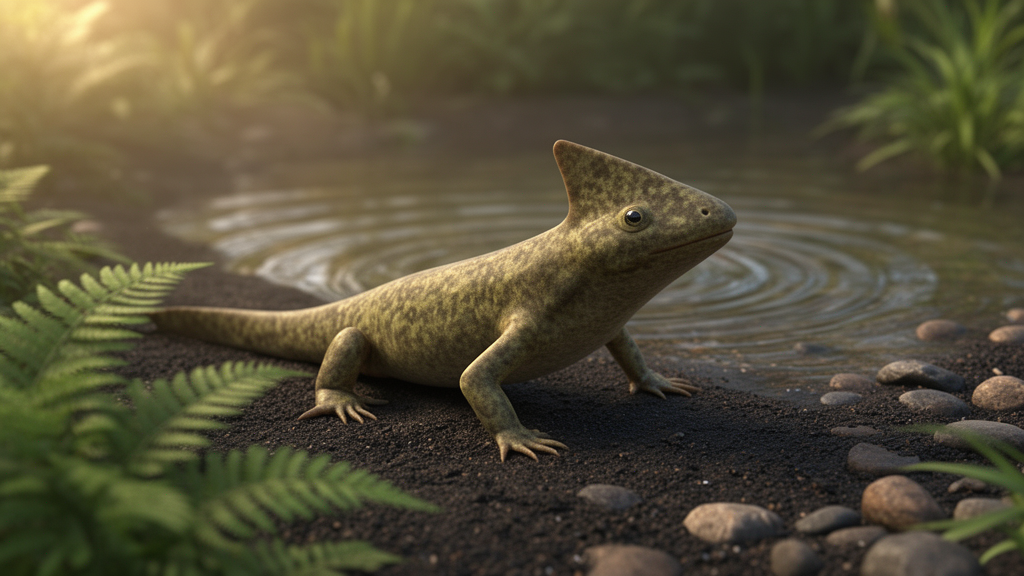
In a small, long-neglected fossil deposit in western Germany, paleontologists have identified a strikingly odd new species of ancient amphibian, one whose triangular, delta-shaped skull and miniature pin-like teeth set it apart from every other temnospondyl known from the region. The animal, named Schoenfelderpeton brevifrons, comes from the early Permian Meisenheim Formation in the Saar-Nahe Basin of Rhineland-Palatinate, and its description reshapes scientists’ understanding of how diverse these newt-like creatures really were in one of Europe’s largest Paleozoic basins.
The two specimens that define the new species were collected in 1978 by the German paleontologist Jürgen Boy at Ruthweiler, near the town of Kusel, but their true distinctiveness went unrecognized for decades. Embedded in light brownish-gray, mica-rich mudstones of the Ruthweiler black shale, the fossils preserve light brown bone with traces of black skin and a faint coating of pyrite. Because the bones and sediment share such similar coloration, the animals are difficult to discern in photographs, which may partly explain why they sat unnoticed within a collection dominated by other, more familiar branchiosaurids.
Branchiosaurids are small, wholly aquatic temnospondyl amphibians that rank among the most abundant vertebrate fossils in the Saar-Nahe Basin, where nearly 200 years of fieldwork by geologists and private collectors has produced an exceptional record of Paleozoic life. Their remains sometimes preserve soft tissues such as skin and even larval gills, making them iconic animals in museum displays. For a long time, the basin’s branchiosaurid fauna was thought to consist almost entirely of a single abundant species, Apateon pedestris, a tiny plankton feeder that apparently spent its entire life in eutrophic lakes set in a mountainous tropical landscape.
The two new specimens overturn that simple picture. The holotype, catalogued as NHMMZ-PW 2022-83-LS, is a larval skull exposed in dorsal view and measuring just 11 millimeters long. The paratype, NHMMZ-PW 2022/399-LS, is a larger, 17-millimeter skull preserved in ventral view, accompanied by the anterior thirteen neural arches, ribs, both clavicles, and an impression of the left humerus. Together they display a suite of features seen in no other regional temnospondyl: a deltoid skull outline, unusually small orbits, and remarkably short frontal bones that occupy only about a quarter to a third of the skull’s length, compared with roughly 0.35 to 0.4 in Apateon.
The maxilla is particularly telling. In both specimens, even the more heavily ossified and presumably mature paratype, the maxilla fails to contact the cheek and carries tiny, closely set, pin-shaped teeth. This open-cheeked, weak-jawed configuration indicates that Schoenfelderpeton brevifrons was likely a plankton feeder, filtering minute food particles from the water much like Apateon pedestris. Because the feature persists in the larger individual, it appears to be a genuine adult condition rather than a larval stage, a case of neoteny in which aquatic, larval traits were retained throughout life. Both specimens also preserve rows of branchial denticles, the pharyngeal teeth characteristic of gill-bearing aquatic larvae.
Detailed anatomical comparison reveals further autapomorphies that justify naming a new species. The squamosal embayment, the notch at the back corner of the skull where the jaw muscles once passed, is unusually shallow and sits at an unusually large distance from the orbit, and it bears a small rounded pocket wedging between the squamosal and tabular bones. The posterior margin of the postparietal is strongly convex, and the parasphenoid, a bone forming much of the braincase floor, carries a wide, short basal plate and a straight, unexpanded cultriform process. The palatine is exceptionally narrow, framing a slit-like choana, the internal nostril, an almost unique construction among branchiosaurids.
To determine where the new animal belongs on the amphibian family tree, the researchers added its anatomical characters to an existing matrix of 48 taxa and 115 characters and analyzed it with the software TNT, using New Technology search algorithms including Sectorial Search, Ratchet, and Tree Fusing across 1,000 random addition sequences. All characters were left unordered, since evolutionary transformation sequences are hard to assess in a group so pervasively shaped by neoteny. The analysis recovered a single most parsimonious tree of length 337, with a consistency index of 0.397 and a retention index of 0.731.
The result places Schoenfelderpeton brevifrons as the sister species of Schoenfelderpeton prescheri, a highly paedomorphic form previously known from Thuringia and Saxony, and nests the pair within a larger clade alongside Leptorophus and the species informally known as “Melanerpeton” humbergense. Because the earlier subclade name Leptorophinae turned out to be preoccupied by a reptiliomorph group based on the Russian genus Leptoropha, the study proposes the new name Leptobranchinae, from the Greek words for light and gill, for this branchiosaurid subclade. The broader tree also reshuffles relationships among other Permian lineages, revealing, for the first time, two distinct sister groups of early Permian branchiosaurids: one uniting Melanerpeton sensu stricto, Xerodromeus, and Apateon, and the other comprising the leptobranchines.
The evolutionary implications are rich. The leptobranchines shared slender palatine and ectopterygoid bones with weak dentition, and some, including the Leptorophus subclade, sported large conical teeth indicating they were small predators of insects, crustaceans, and even other branchiosaurid larvae. The two Schoenfelderpeton species, by contrast, evolved or re-evolved the open cheek and pin-like dentition of plankton feeders, paralleling the condition seen in certain populations of Apateon. This repeated convergence, in which distant relatives independently arrived at the same filter-feeding anatomy, illustrates how strongly the ecological pressures of Permian lake ecosystems molded these animals’ bodies.
Schoenfelderpeton brevifrons inhabited the Ruthweiler black shale, a regionally restricted lake deposit laid down during the final phase of the M8 sequence, above the famous Odernheim limestone unit. The Meisenheim Formation is believed to be of Asselian age, roughly 295 to 300 million years ago. The new species lived in a tetrapod community strikingly devoid of fishes, dominated by the abundant “Melanerpeton” humbergense and the large Apateon caducus, a putative apex predator of that setting. In this fishless lake, a modest plankton-eating amphibian with a delta-shaped head found its own niche. Known so far only from this single locality, Schoenfelderpeton brevifrons stands as a reminder that even collections gathered nearly half a century ago can still yield species entirely new to science, and that the diversity of Permian amphibians in Europe remains far from fully charted.
Subject of Research: A new branchiosaurid temnospondyl amphibian from the early Permian of Germany
Article Title: A new delta-headed branchiosaurid temnospondyl from the early Permian Meisenheim Formation of Germany
Article References: Schoch, R. R. (2026). A new delta-headed branchiosaurid temnospondyl from the early Permian Meisenheim Formation of Germany. Fossil Record, 29(2), 765-775. https://doi.org/10.3897/fr.29.209145
Image Credits: AI Generated
DOI: 10.3897/fr.29.209145
Keywords: Schoenfelderpeton brevifrons, branchiosaurid, temnospondyl, early Permian, Saar-Nahe Basin, Meisenheim Formation, paleontology, neoteny, Germany, amphibian evolution, phylogenetics, Ruthweiler
Cite Scienmag News
Gavin Prescott. (October 15, 2026). Delta-Headed Amphibian from Germany Reveals Hidden Permian Diversity. Scienmag. https://scienmag.com/delta-headed-amphibian-from-germany-reveals-hidden-permian-diversity/
Gavin Prescott. "Delta-Headed Amphibian from Germany Reveals Hidden Permian Diversity." Scienmag, 15 October 2026, https://scienmag.com/delta-headed-amphibian-from-germany-reveals-hidden-permian-diversity/. Accessed 15 October 2026.
Gavin Prescott. "Delta-Headed Amphibian from Germany Reveals Hidden Permian Diversity." Scienmag. October 15, 2026. https://scienmag.com/delta-headed-amphibian-from-germany-reveals-hidden-permian-diversity/


