


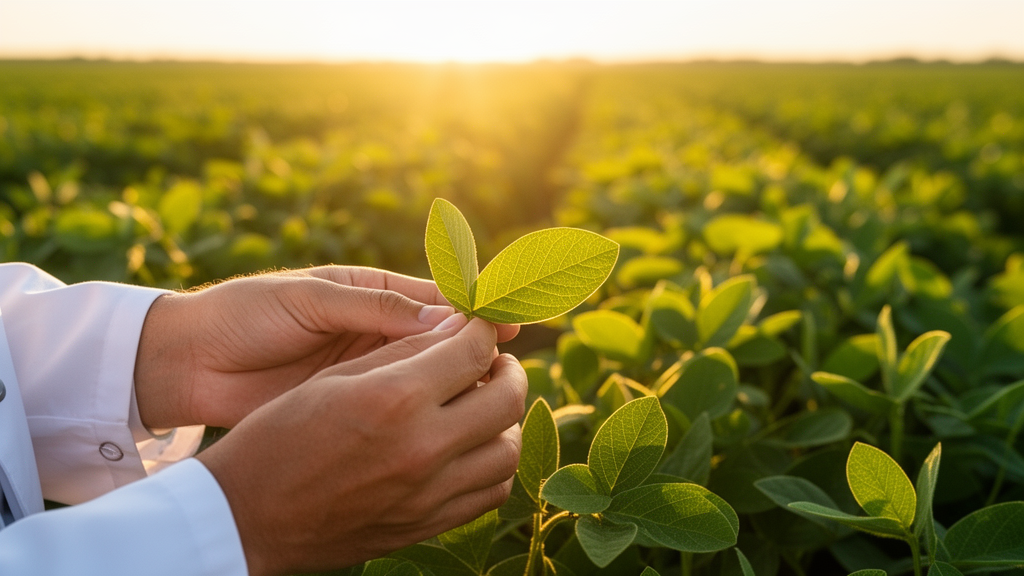
Soybean is quietly one of the most important plants on Earth. It accounts for more than 60 percent of global vegetable oil production and stands as the world’s largest source of plant-based protein, grown across roughly 146.8 million hectares with production of 424.2 million metric tons in the 2024-25 season. Yet despite decades of breeding, soybean yield gains have plateaued relative to other major crops, largely because elite varieties descend from a narrow genetic base. Now a comprehensive review published in Theoretical and Applied Genetics argues that the next leap forward may come from an unexpected direction: teaching soybean to photosynthesize better, and using drones, genomics, and machine learning to do it at scale.
The core of the argument rests on a striking inefficiency. Soybean, a C3 crop, converts only about 2.4 percent of total incident solar radiation into biomass, far below the theoretical C3 maximum of 4.6 to 5.1 percent. Under field conditions, its radiation use efficiency typically ranges from 0.8 to 1.5 grams of biomass per megajoule of intercepted radiation. Maize, a C4 crop, routinely exceeds 3.5 grams per megajoule under optimal conditions, and roughly 32 percent of historical maize yield gains in the United States have been attributed to improved radiation use efficiency alone. Because soybean has already nearly maxed out light interception, with canopy-level efficiency reaching around 0.9, and harvest index sits at 0.35 to 0.45, the conversion of light into biomass remains the biggest untapped lever for raising the crop’s intrinsic yield potential.
Several biochemical bottlenecks explain why soybean leaves waste so much of the sunlight they capture. Chief among them is photorespiration, the wasteful process that begins when the CO2-fixing enzyme Rubisco grabs oxygen instead of carbon dioxide. Photorespiration imposes an estimated 20 to 40 percent yield penalty in C3 crops, with one analysis attributing a 36 percent yield reduction in soybean specifically to this single inefficiency. Other constraints include slow Rubisco activation when leaves shift from shade to sun, sluggish relaxation of non-photochemical quenching that needlessly dumps captured energy as heat, and limited mesophyll conductance that throttles CO2 delivery to chloroplasts. Modeling work suggests that doubling the Calvin-Benson cycle enzymes PGK and PRK could raise soybean seed yield by an average of about 6.75 percent across field seasons, a deceptively modest figure that translates into millions of metric tons globally.
Canopy architecture offers another route to gains. In modern cultivars, leaf area index frequently exceeds 4 to 6, causing lower leaves to receive less than 10 percent of incident light and operate below their light compensation point for much of the day. Because C3 leaf photosynthesis saturates at roughly 25 percent of full sunlight, upper leaves waste energy while lower leaves starve. Recent evidence indicates that narrower, more erect leaves could reduce upper-canopy saturation and improve light penetration, supporting a 5 to 10 percent gain in canopy photosynthesis. The importance of lower-canopy light should not be underestimated: pod and seed tissues themselves photosynthesize, offsetting up to 81 percent of their respiratory carbon losses and contributing about 9 percent of total canopy carbon gain, and shading pods during seed fill cuts individual seed weight by 13 to 14 percent.
The historic obstacle to exploiting these traits has been measurement. Photosynthetic efficiency is notoriously difficult and slow to assess with handheld gas exchange systems, which are impractical for screening the thousands of genotypes a breeding program must evaluate. That is changing rapidly. Researchers can now deploy pulse-amplitude-modulated fluorometers such as MultispeQ, light-induced fluorescence transient sensors, and UAV-mounted multispectral, hyperspectral, and thermal cameras to phenotype entire field trials in single flights. Hyperspectral reflectance has proven especially powerful: in the SoyNAM population of roughly 5,600 recombinant inbred lines, hyperspectral traits showed genetic correlations of about 0.4 to 0.6 with the key photosynthetic capacity parameters Vcmax25 and Jmax25, effectively serving as a phenomic equivalent of genome-wide prediction.
Natural genetic variation for photosynthesis is abundant and largely unexploited. Modern soybean varieties already exhibit up to 23 percent greater daily carbon assimilation than historical cultivars, driven mainly by enhanced stomatal conductance. Screening efforts have identified standout accessions such as PI 603911 C, which maintained field CO2 assimilation rates 11 percent above a reference check, and the Japanese mini-core line GmJMC47, which combines high photosynthetic rates with efficient light harvesting. Genome-wide association studies have pinpointed candidate genes including GmIWS1, GmCDC48, and GmFtsH25, the last of which remains the only cloned and functionally validated photosynthesis gene in soybean, with overexpressing lines showing enhanced growth and photosynthetic rates. However, most reported quantitative trait loci have small effects, poor reproducibility across environments, and heritability that declines sharply from early reproductive stages, where estimates can reach 50 to 85 percent, to later stages, where they fall as low as 15 percent.
This environmental sensitivity is precisely why the review’s authors advocate a genotype-by-environment-by-management, or GxE×M, framework rather than single-locus fixes. Crossover interactions can reverse allelic rankings between locations, with one study finding that 73 percent of genotype-by-environment QTLs produced crossover effects across 11 environments. Management practices are not passive backdrops but active determinants of whether photosynthetic potential is realized: cover crops increased water-use efficiency by 30 percent and Vcmax by up to 42 percent in drought seasons, planting density and row spacing govern whether erect-leaf architectures pay off, and nitrogen, phosphorus, and biochar amendments directly shape chlorophyll content and Rubisco activity. A high-RUE genotype planted too densely, or facing weed competition, may yield no better than an ordinary one.
The proposed breeding pipeline fuses these threads into a predictive engine. Genomic selection estimates genetic potential from DNA markers, capturing the small effects of many loci simultaneously, while phenomic prediction uses high-throughput spectral, thermal, and fluorescence data to estimate realized field performance before harvest. Evidence from related crops is encouraging: genomic prediction of photosynthesis reached accuracy above 0.65 in soybean, a dynamic photosynthetic index predicted soybean biomass with accuracy near 0.50, and in common bean, phenomic prediction actually outperformed genomic prediction for seed yield. Combining both approaches improved prediction accuracy for soybean seed yield, protein, and oil in recent work. The practical workflow is elegant: train models on diverse panels phenotyped across environments, then screen thousands of early-generation lines with drones, advancing only the top 10 to 20 percent to expensive multi-environment yield trials.
The framework also prescribes where each trait belongs. Leaf-level traits with measurable genetic architecture, such as stomatal conductance and chlorophyll fluorescence, suit genomic selection and allele introgression from the USDA germplasm collection of roughly 20,000 accessions spanning more than 80 countries. Canopy-integrated traits like apparent photosynthesis and leaf area index respond strongly to management, making them targets for agronomic optimization. Bridge traits such as chlorophyll content and canopy architecture, which show both genetic variation and management responsiveness, are ideal for multi-trait genomic prediction under explicit G×E×M modeling. Chlorophyll content itself shows consistently moderate to strong correlations with seed yield, ranging from 0.26 to 0.90 across studies, making it one of the most scalable and reliable selection proxies available.
Challenges remain before photosynthesis-informed breeding becomes routine. Transgenic successes, such as accelerating recovery from photoprotection, which boosted biomass and seed yield by up to 33 percent in one soybean genotype, have drawn criticism over experimental design and the need for rigorous multi-location field validation. The authors call for functional validation of candidate genes using CRISPR-based tools, standardized phenotyping protocols, open benchmark datasets, and physiologically informed training populations that include exotic donors to avoid biasing selection toward elite germplasm. They also flag emerging frontiers, from DNA language models and deep learning architectures capable of capturing nonlinear gene interactions, to hybrid frameworks coupling mechanistic crop models with machine learning. If these pieces come together, the researchers estimate that complementary improvements in canopy architecture, stress-resilient photosynthesis, and leaf-level biochemistry could lift soybean radiation use efficiency by 15 to 20 percent, a gain that would convert sunlight into seed far more effectively than anything the crop has managed in a century of conventional breeding.
Subject of Research: Integrating photosynthetic efficiency traits into soybean breeding through high-throughput phenomics, genomic prediction, and G×E×M modeling
Article Title: Photosynthesis-informed breeding to enhance Soybean (Glycine max) yield potential: a framework integrating high-throughput phenomics, genomic prediction and G×E×M
Article References: Singh-Bakala, H., Ravelombola, F., Vieira, C. C., Rayaprolu, L., Herritt, M., Washburn, J. D., Zhang, R., Lin, F., & Shannon, G. (2026). Photosynthesis-informed breeding to enhance Soybean (Glycine max) yield potential: a framework integrating high-throughput phenomics, genomic prediction and G×E×M. Theoretical and Applied Genetics, 139(10), Article 287. https://doi.org/10.1007/s00122-026-05374-8
Image Credits: AI Generated
DOI: 10.1007/s00122-026-05374-8
Keywords: soybean, photosynthesis, radiation use efficiency, genomic selection, high-throughput phenotyping, G×E×M, photorespiration, canopy architecture, UAV remote sensing, phenomic prediction, yield potential, breeding
Cite Scienmag News
Alan Morgan. (October 15, 2026). Scientists Aim to Reengineer Photosynthesis to Unlock Soybean’s Hidden Yield Potential. Scienmag. https://scienmag.com/scientists-aim-to-reengineer-photosynthesis-to-unlock-soybeans-hidden-yield-potential/
Alan Morgan. "Scientists Aim to Reengineer Photosynthesis to Unlock Soybean’s Hidden Yield Potential." Scienmag, 15 October 2026, https://scienmag.com/scientists-aim-to-reengineer-photosynthesis-to-unlock-soybeans-hidden-yield-potential/. Accessed 15 October 2026.
Alan Morgan. "Scientists Aim to Reengineer Photosynthesis to Unlock Soybean’s Hidden Yield Potential." Scienmag. October 15, 2026. https://scienmag.com/scientists-aim-to-reengineer-photosynthesis-to-unlock-soybeans-hidden-yield-potential/


