


…
…
Quantum dot–organic light-emitting diode displays rely on a photoemissive layer of nanoscale semiconductor crystals whose emission wavelength is set by particle size rather than by chemical composition. In a typical color-conversion architecture, a blue organic light-emitting diode supplies pump light that strikes patterned films of red- and green-emitting quantum dots, which absorb the blue photons and re-emit them at longer wavelengths. This approach sidesteps the need for separate red, green, and blue subpixel emitters, which is a considerable advantage when pixel pitches shrink to a few micrometers, as they must for near-eye and microdisplay applications. The difficulty is that the conversion is never complete. A portion of the blue pump light passes through the quantum dot layers without being absorbed, and in a dense, high-resolution panel that unconverted blue light leaks out of red and green subpixels, contaminating their color and washing out the display’s gamut.
The scale of the problem grows as pixels shrink. At conventional television and monitor resolutions, optical crosstalk between subpixels is a manageable nuisance, and color filters or other downstream layers can trim stray blue emission. But in a microdisplay intended to sit centimeters from the eye, the subpixel pitch is measured in micrometers, and the fraction of blue light that scatters laterally into neighboring pixels rises sharply. The result is a fundamental tension: the very pixel densities that make microdisplays compelling for augmented and virtual reality are the same densities that make blue leakage most damaging to color purity. Researchers have therefore sought optical structures that can be built directly into the pixel stack itself, acting locally at each subpixel rather than globally across the panel.
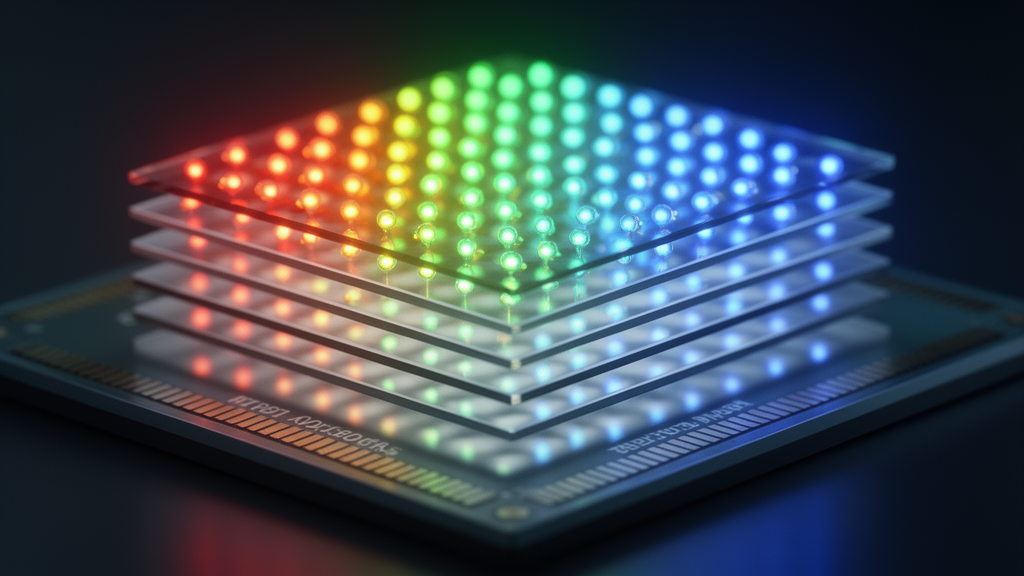
Distributed Bragg reflectors are one of the oldest and most reliable tools in photonics for manipulating light with dielectric stacks. A DBR consists of alternating layers of two materials with different refractive indices, each a quarter wavelength thick at the target wavelength. At that wavelength, partial reflections from each interface add constructively, and the stack behaves as a nearly perfect mirror, with reflectance limited mainly by material absorption and interface roughness. Away from the design wavelength, the constructive interference weakens and the stack becomes progressively transparent, which is precisely the spectral selectivity a color-conversion display needs: a mirror that is highly reflective at the blue pump wavelength but essentially invisible to the red and green emission the quantum dots produce.
What makes the reported work notable is not the DBR concept itself but the conditions under which the reflectors were deposited. Conventional DBR fabrication relies on high-temperature processes, often several hundred degrees Celsius, that produce the dense, low-absorption dielectric films needed for high reflectance. A fully assembled QD-OLED stack cannot tolerate such temperatures. Organic transport layers, the quantum dot film, and the metal electrodes all degrade well below the temperatures used in standard dielectric deposition, so any post-fabrication optical layer must be added gently. The team addressed this by using plasma-enhanced chemical vapor deposition carried out below 100 degrees Celsius, depositing alternating silicon nitride and silicon oxide layers directly on top of the completed device. Silicon nitride has a relatively high refractive index and silicon oxide a relatively low one, giving the index contrast the quarter-wave stack requires, and both materials can be grown as dense, optically clean films at temperatures benign to organics.
The optical results demonstrate that low-temperature deposition did not compromise performance. The integrated reflectors achieved 95.9 percent reflectance at 455 nanometers, the wavelength of the blue pump emission, while remaining largely transparent across the red and green portions of the spectrum. That combination is what enables photon recycling, a process in which blue photons that would otherwise escape the device are reflected back down into the quantum dot layer and given a second chance to be absorbed and converted. Each reflection round trip increases the effective optical path length of the pump light through the emissive film, so even quantum dot layers that are too thin to absorb all the blue light on a single pass can approach full conversion when the light is trapped between the DBR and the underlying electrode. The recycled photons that are successfully converted emerge as additional red or green emission, which is why the integrated devices showed emission intensity gains of 19.7 percent in the red channel and 10.7 percent in the green channel relative to otherwise identical devices without the reflectors.
The asymmetry between the red and green improvements is worth considering. Red-emitting quantum dots typically have larger particle diameters and correspondingly longer absorption lengths at the pump wavelength, and their conversion efficiency is often more sensitive to optical path length than that of green dots, whose absorption of blue light is generally stronger. A recycling structure that multiplies the number of passes through the conversion layer therefore tends to benefit the weakest absorber most, which is consistent with the larger gain observed in the red channel. The same mechanism explains the roughly 90 percent reduction in blue leakage: light that once escaped the red and green subpixels as stray blue emission is now reflected and recycled, so it either contributes usefully to conversion or is absorbed within the stack rather than degrading the color of neighboring pixels.
Pattern fidelity at the micrometer scale presented a separate set of engineering challenges. A DBR that covers the entire panel uniformly would be useless for pixel-level color control; the reflectors must be patterned so that each red and green subpixel carries its own mirror while blue subpixels, which emit directly and need no conversion, remain unobstructed. Etching dielectric multilayers with sub-micrometer layer thicknesses to feature sizes of a few micrometers risks several failure modes: sloped sidewalls that shrink the effective mirror area, rough or ragged edges that scatter light, and plasma damage that degrades the organic layers beneath. The researchers used a single-step fluorine-based dry etch to define 4 micrometer features with a near-vertical taper angle of 89 degrees. A taper this close to vertical preserves the full lateral extent of the mirror within each pixel footprint, which matters because any loss of mirror area directly reduces the recycling benefit. The one-step process is also significant for manufacturing: multi-step etching with hard masks adds alignment requirements and defect opportunities that become punishing at pixel densities in the thousands per inch.
The reported pixel density of 3175 pixels per inch places the technology in the regime relevant to next-generation near-eye displays. At that density, the pitch between subpixels is on the order of a few micrometers, small enough that the display panel itself can serve as the near-to-eye image source without bulky projection optics. Achieving a wide color gamut at such densities has been a persistent obstacle, because the optical crosstalk mechanisms that are tolerable at lower densities dominate at these scales. The measured color gamut of 120.5 percent relative to the sRGB standard indicates that the combination of efficient conversion and suppressed leakage preserves the intrinsic color advantage of quantum dot emitters even at high pixel density. Quantum dots are prized for their narrow emission linewidths, which translate directly into gamut area when the primaries are pure, and the DBR integration appears to protect that purity rather than sacrifice it to the demands of miniaturization.
The monolithic nature of the integration deserves emphasis as a manufacturing consideration. Alternative approaches to managing blue leakage typically involve adding discrete optical layers, such as color filters or external reflector films, laminated onto the display. Each additional layer introduces interfaces that can trap air, delaminate, or add optical losses, and each lamination step adds cost and yield risk. Depositing the reflectors directly onto the finished device stack, in the same general class of deposition and etch tools already used in display manufacturing, keeps the process flow integrated. The sub-100-degree-Celsius thermal budget is the enabling constraint here: it means the reflectors can be added after all temperature-sensitive layers are in place, rather than requiring the device to be built around the optics.
There are also broader implications for how optical management can be woven into display architectures. Photon recycling is closely related to concepts explored in other emissive technologies, where cavity effects and reflector stacks are used to redirect trapped modes toward the viewer or to reshape emission spectra. In OLEDs generally, a large fraction of generated light is trapped as waveguided modes within the high-index organic and substrate layers, and much of the engineering effort in that field goes into extracting this light. The DBR approach here addresses a related but distinct problem: not extracting trapped light but redirecting pump light that would otherwise be lost, converting an efficiency liability into useful emission. The same principle could in principle be extended to other color-conversion systems, including microLED-based architectures where blue pump light drives phosphor or quantum dot conversion layers, and where leakage between densely packed subpixels is an equally pressing concern.
The materials system also merits attention. Silicon nitride and silicon oxide are among the most thoroughly characterized dielectric pairs in semiconductor manufacturing, with well-established deposition chemistry, etch selectivity, and long-term stability. Choosing an established materials system rather than exotic optical compounds reduces the risk that laboratory results will fail to survive scale-up. Fluorine-based etch chemistry is likewise standard in the industry, which suggests a plausible path from the reported laboratory demonstration toward manufacturing integration, though the usual caveats about uniformity across large-area substrates and yield at production volumes apply to any such transition.
The funding acknowledgments indicate that the work sits within a coordinated Korean research program spanning government institutes, universities, and industry, with support directed at post-InP quantum dot materials and near-eye light field display technology. This alignment reflects a broader strategic recognition that microdisplays for immersive applications are among the most demanding display products, combining extreme pixel density, high brightness, wide color gamut, and stringent power constraints in a single device. Quantum dot conversion from a blue OLED base is one of several competing architectures for such displays, alongside active-matrix microLEDs and other approaches, and optical innovations like the patterned DBRs described here represent the kind of incremental but meaningful advances that determine which architecture ultimately prevails.
Looking forward, the demonstrated combination of high reflectance at the pump wavelength, transparency at the emission wavelengths, micrometer-scale patterning, and thermal compatibility with completed devices establishes a template that other groups can adapt. Questions that remain for future work include the long-term stability of the dielectric stacks under continuous operation, the interaction between the reflectors and the angular distribution of emitted light, and whether the recycling benefit can be pushed further by optimizing the DBR spectral profile or the quantum dot layer thickness in a coupled design. The roughly 90 percent suppression of blue leakage and the double-digit emission gains reported here suggest that there is substantial headroom in optical management for color-conversion displays, and that the era of treating the pixel stack as merely an electrical structure, rather than an integrated optical cavity, is giving way to designs in which photonics and electronics are engineered together from the start.
Subject of Research: Low-temperature monolithic integration of patterned distributed Bragg reflectors for high-resolution QD-OLED microdisplays
Article Title: Low-temperature monolithic integration of patterned distributed Bragg reflectors for high-resolution QD-OLED microdisplays
Article References: Low-temperature monolithic integration of patterned distributed Bragg reflectors for high-resolution QD-OLED microdisplays. (n.d.). https://doi.org/10.1038/s41528-026-00652-3
Image Credits: AI Generated
DOI: 10.1038/s41528-026-00652-3
Keywords: Low-temperature, monolithic, integration, patterned, distributed, Bragg, reflectors, high-resolution, QD-OLED, microdisplays, scientific research
Cite Scienmag News
Denise Maddox. (October 15, 2026). Patterned Bragg Reflectors Built Below 100 °C Boost QD-OLED Microdisplay Color Purity. Scienmag. https://scienmag.com/patterned-bragg-reflectors-built-below-100-c-boost-qd-oled-microdisplay-color-purity/
Denise Maddox. "Patterned Bragg Reflectors Built Below 100 °C Boost QD-OLED Microdisplay Color Purity." Scienmag, 15 October 2026, https://scienmag.com/patterned-bragg-reflectors-built-below-100-c-boost-qd-oled-microdisplay-color-purity/. Accessed 15 October 2026.
Denise Maddox. "Patterned Bragg Reflectors Built Below 100 °C Boost QD-OLED Microdisplay Color Purity." Scienmag. October 15, 2026. https://scienmag.com/patterned-bragg-reflectors-built-below-100-c-boost-qd-oled-microdisplay-color-purity/


