


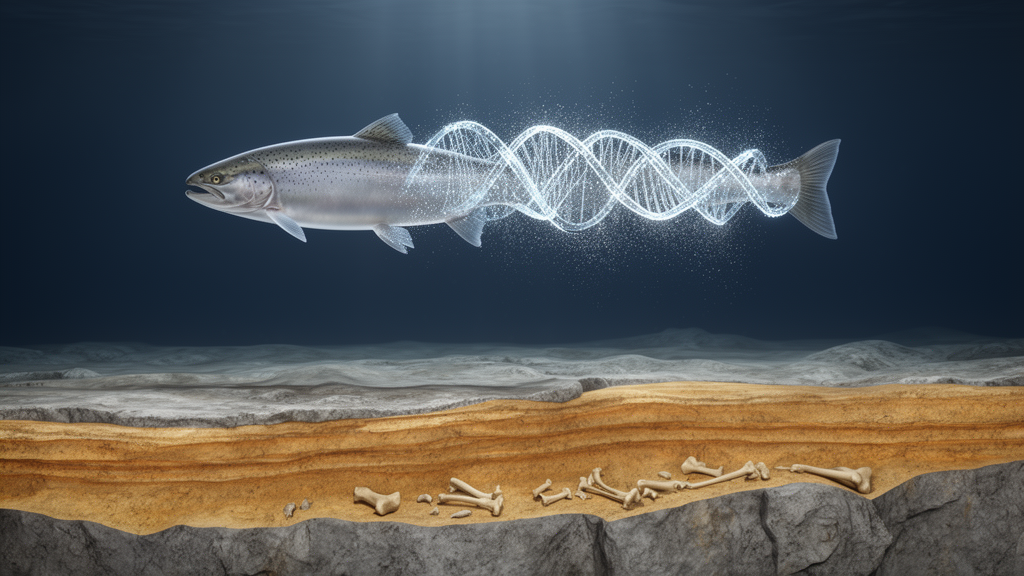
Deep inside El Mirón Cave in Cantabria, northern Spain, Upper Paleolithic hunter-gatherers left behind more than stone tools and ochre paintings. Among the Magdalenian deposits, dated to roughly 18,800 to 16,700 years before present, archaeologists recovered salmon vertebrae from meals eaten beside the nearby river Asón. Those discarded bones have now yielded something extraordinary: complete mitochondrial genomes and tens of thousands of nuclear genetic variants from Atlantic salmon that swam Iberian rivers at the tail end of the last Ice Age. By sequencing these ancient genomes and comparing them with modern populations across Europe and North America, researchers have uncovered a genetic discontinuity so pronounced that it forces a rethink of how Europe’s salmon were recolonized after the glaciers retreated, and of how much of that history is still visible in the fish swimming today.
The study, published in iScience, was led by Daniel García-Souto and Sofía Consuegra, with ancient DNA laboratory work carried out in the Harvard Medical School laboratory of David Reich, one of the leading figures in paleogenomics. The team extracted DNA from eight ancient vertebrae, most likely the remains of salmon consumed by humans at the cave. Endogenous DNA content varied considerably across samples, from 5.5 percent to 61.7 percent, and although nuclear genome coverage was extremely low, averaging between 0.0044-fold and 0.0339-fold, the mitochondrial genomes were recovered at usable depths for seven of the eight specimens. From the nuclear data, the researchers identified 58,341 reliable single nucleotide polymorphisms, of which 1,419 could be intersected with modern European SNP array datasets for population-level comparisons.
The mitochondrial results delivered the first surprise. All of the ancient individuals carried the AABBA haplotype, a maternal lineage that is now common in Northern Europe but was historically rare in Cantabrian rivers before the population crashes and stocking programs of the 1970s and 1980s. Phylogenetic analysis placed the ancient Iberian mitogenomes closest to modern salmon from southern England and western France, including haplotypes characteristic of rivers such as the Teign and the Allier, rather than with the lineages currently found in the river Asón. This pattern points to what the authors describe as a cryptic glacial refugium for Atlantic salmon during the Last Glacial Maximum, connecting the Iberian refuge to other putative refugial populations in Britain and France.
Nuclear genome data told the same story from an independent angle. When the ancient samples were projected onto a principal component space defined by modern European salmon, the first axis separated Baltic Sea populations from Atlantic European ones, while the second captured a well-known latitudinal gradient. The ancient Iberian fish did not cluster with modern Cantabrian salmon. Instead, they aligned with Northern European populations, particularly those from the British Isles, and admixture analyses showed that they share ancestry components with British and Norwegian populations that are absent or rare in today’s Iberian salmon. Even when the analysis was restricted to transversion SNPs alone, a strategy that guards against postmortem damage artifacts, the ancestry patterns held firm.
Because ancient DNA is notoriously prone to degradation and data loss, the team went to unusual lengths to rule out methodological artifacts. They simulated increasing levels of missing data, from 40 to 90 percent, and postmortem cytosine deamination damage, from 1 to 10 percent, in modern pseudohaploid genotypes before projecting them onto the same principal component space. Even under the most extreme missingness scenario, the 95th percentile of simulated displacement was roughly twelve times smaller than the observed separation between ancient and modern Cantabrian samples, and damage simulations produced displacements 31 to 52 times smaller. The genetic discontinuity, in other words, is far too large to be an artifact of damaged, incomplete ancient DNA.
What could explain an eighteen-thousand-year break in genetic continuity? The authors are careful to frame the finding as a difference in broad-scale allele-frequency structure rather than proof of direct ancestry or complete population replacement, given the vast temporal gap between the samples. Several non-mutually exclusive processes could be at work: demographic declines, genetic drift, selection, and the effects of historical stocking with a limited number of breeders, all of which have reshaped contemporary Iberian populations. Local population replacement cannot be entirely excluded, yet the continuous presence of salmon remains at El Mirón before and after the Last Glacial Maximum, together with historical records, suggests that a salmon population has persisted in the river Asón without interruption. The most likely interpretation is that thousands of years of natural and human-driven change have progressively overwritten the original genomic signature.
The ancient genomes also preserved traces of adaptation. Among the variants shared with modern salmon, the team identified eleven SNPs showing evidence of selection in contemporary populations, linked to roughly 140 candidate genes. One high-impact mutation in the hspe1 gene, which encodes a major heat shock protein involved in mitochondrial stress response, showed a marked allele frequency difference between southern and northern modern populations. Another, in the immune-related ifi44L gene, introduces a premature stop codon and also displays a significant north-south frequency shift. Although the key mutations at vgll3 and mMEP-2, the two loci best known for controlling age at sexual maturity in Atlantic salmon, could not be directly genotyped in the ancient samples, linked variation in half of the ancient individuals suggests that early-maturation haplotypes may already have been present in post-glacial Iberian salmon. A nonsynonymous substitution in the mitochondrial ND4 gene, previously identified as being under positive selection, was carried by seven of the eight ancient specimens.
Diversity estimates added a sobering dimension. Corrected mitochondrial nucleotide diversity in the ancient population was about twice that of the contemporary river Asón population, and the estimated female effective population size, at a mean of 1,548 individuals, was significantly higher than the modern estimate of 731. The ancient value fell in the lower-to-intermediate range compared with other European rivers, well below giants like the Rynda in Russia and the Teno in Norway, which exceed 3,000, but far above the collapsed southern populations of today. This pattern mirrors the more stable Northern European populations and contrasts sharply with the low current nuclear effective population sizes documented across Southern Europe, underscoring how severely recent bottlenecks have eroded Iberian salmon diversity.
The broader lesson extends well beyond salmon. Contemporary genomes are routinely used as proxies for a species’ evolutionary history, but this study demonstrates that they can be profoundly misleading, especially in species that have suffered declines, bottlenecks, and intensive management. Modern Iberian salmon are not living fossils of the post-glacial refuge; they are the product of millennia of drift, selection, migration, and, most recently, overexploitation, habitat fragmentation, climate change, and stocking. Without the ancient baseline, the deep history of the Iberian refuge would have been invisible, and the roles of natural post-glacial processes versus anthropogenic impacts would have remained hopelessly entangled.
For conservation, the implications are immediate. Southern European salmon populations are critically endangered, and reintroduction and stocking decisions are often made using contemporary genetic data alone. An ancient DNA baseline offers an evolutionary yardstick against which present-day diversity can be measured, helping managers distinguish what has been lost recently from what was never there. The authors acknowledge the limitations of their dataset, including the small sample size, low nuclear coverage, and the fact that all ancient individuals came from a single archaeological site, and they call for broader sampling of ancient salmon with higher-coverage genomes. Even so, the message from El Mirón Cave is clear: the past is a different country, and its salmon were not the salmon we know. To understand and save what remains, scientists must read the genetic record written in bones eighteen millennia old.
Subject of Research: Ancient DNA analysis of Upper Paleolithic Atlantic salmon from Iberia and its implications for post-glacial phylogeography and conservation
Article Title: What modern genomes overlook: Ancient DNA rewrites the phylogeography of European atlantic salmon ( Salmo salar )
Article References: García-Souto, D., Mallick, S., Barreiro-Docío, E., Rohland, N., Kearns, A. B., Saura, M., Garcia de Leaniz, C., Straus, L. G., González Morales, M. R., Reich, D., & Consuegra, S. (2026). What modern genomes overlook: Ancient DNA rewrites the phylogeography of European atlantic salmon (Salmo salar). iScience, 29(11), Article 117875. https://doi.org/10.1016/j.isci.2026.117875
Image Credits: AI Generated
DOI: 10.1016/j.isci.2026.117875
Keywords: ancient DNA, Atlantic salmon, Salmo salar, phylogeography, glacial refugium, Iberian Peninsula, El Mirón Cave, population genetics, mitochondrial genomes, conservation, Last Glacial Maximum, effective population size
Cite Scienmag News
Juliet Wilcox. (October 15, 2026). Ancient Salmon DNA From a Spanish Cave Rewrites 18,000 Years of Atlantic Salmon History. Scienmag. https://scienmag.com/ancient-salmon-dna-from-a-spanish-cave-rewrites-18000-years-of-atlantic-salmon-history/
Juliet Wilcox. "Ancient Salmon DNA From a Spanish Cave Rewrites 18,000 Years of Atlantic Salmon History." Scienmag, 15 October 2026, https://scienmag.com/ancient-salmon-dna-from-a-spanish-cave-rewrites-18000-years-of-atlantic-salmon-history/. Accessed 15 October 2026.
Juliet Wilcox. "Ancient Salmon DNA From a Spanish Cave Rewrites 18,000 Years of Atlantic Salmon History." Scienmag. October 15, 2026. https://scienmag.com/ancient-salmon-dna-from-a-spanish-cave-rewrites-18000-years-of-atlantic-salmon-history/


