


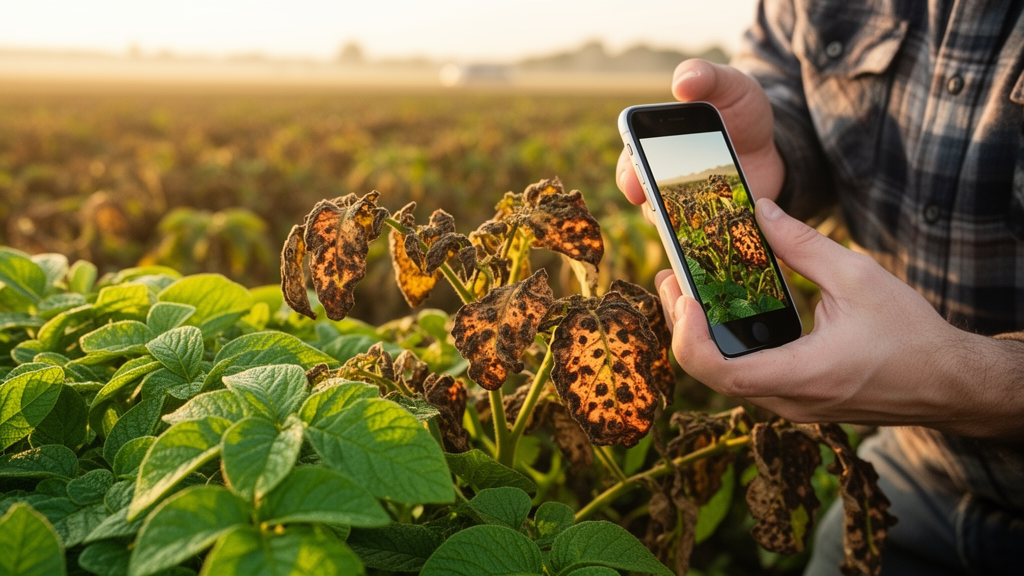
Potato late blight is the disease that triggered the Irish Potato Famine of the 1840s, and it still costs the world more than $6.7 billion in lost yield every year. Its fungal cousin, early blight, can strip 20 to 50 percent of harvests in vulnerable regions. Farmers have long relied on visual inspection and slow laboratory tests that often miss infections before they spread. Now a team of researchers in India and the United States has built a compact artificial intelligence model that can recognize both diseases from a single leaf photograph with near-perfect accuracy, and it can show exactly why it made each call.
The new system, described in the journal Discover Artificial Intelligence, is called SpudNet5-R3. It is a custom five-layer convolutional neural network, a type of deep learning architecture that learns to detect visual patterns by passing images through stacks of filters. What makes SpudNet5-R3 unusual is a single, carefully placed shortcut: a residual connection at the third convolutional block. This shortcut carries mid-level features from an earlier stage of the network directly forward, bypassing several layers. The team found this specific placement preserved the fine spatial details needed to spot the concentric target-spot patterns of early blight, while preventing the vanishing gradient problems that plague purely sequential networks of similar depth.
The researchers trained and compared SpudNet5-R3 against heavyweight architectures including XceptionNet, DenseNet121, and several custom CNN variants, using two public datasets. The first, PlantVillage, contains 2,152 potato leaf images captured under controlled conditions with plain backgrounds. The second, the Potato Leaf Disease dataset, holds 4,072 images shot in more natural and varied settings, with messy lighting and cluttered backgrounds that mimic what a phone camera would actually see in a field. All images were resized to 224 by 224 pixels, and each dataset was split 80:10:10 into training, validation, and test sets.
Before training, the team ran a rigorous preprocessing pipeline. They tested four contrast-enhancement techniques, including gamma correction, a tanh transform, Reinhard normalization, and Contrast Limited Adaptive Histogram Equalization, known as CLAHE. CLAHE won out because it preserved lesion texture most faithfully; it was applied to the lightness channel of the LAB color space with a clip limit of 2.0 and an 8-by-8 tile grid. To correct class imbalance, the researchers applied targeted augmentation only to the training partition, using random rotations of up to 20 degrees, shifts, shearing, zooming, horizontal flips, and brightness scaling. Validation and test sets stayed untouched, so the benchmark remained honest.
The results were striking. On the clean PlantVillage dataset, SpudNet5-R3 achieved 99.07 percent test accuracy with a macro F1-score of 99 percent, misclassifying just 2 of 216 test images. Every healthy leaf was correctly identified, and the model scored a perfect area under the ROC curve of 1.00 for all three classes. On the messier PLD dataset, accuracy dipped to 95.56 percent with a 96 percent macro F1-score, still an excellent result given the visual noise. Only 18 of 405 test images were misclassified, and the healthy class was recognized with 99 percent accuracy. Repeated runs produced low standard deviations, confirming the model’s stability rather than a lucky training run.
Speed matters as much as accuracy for farm deployment. SpudNet5-R3 contains just 668,291 parameters and its serialized checkpoint weighs about 7.71 megabytes, small enough for a smartphone or edge device. Its forward pass costs roughly 4.09 billion floating-point operations, and inference took about 0.016 seconds per image on the first dataset and 0.010 seconds on the second. In direct comparisons, DenseNet121 needed 0.5865 seconds per image on the first dataset and 0.7676 on the second, making the lightweight model dramatically faster. The model also converged within only 25 training epochs, cutting training time and energy costs.
An ablation study confirmed that every stage of the pipeline contributed. A resizing-only baseline reached 97.13 percent accuracy on PlantVillage and 92.10 percent on PLD. Adding color normalization lifted those figures to 97.96 and 93.21 percent, and CLAHE pushed them further to 98.52 and 93.95 percent. The full pipeline with targeted augmentation delivered the final 99.07 and 95.59 percent results. The gains were largest on the harder, field-like dataset, showing that careful preprocessing is not cosmetic but essential for real-world robustness.
Perhaps the most important feature is transparency. The team applied Gradient-weighted Class Activation Mapping, or Grad-CAM, an explainable AI technique that produces heatmaps showing which parts of an image drove the model’s decision. For early blight, the heatmaps locked onto the dark concentric lesions and their yellow halos. For late blight, attention clustered tightly around irregular necrotic patches. For healthy leaves, activation was diffuse, with no hot spots. This alignment with actual disease morphology, rather than background artifacts, suggests the network learned biologically meaningful features, a critical requirement for any diagnostic tool that farmers and agronomists are asked to trust.
Benchmarked against modern architectures including MobileNetV3, EfficientNetV2, ConvNeXt, Vision Transformers, Swin Transformers, and a CNN-Transformer hybrid, SpudNet5-R3 posted the highest accuracy on the controlled dataset and remained competitive on the harder one, where DenseNet121 and the hybrid model edged ahead. The trade-off is clear: bigger models generalize slightly better under extreme visual variability, but the lightweight design wins decisively on speed, memory, and simplicity. The authors say the combination of high accuracy, fast inference, and explainability makes SpudNet5-R3 well suited to mobile and edge computing applications, putting a blight-detection expert in the pocket of any farmer with a smartphone and supporting timely disease management before an outbreak turns into a famine-scale loss.
Subject of Research: A lightweight explainable hybrid convolutional neural network for detecting potato leaf blight diseases
Article Title: A lightweight explainable hybrid convolutional neural network for potato leaf blight detection
Article References: Roy, S., Jain, A., Dubey, A. K., Yadav, S., Kaur, S., Jain, V., Panwar, A., & Mallik, S. (2026). A lightweight explainable hybrid convolutional neural network for potato leaf blight detection. Discover Artificial Intelligence, 6(1), Article 1462. https://doi.org/10.1007/s44163-026-02515-2
Image Credits: AI Generated
DOI: 10.1007/s44163-026-02515-2
Keywords: potato late blight, early blight, convolutional neural network, deep learning, explainable AI, Grad-CAM, plant disease detection, precision agriculture, SpudNet5-R3, CLAHE, data augmentation, edge computing
Cite Scienmag News
Blake Davidson. (October 15, 2026). Lightweight AI Spots Potato Blight With 99% Accuracy and Explains Its Choices. Scienmag. https://scienmag.com/lightweight-ai-spots-potato-blight-with-99-accuracy-and-explains-its-choices/
Blake Davidson. "Lightweight AI Spots Potato Blight With 99% Accuracy and Explains Its Choices." Scienmag, 15 October 2026, https://scienmag.com/lightweight-ai-spots-potato-blight-with-99-accuracy-and-explains-its-choices/. Accessed 15 October 2026.
Blake Davidson. "Lightweight AI Spots Potato Blight With 99% Accuracy and Explains Its Choices." Scienmag. October 15, 2026. https://scienmag.com/lightweight-ai-spots-potato-blight-with-99-accuracy-and-explains-its-choices/


