


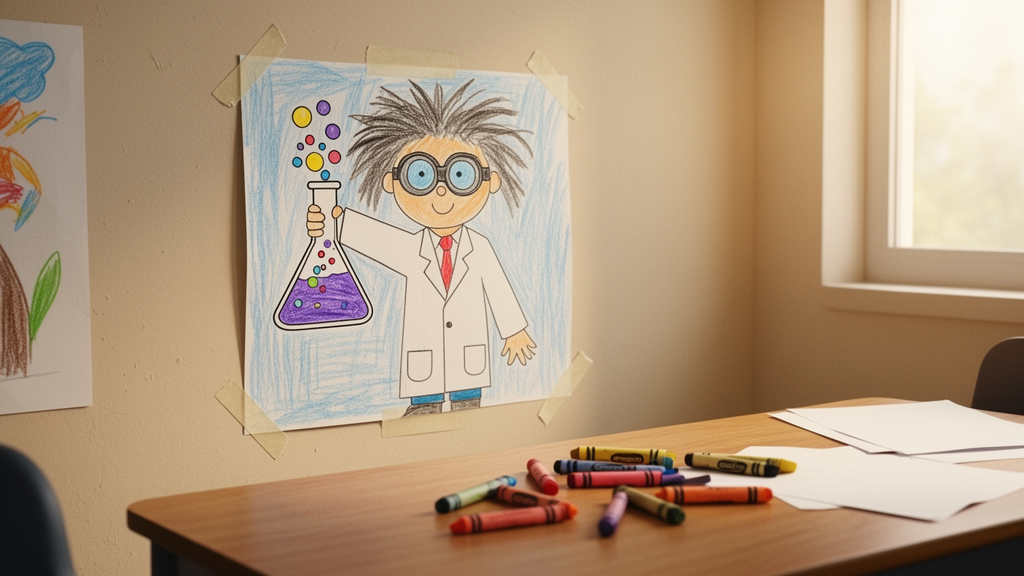
Ask a child to draw a scientist, and you will almost certainly receive a familiar figure: a man in a lab coat, standing amid bubbling flasks, often with wild hair and a hint of danger in the air. For more than four decades, the Draw-a-Scientist Test has documented this stereotype across classrooms worldwide, revealing how deeply cultural images of science take root in young minds. What has remained almost entirely unexplored, however, is how neurodivergent children—students whose cognitive profiles differ from the neurotypical majority—picture the people who do science. A new pilot study from Brazil now offers a first, cautious glimpse into that question, and the results suggest that the classic stereotype exerts a powerful pull even among learners who themselves see the world differently.
The study, published in SN Social Sciences by researchers at the University of Fortaleza, focused on seven children aged nine to eleven, all with a documented clinical diagnosis of Autism Spectrum Disorder, enrolled in the fourth and fifth grades of elementary school. Each child had just taken part in the Young Scientists Project, a structured visit to the university’s Morphofunctional Sciences Laboratory designed specifically to accommodate the sensory, communicative, and learning profiles of students with autism. During the visit, the children handled non-toxic anatomical models of bones, muscles, and organs, explored interactive software, watched educational videos, and tried simple experiments, all under the guidance of university professors and researchers wearing white lab coats, masks, and gloves.
Crucially, the drawing task was not administered on the spot. To capture consolidated mental representations rather than immediate sensory recall, the researchers waited approximately twenty-four hours before asking the children, in a quiet and familiar classroom, to follow the standard DAST instruction: draw a scientist. No additional guidance was given, and any text that appeared in the drawings was included spontaneously by the children. The researchers then analyzed the seven images using an adapted version of the Draw-a-Scientist Test Checklist, a standardized coding framework that scores features such as lab coats, glasses, laboratory instruments, chemical formulas, computers, and gender cues.
The coding process itself was unusual. As an exploratory screening step, the team fed high-resolution digital copies of the drawings to ChatGPT-4o, a multimodal vision-language model, with a standardized prompt asking it to evaluate the images against the core DAST checklist indicators. Two human researchers then independently audited the model’s textual descriptions against the original physical drawings, correcting misclassifications and adding contextual interpretation. In line with Springer Nature’s guidelines on responsible artificial intelligence use, the AI was never treated as an autonomous codifier; all final coding decisions remained with the human researchers, who explicitly acknowledge that no formal inter-rater reliability testing, such as Cohen’s kappa, was performed in this pilot phase.
The results paint a picture of remarkable persistence. Six of the seven drawings—85.7 percent—contained male visual cues such as short hair or traditionally male clothing, while only one drawing featured a female-coded scientist, identifiable by long hair and a headband accessory. Four drawings placed the scientist in a laboratory environment, and three included specific laboratory instruments such as glassware and experimental apparatus. Just one drawing showed a lab coat. None of the children drew glasses, disheveled hair, books or papers, chemical formulas, or computer technology. Representations of scientists working in the field, using digital tools, or engaging with the broader modern scientific enterprise were entirely absent from the cohort’s output.
One drawing stood out from the conventional pattern. Rather than a laboratory, it depicted what the researchers interpreted as an office or clinical setting, complete with chairs, a desk, and a wall-mounted height measurement scale, accompanied by the spontaneously written word METICO—a phonetic misspelling of the Portuguese word for doctor. The researchers suggest this child’s representation may reflect the healthcare and morphology elements of the previous day’s laboratory experience, where anatomical models and researchers in clinical attire featured prominently. Without post-drawing interviews, however, the team is careful to frame such interpretations as contextual readings rather than conclusions about the child’s inner mental model, noting that categorizing such features strictly as conventional laboratory equipment risks oversimplifying the child’s intent.
The authors are equally careful about what the gender findings do and do not mean. The predominance of male-coded figures, they argue, should not be read as proof that these children consciously hold fixed gender stereotypes. Instead, it reflects how historically consolidated images of scientists serve as readily accessible graphical templates for young learners, a pattern documented repeatedly since Chambers first introduced the Draw-a-Scientist Test in 1983. The visual presence of male indicators and laboratory equipment is a descriptive finding about graphic tropes, not a definitive window into underlying beliefs—a distinction the study maintains rigorously throughout its analysis.
The pilot’s limitations are considerable and openly acknowledged. With only seven participants, no statistical analysis is possible, and the sample cannot represent the enormous heterogeneity of neurodivergent learners, whose cognitive and communicative profiles vary widely. There was no neurotypical control group for comparison, no categorization of participants’ granular clinical profiles, and no draw-and-tell interviews to clarify ambiguous graphic elements. The twenty-four-hour interval between the laboratory visit and the drawing task means recent experiential retention cannot be ruled out as an influence. The researchers also note that the classic prompt itself tends to elicit cultural stereotypes rather than nuanced personal views, and they recommend that future studies try alternative instructions, such as asking children to draw a scientist they admire, alongside structured verbal interviews and formal dual-coding frameworks for evaluating AI-assisted analysis.
Why does this small study matter beyond its sample size? Because neurodivergent individuals may be among the most under-tapped talent pools in science. Research cited by the authors indicates that people with autism often display above-average abilities in pattern recognition, memorization, and mathematics, and that neurodiverse thinkers frequently perceive problems and solutions in ways that drive innovation. Yet these same individuals face systemic barriers to science engagement and identity formation, and they often lack equitable access to STEM learning opportunities. If the figure of the scientist that children carry in their minds shapes their motivation and their sense of who belongs in science, then understanding how neurodivergent children visualize that figure is a first step toward building pedagogical strategies that help them see themselves in it.
The study’s working hypotheses point toward concrete educational experiments. Science curricula, the authors suggest, could move beyond the traditional chemistry laboratory to showcase field research, computational modeling, and healthcare innovation. Exposure to diverse role models—including neurodivergent researchers, women, and other underrepresented groups—could help students build personal identification with STEM roles. Multimodal, sensory-adapted learning tools such as interactive anatomical models, visual schedules, and accessible digital platforms offer a promising route for engaging neurodivergent learners on their own terms. The experience of Drawing 3, with its clinical setting and phonetically spelled doctor, hints that even a single sensory-rich laboratory visit can begin to broaden a child’s mental model of scientific practice beyond media-driven stereotypes. Whether that broadening can be sustained, generalized, and translated into lasting scientific identity among neurodivergent children is precisely the question this modest but methodologically inventive pilot study was designed to raise—and future research with larger cohorts, longitudinal designs, and direct measures of student engagement will now have to answer it.
Subject of Research: How neurodivergent children with autism represent scientists through drawings, assessed with the Draw-a-Scientist Test and AI-assisted visual coding
Article Title: The image of scientists among neurodivergent children: a pilot study
Article References: The image of scientists among neurodivergent children: a pilot study. (n.d.). https://doi.org/10.1007/s43545-026-01842-6
Image Credits: AI Generated
DOI: 10.1007/s43545-026-01842-6
Keywords: Draw-a-Scientist Test, neurodivergence, autism spectrum disorder, scientist stereotypes, STEM education, inclusive education, science identity, ChatGPT-4o, multimodal AI, elementary school, Brazil, pilot study
Cite Scienmag News
Courtney Benton. (October 15, 2026). When Autistic Children Draw a Scientist, Old Stereotypes Still Dominate the Page. Scienmag. https://scienmag.com/when-autistic-children-draw-a-scientist-old-stereotypes-still-dominate-the-page/
Courtney Benton. "When Autistic Children Draw a Scientist, Old Stereotypes Still Dominate the Page." Scienmag, 15 October 2026, https://scienmag.com/when-autistic-children-draw-a-scientist-old-stereotypes-still-dominate-the-page/. Accessed 15 October 2026.
Courtney Benton. "When Autistic Children Draw a Scientist, Old Stereotypes Still Dominate the Page." Scienmag. October 15, 2026. https://scienmag.com/when-autistic-children-draw-a-scientist-old-stereotypes-still-dominate-the-page/


