


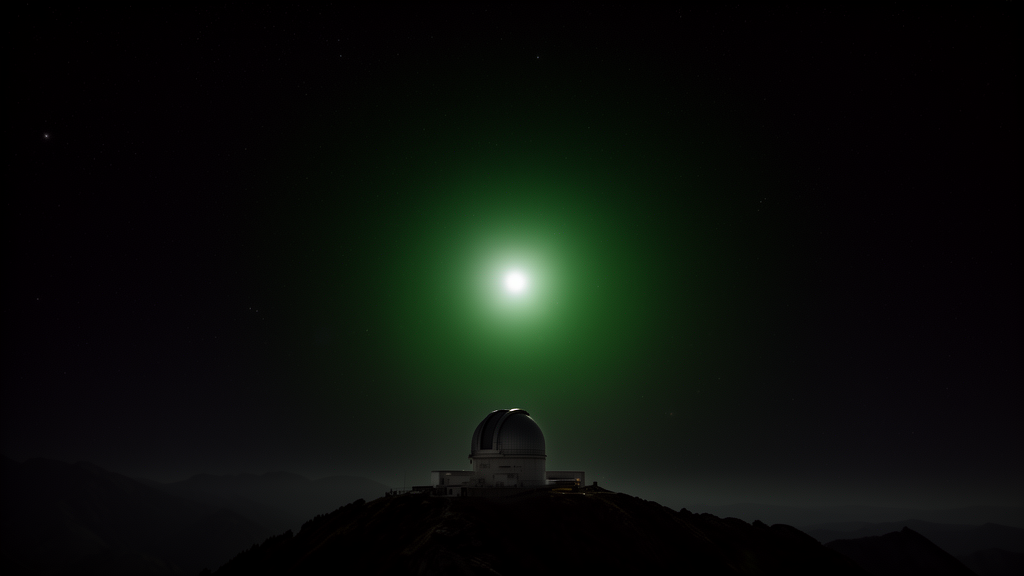
Astronomers at the University of Warwick have discovered that some of the densest stars in the Universe do not follow the colour rules that govern nearly everything else in the night sky. In a study published in RAS Techniques and Instruments, the team showed that white dwarfs, the collapsed remnants of Sun-like stars, can glow in an unexpected palette of green, pink, purple, cyan and yellow, and they identified the first star ever credibly reported to appear green to the human eye. The finding overturns a long-standing assumption that stellar colour is a simple thermometer, and it reveals that chemistry and extreme density can paint a star in hues that no ordinary star can achieve.
For almost every star astronomers have ever catalogued, colour tracks temperature with remarkable fidelity. Cool stars glow orange and red, stars like our Sun emit a balanced white light, and the hottest stars shine pale blue, following the same logic that makes a blacksmith’s iron shift from red to orange to white-hot as it heats. This relationship holds because most stars behave as near-perfect thermal radiators, their light distributed across wavelengths in a way determined almost entirely by temperature. White dwarfs were assumed to obey the same rule. The earliest ones discovered were hot and blazed white or pale blue, which is how the class earned its name. The Warwick team asked whether that apparent simplicity was hiding something, and the answer turned out to be a resounding yes.
The key to the anomaly is density. The coolest white dwarf atmospheres can reach around one gram per cubic centimetre, roughly the density of water and millions of times denser than the Sun’s photosphere. In that crushing environment, trace elements such as carbon, calcium and sodium no longer behave as they do in a diffuse gas. They interact with the surrounding dense helium plasma and absorb light across far broader ranges of wavelength than they would under ordinary conditions. Because colour is simply the balance of light remaining after absorption, these broadened absorption features can strip away entire swathes of the spectrum and push a star’s apparent colour far from the orange, white and blue expected of a perfect radiator.
No white dwarf is close enough for its colour to be seen directly through a telescope, so the researchers calculated it from data that astronomers already collect routinely. Every stellar spectrum is a fingerprint, produced when starlight is split by wavelength much as a prism splits sunlight into a rainbow. The team ran these spectra through a model of human colour vision, converting the measured distribution of light into the colour each star would present to an observer standing nearby. The method demonstrates how much information a spectrum carries: not just a star’s temperature or chemical composition, but its true chromaticity, the precise colour quality of its light as the eye would perceive it.
Applying the technique to white dwarfs across the sky, the team found that the colours fall into distinct groups, each tied to atmospheric composition. Carbon-rich white dwarfs typically appear pink or purple. Those polluted by debris from shattered asteroids and comets, the remnants of old planetary systems, tend towards yellow. Cooler white dwarfs with mixed hydrogen and helium atmospheres often take on a cyan or pale blue tinge, caused by hydrogen molecules colliding with helium atoms in their ultra-dense atmospheres. Each group represents a different physical mechanism distorting the starlight, from molecular absorption to the accretion of planetary wreckage, and together they map a chromatic diversity nobody had previously suspected in stellar remnants.
The most striking case is WD J1330+6435, a cool white dwarf of roughly 4,000 degrees Celsius that has accreted rocky material from its own planetary system, enriching its atmosphere with calcium, lithium and sodium. In the team’s models, the sodium absorbs light across broad bands of the yellow, orange and red spectrum, leaving behind a chartreuse green glow. As far as the researchers are aware, no other star, living or dead, has ever been credibly reported as green, making this the first known genuinely green star in the Galaxy. Dr Mark Hollands, the Warwick Prize Fellow who led the work, described the effect in vivid terms: the sodium in the atmosphere absorbs the orange part of the spectrum, leaving a ghostly green star that would look like something out of science fiction to an observer on a nearby planet.
At the opposite end of the colour range, the team identified what may be the reddest star ever recorded. WD J1011+2845, a white dwarf just 48 light years from Earth, possesses a deep convection zone that has dredged carbon up from its core to its surface. The carbon atoms form diatomic molecules that distort the star’s light so severely that almost all of it is squeezed into wavelengths beyond 600 nanometres, at the deep red end of the visible spectrum and beyond. The result is a deep salmon-pink glow unlike anything produced by an ordinary star. A similar process operates in WDJ0902+2010, where convection has lifted interior carbon into a helium-dominated envelope, and the resulting C2 molecules absorb blue, green and yellow light so strongly that the star appears pink.
To establish how common these exotic colours are, the team studied a representative sample: the 151 white dwarfs within 20 parsecs, about 65 light years, of Earth. Five of them showed unusual colouring, two yellow and three pink, suggesting that roughly one in thirty white dwarfs in the Universe shines with an unusually coloured light. For the remaining 146, the researchers measured the colour temperature, a quantity that compares an object’s colour with that of a perfect radiator and is familiar from household light bulbs, where warm white corresponds to about 3,000 Kelvin and cool white to about 6,000 Kelvin. The median colour temperature of the sample came out at approximately 6,800 Kelvin, which the human eye perceives as white.
That median result corrects a persistent misconception in astronomy: that white dwarfs are typically blue. Hotter, bluer white dwarfs are brighter and can be seen from greater distances, so they are over-represented in surveys that select stars by brightness alone. A properly representative sample shows that the average white dwarf really is white, even though a substantial minority deviates dramatically. Professor Boris Gänsicke of the University of Warwick’s Department of Physics noted that while one in thirty might not sound like a large fraction, across the entire population of white dwarfs in the Universe it amounts to a great many oddly coloured stars, even as the median across a representative population confirms the class’s traditional name.
The study, titled ‘Any colour you like: The diverse chromaticities of white dwarfs’, opens a new observational window on stellar remnants and the planetary systems that surround them. Because unusual colours flag specific chemistry, sodium from accreted rocky debris, carbon dredged from degenerate cores, or molecular hydrogen colliding with helium, colour becomes a rapid diagnostic of what a white dwarf is made of and what it has been eating. With large surveys cataloguing hundreds of thousands of white dwarfs, the Warwick method could soon turn up many more green, pink and purple stars, each one a dense laboratory where extreme physics bends light into colours that the rest of the cosmos reserves for nebulae and aurorae rather than stars.
Subject of Research: The diverse visible colours of white dwarf stars caused by dense atmospheric chemistry and planetary debris accretion
Article Title: Green, pink and purple: astronomers reveal the surprising true colors of white dwarf stars
Article References: Green, pink and purple: astronomers reveal the surprising true colors of white dwarf stars. (n.d.). Original publication
Image Credits: AI Generated
DOI: Not provided
Keywords: white dwarfs, stellar colour, University of Warwick, sodium absorption, carbon dredge-up, planetary debris, stellar spectra, colour temperature, astrophysics, green star, RAS Techniques and Instruments, stellar remnants
Cite Scienmag News
Grant Pearson. (October 15, 2026). White dwarf stars break the colour rule: astronomers find the first truly green star. Scienmag. https://scienmag.com/white-dwarf-stars-break-the-colour-rule-astronomers-find-the-first-truly-green-star/
Grant Pearson. "White dwarf stars break the colour rule: astronomers find the first truly green star." Scienmag, 15 October 2026, https://scienmag.com/white-dwarf-stars-break-the-colour-rule-astronomers-find-the-first-truly-green-star/. Accessed 15 October 2026.
Grant Pearson. "White dwarf stars break the colour rule: astronomers find the first truly green star." Scienmag. October 15, 2026. https://scienmag.com/white-dwarf-stars-break-the-colour-rule-astronomers-find-the-first-truly-green-star/


