


Every year, humanity pours roughly 14 billion cubic meters of concrete, a figure projected to climb toward 20 billion cubic meters by 2050 as cities expand and infrastructure ages. Behind that staggering volume sits an uncomfortable truth: cement production, which requires calcining limestone above 1450 degrees Celsius, is responsible for nearly 8 percent of global anthropogenic carbon dioxide emissions. As carbon pricing regimes such as the European Union’s Carbon Border Adjustment Mechanism enter their definitive phase and countries like Japan begin counting even indirect Scope 3 emissions in construction projects, the pressure to reinvent the binder at the heart of concrete has never been greater. A new study published in Case Studies in Construction Materials offers an intriguing piece of the puzzle, showing that a muddy waste product from concrete plants, once pumped full of carbon dioxide, can partially replace the reactive ingredient in cement-free geopolymer binders without sacrificing much strength.
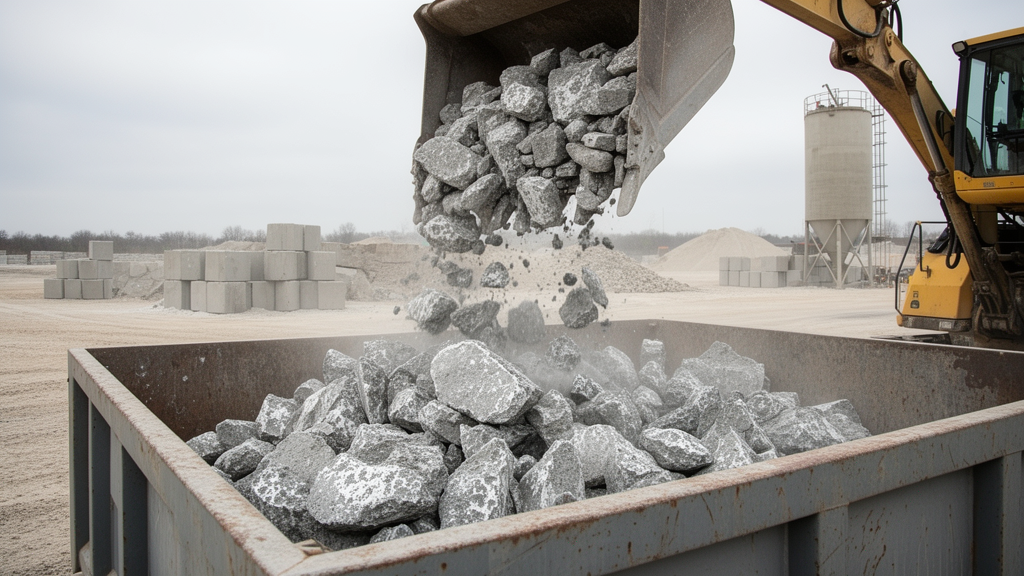
The material in question is concrete slurry waste, the alkaline sludge generated when truck mixers and batching plants are washed out at ready-mixed concrete facilities, along with the surplus concrete that comes back when suppliers overorder. Traditionally treated as a disposal headache because of its high pH, moisture content and inconsistent composition, this slurry actually contains residual unhydrated clinker minerals and cement hydration products. Earlier work by the same researcher demonstrated something remarkable: when the slurry water is subjected to pressurized wet carbonation with supercritical carbon dioxide, each kilogram of the resulting solid can lock away approximately 130 grams of CO2 in stable carbonate form. That turns a waste stream into a carbon sink, but the open question was whether the carbonated powder could do useful chemical work inside a geopolymer, or whether it would simply dilute the mixture.
Geopolymers are binders built not on Portland cement clinker but on aluminosilicate precursors such as fly ash, metakaolin or ground granulated blast-furnace slag, known as GGBS, which are dissolved and reassembled by a strongly alkaline activator solution. In slag-rich systems, the abundant calcium drives the formation of calcium-sodium aluminosilicate hydrate gels, abbreviated C-(N)-A-S-H, which knit into a dense load-bearing network remarkably quickly. The new research, conducted by Sangrak Sim, asked what happens when carbonated concrete slurry waste, or CCSW, replaces 25, 50 or 75 percent of the GGBS by mass in such a system, with the activator-to-binder ratio held constant at 0.6 and a fixed sodium silicate to sodium hydroxide solution ratio of 2.0.
The carbonation step itself proved transformative. Uncarbonated slurry waste showed pronounced X-ray diffraction peaks from anhydrous clinker phases and portlandite, the crystalline calcium hydroxide left over from hardened cement. After ten minutes in a pressurized reactor at 40 degrees Celsius and 100 bar of CO2, those peaks vanished and calcite dominated instead. Perhaps more surprisingly, the carbonation process also shattered the particles: the median particle diameter dropped from 8.89 micrometers for the raw waste to 7.48 micrometers for the carbonated product, with no grinding involved, because the fine calcium carbonate crystals formed during carbonation break the material apart. Fine particles pack better and dissolve faster, which matters enormously in a reactive binder.
The mechanical results traced a clear dose-response curve. The pure GGBS control paste reached compressive strengths of 46.7 megapascals after one day, 73.9 after seven and 87.9 after 28 days of humid curing. At a 25 percent replacement level, the carbonated waste paste was nearly indistinguishable at early ages, hitting 46.4 megapascals on day one and finishing at 81.9 megapascals after 28 days, only about 6 megapascals below the control. Doubling the replacement to 50 percent cost roughly 23 megapascals of 28-day strength, while at 75 percent the paste managed just 4.7 megapascals at one day and 43.1 at 28 days, with almost no strength gain in the final three weeks. The pattern points to dilution: every kilogram of waste displaces a kilogram of highly reactive slag, and calcite, whatever its virtues, cannot rebuild the gel network on its own.
Yet the spectroscopic evidence revealed that the waste is far from inert. Fourier-transform infrared spectroscopy, deconvoluted across the 800 to 1200 per centimeter window where silicon-oxygen-aluminum stretching vibrations live, allowed the researcher to calculate a degree of geopolymerization for each paste. The control climbed from 49.1 percent at one day to 72.8 percent at 28 days. The 25 percent blend reached 64.4 percent, the 50 percent blend 62.3 percent, and even the 75 percent blend managed 56.2 percent, all rising steadily with curing age. Meanwhile, the calcite-related peak area actually shrank over time in some blends, dropping from 3.05 to 2.43 in the 50 percent mixture between days one and 28. That decline hints that under the fierce alkalinity of the activator, calcite surfaces partially dissolve, releasing calcium ions that feed the surrounding gel chemistry rather than sitting passively in the matrix.
Thermogravimetric analysis reinforced this picture with quantitative mass-loss fingerprints. Carbonate decomposition losses at 28 days rose predictably with waste content, from 1.41 percent in the control to 5.44 percent in the 75 percent blend, confirming the calcite inventory. But the mass loss between 300 and 600 degrees Celsius, a region complicated by overlapping dehydroxylation of hydroxyl-bearing gels and the decomposition of poorly crystalline carbonate species, also increased with waste content at every age. Combined with scanning electron microscopy, which revealed two distinct gel chemistries around waste particles, a calcium-poor aluminosilicate gel formed from the waste’s amorphous phases and a calcium-rich gel nucleated near carbonate surfaces, the data sketch a material playing three roles at once: a partial reactive precursor, a fine filler, and a nucleation scaffold.
Pore structure measurements tied these chemical stories to physical performance. Mercury intrusion porosimetry showed that at one day, the 25 percent blend actually had the densest pore structure of all mixtures, its fine carbonate particles physically plugging capillary spaces and seeding gel precipitation. But by seven days the control had overtaken it, its ongoing slag reaction churning out enough binding gel to fill pores faster than any filler could. In the high-replacement blends, pore refinement with age was visible but limited, because the reactive slag reservoir had simply been drawn down too far. Densification, in other words, is ultimately paid for in reactive calcium, silicon and aluminum, and the carbonated waste can only subsidize that budget, not replace it.
The study is candid about its limits. The experiments were run on pastes, so aggregates, interfacial transition zones, workability and long-term durability in real concrete remain untested, and the indicative carbon accounting, which weighs roughly 0.052 kilograms of CO2-equivalent per kilogram of slag against 130 kilograms of CO2 fixed per ton of carbonated waste, deliberately excludes the energy costs of pressurized carbonation, drying, gas compression and activator production. A full life-cycle assessment is still needed before the approach can claim genuine climate benefits. Even so, the core finding stands: at moderate replacement levels, a CO2-sequestering waste powder can shoulder a quarter of the binder workload in a slag geopolymer while preserving most of its strength. In an industry staring down carbon border taxes and trillion-dollar decarbonization bills, the idea that yesterday’s concrete sludge, inflated with captured carbon, could help build tomorrow’s foundations is exactly the kind of circular-economy alchemy the built environment needs.
Subject of Research: Use of carbonated concrete slurry waste as a partial precursor replacement in GGBS-based geopolymer pastes
Article Title: Effect of carbonated concrete slurry waste incorporation on the geopolymerization, mechanical performance, and microstructural evolution of GGBS-based geopolymer pastes
Article References: Sim, S. (2026). Effect of carbonated concrete slurry waste incorporation on the geopolymerization, mechanical performance, and microstructural evolution of GGBS-based geopolymer pastes. Case Studies in Construction Materials, 25, Article e06608. https://doi.org/10.1016/j.cscm.2026.e06608
Image Credits: AI Generated
DOI: 10.1016/j.cscm.2026.e06608
Keywords: geopolymer, GGBS, concrete slurry waste, carbonation, CO2 sequestration, C-(N)-A-S-H gel, compressive strength, calcite, FT-IR spectroscopy, microstructure, sustainable construction, alkali-activated materials
Cite Scienmag News
Denise Maddox. (October 15, 2026). Carbonated Concrete Waste Could Help Cement-Free Binders Stay Strong. Scienmag. https://scienmag.com/carbonated-concrete-waste-could-help-cement-free-binders-stay-strong/
Denise Maddox. "Carbonated Concrete Waste Could Help Cement-Free Binders Stay Strong." Scienmag, 15 October 2026, https://scienmag.com/carbonated-concrete-waste-could-help-cement-free-binders-stay-strong/. Accessed 15 October 2026.
Denise Maddox. "Carbonated Concrete Waste Could Help Cement-Free Binders Stay Strong." Scienmag. October 15, 2026. https://scienmag.com/carbonated-concrete-waste-could-help-cement-free-binders-stay-strong/


