


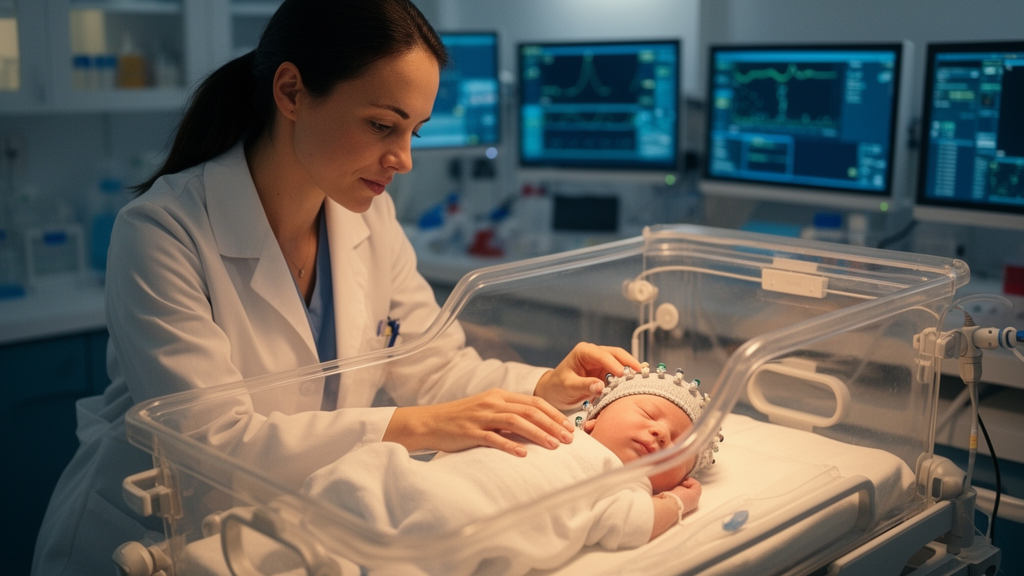
Every so often, the story behind a scientific career turns out to be as compelling as the science itself. John Sunwoo, a pediatric researcher at Harvard Medical School and an investigator at Mass General Brigham for Children, did not set out to study the brains of the tiniest newborns. His original ambition was far grander and, by his own account, almost audaciously naive: he wanted to reverse-engineer the human brain. That dream, sparked by witnessing how deep brain stimulation could transform the lives of patients with Parkinson’s disease, eventually led him somewhere unexpected — to the neonatal intensive care unit, where he now uses light-based sensors to monitor blood flow and autonomic function in infants too young and too fragile to speak for themselves.
The turning point, as Sunwoo has described it, came from seeing neuromodulation in action. Deep brain stimulation, in which implanted electrodes deliver carefully timed electrical pulses to targeted nuclei such as the subthalamic region, can dramatically reduce the tremors, rigidity, and motor fluctuations that define advanced Parkinson’s disease. For a young student watching patients regain control of their own bodies, the implication was electrifying: if electricity delivered to a precise brain target could restore function, then perhaps the circuitry of the brain itself could be mapped, understood, and ultimately reconstructed. It was a question that would define the first major decision of his scientific life.
That decision was to switch majors and pursue a doctorate in biomedical engineering, training at Cornell University and then the University of Southern California. His doctoral work concentrated on noninvasive physiologic monitoring, brain oxygenation, and the autonomic nervous system, with a strong emphasis on studies involving actual patients rather than isolated laboratory models. This clinical orientation would prove decisive. Working with human subjects teaches a particular kind of humility, Sunwoo has noted, because the brain in all its complexity resists the tidy reverse-engineering fantasy that first drew him to neuroscience. Understanding even a small slice of neural function, he realized, demands starting from the foundational elements — the measurable physiological signals that reveal how the body, and the brain within it, is actually behaving.
So instead of abandoning the dream, Sunwoo scaled it down and grounded it. Noninvasive physiologic monitoring became his new mission, and the brain remained very much at its center. After completing his PhD, he joined the Athinoula A. Martinos Center for Biomedical Imaging at Massachusetts General Hospital, one of the world’s leading facilities for advanced imaging and optical monitoring of human physiology. There he trained in diffuse correlation spectroscopy, a technique that has quietly become one of the most promising tools for measuring cerebral blood flow without needles, radiation, or surgery.
Diffuse correlation spectroscopy, or DCS, belongs to the broader family of near-infrared spectroscopy methods, but it does something distinct. Near-infrared light, at wavelengths between roughly 650 and 900 nanometers, penetrates several centimeters through scalp, skull, and other tissue. Conventional near-infrared spectroscopy measures changes in the absorption of that light to estimate the balance of oxygenated and deoxygenated hemoglobin — in other words, oxygenation. DCS goes a step further by exploiting a quantum optical phenomenon: when coherent laser light scatters off moving red blood cells, the reflected light fluctuates in a pattern that encodes the speed of those cells. By analyzing these intensity fluctuations with a correlation algorithm, researchers can derive an index of blood flow in the microvasculature beneath the sensor. The result is a continuous, bedside measurement of perfusion in tissue that would otherwise require CT perfusion scans, MRI, or invasive probes to assess.
For Sunwoo, the appeal of this technology found its natural application in one of medicine’s most vulnerable populations: preterm infants in the neonatal intensive care unit. These patients are non-verbal, their physiology is extraordinarily labile, and their brains are in a period of explosive development that makes them exquisitely sensitive to disturbances in blood flow and oxygen delivery. Continuous monitoring is not a luxury in this setting; it is a clinical necessity. Yet standard NICU monitoring focuses heavily on heart rate, oxygen saturation, and blood pressure — systemic signals that may not reflect what is actually happening inside the cerebral circulation. A bedside optical sensor that tracks cerebral blood flow directly offers a way to close that gap, and Sunwoo’s work at the Martinos Center placed him at the intersection of optical engineering and neonatal critical care.
His published research illustrates the promise concretely. In a 2022 study in Scientific Reports, Sunwoo and colleagues applied DCS blood flow monitoring to extremely low gestational age newborns, examining how cerebral perfusion patterns relate to the vulnerability of these infants to intraventricular hemorrhage. Intraventricular hemorrhage, bleeding into the brain’s ventricular system, remains one of the most feared complications of extreme prematurity, and its onset has long been linked to unstable fluctuations in cerebral blood flow. By measuring flow continuously at the bedside, the study sought to identify which infants are most at risk and when that risk peaks — information that could eventually guide interventions to stabilize perfusion before injury occurs.
More recently, Sunwoo has turned his attention to another dimension of neonatal brain protection: the autonomic nervous system. In a 2026 study published in Pediatric Research, he and his collaborators assessed parasympathetic tone in infants undergoing therapeutic hypothermia for brain injury following neonatal encephalopathy. Therapeutic hypothermia, the deliberate cooling of the body to around 33.5 degrees Celsius, is the standard of care for infants with hypoxic-ischemic encephalopathy, a condition in which oxygen deprivation around the time of birth damages the brain. Cooling slows the cascade of metabolic injury, but it also profoundly alters autonomic regulation, including the vagal control of heart rate. By quantifying parasympathetic tone during cooling and rewarming, the research aims to understand how the autonomic nervous system responds to this therapy and whether those responses carry prognostic information about which infants will recover and which will sustain lasting damage.
Today, as a faculty member in Pediatrics at Harvard Medical School and an investigator at Mass General Brigham for Children, Sunwoo’s laboratory focuses on using physiologic signals to better understand and protect infants at risk of brain injury. His work is supported by the National Institutes of Health, including grants from the Eunice Kennedy Shriver National Institute of Child Health and Human Development and the National Institute of Neurological Disorders and Stroke, along with funding from the Harvard Medical School Office for Faculty Affairs. The trajectory that began with a dream of reverse-engineering the brain has matured into something arguably more achievable and more immediately humane: reading the physiological signals of patients who cannot report their own symptoms, and translating those signals into clinical protection.
There is a broader lesson in this career arc that resonates well beyond one researcher’s story. Big scientific dreams rarely survive first contact with the brain’s staggering complexity in their original form, but they can be redirected into productive channels. The student who wanted to rebuild the brain became the scientist who measures its blood flow, one photon at a time, in infants weighing less than a kilogram. The humility that Sunwoo describes — learning firsthand what it takes to understand the brain — did not extinguish the original ambition. It refined it, grounding a grand vision in the quiet, continuous work of monitoring, measuring, and protecting the most fragile patients in medicine. In neonatal intensive care, where every bit of continuous monitoring matters, that grounded vision may ultimately prove as transformative as the dream that started it all.
Subject of Research: Noninvasive optical monitoring of cerebral blood flow and autonomic function in newborns at risk of brain injury
Article Title: ECI biocommentary: John Sunwoo
Article References: Sunwoo, J. (2026). ECI biocommentary: John Sunwoo. Pediatric Research. https://doi.org/10.1038/s41390-026-05426-1
Image Credits: AI Generated
DOI: 10.1038/s41390-026-05426-1
Keywords: diffuse correlation spectroscopy, near-infrared spectroscopy, cerebral blood flow, neonatal intensive care, preterm infants, intraventricular hemorrhage, therapeutic hypothermia, neonatal encephalopathy, autonomic nervous system, parasympathetic tone, brain injury, biomedical engineering
Cite Scienmag News
Harold Sullivan. (October 14, 2026). From Deep Brain Stimulation Dreams to Watching Newborn Brains: The Unlikely Path of a Neonatal Physiologist. Scienmag. https://scienmag.com/from-deep-brain-stimulation-dreams-to-watching-newborn-brains-the-unlikely-path-of-a-neonatal-physiologist/
Harold Sullivan. "From Deep Brain Stimulation Dreams to Watching Newborn Brains: The Unlikely Path of a Neonatal Physiologist." Scienmag, 14 October 2026, https://scienmag.com/from-deep-brain-stimulation-dreams-to-watching-newborn-brains-the-unlikely-path-of-a-neonatal-physiologist/. Accessed 14 October 2026.
Harold Sullivan. "From Deep Brain Stimulation Dreams to Watching Newborn Brains: The Unlikely Path of a Neonatal Physiologist." Scienmag. October 14, 2026. https://scienmag.com/from-deep-brain-stimulation-dreams-to-watching-newborn-brains-the-unlikely-path-of-a-neonatal-physiologist/


