


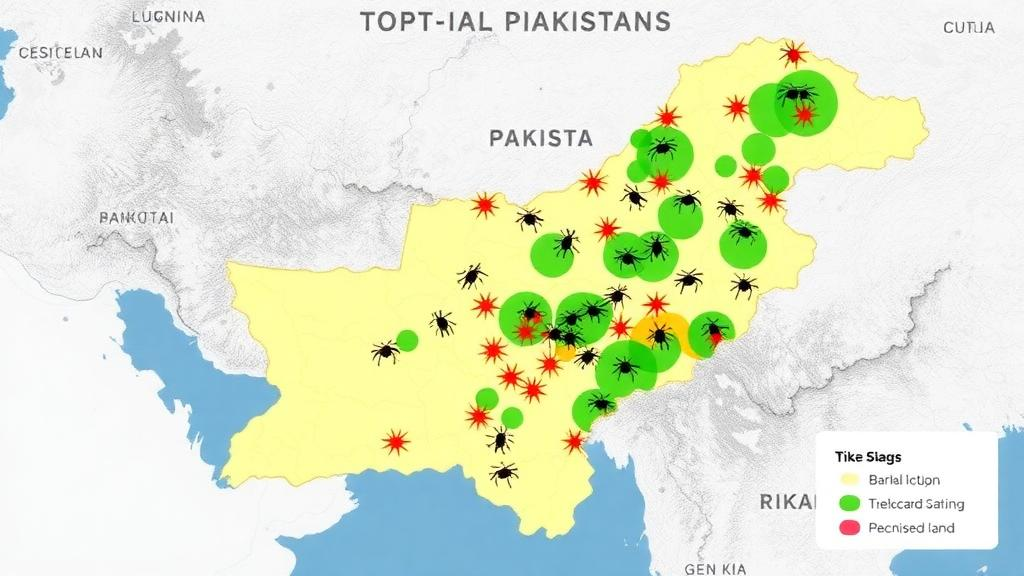
In the mountainous districts of Upper Dir, Lower Dir and Bajaur in northern Pakistan, cattle and buffaloes form the backbone of smallholder livelihoods, and the parasites that afflict them carry an economic weight far beyond their size. A new study published in Acta Parasitologica has combined tick collection, blood diagnostics and molecular sequencing to build one of the most complete pictures yet of tropical theileriosis and its tick vectors in this region. Over a full year of sampling, from May 2024 to April 2025, a research team led by Zia Ur Rahman and Abid Ali examined 900 large ruminants, recovered more than three thousand ticks, and tested blood from clinically affected animals to determine exactly which parasites and which vectors circulate in these valleys.
The scale of the fieldwork gives the results unusual weight. The team collected 3,151 ticks in total from 805 cattle and 95 buffaloes. The collection was dominated by adult females, which accounted for 1,630 individuals or 51.7 percent of the haul, followed by 725 males at 23 percent, 458 nymphs at 14.5 percent and 338 larvae at 10.7 percent. This stage structure matters because different life stages feed on hosts at different times of year and differ in their capacity to acquire and transmit pathogens. Alongside the tick collections, the researchers drew 221 blood samples from animals that were both showing clinical signs and carrying ticks, a deliberately targeted sampling strategy designed to capture active infection rather than background carriage.
Morphological identification of the ticks revealed a two-genus community. Rhipicephalus species made up 83.59 percent of the collection, with Hyalomma accounting for the remaining 16.41 percent. Within Rhipicephalus, the cattle tick Rhipicephalus microplus was overwhelmingly dominant at 70.29 percent of all ticks collected, followed by Rhipicephalus haemaphysaloides at 7.61 percent and an unidentified Rhipicephalus at 5.68 percent. The Hyalomma contingent comprised Hyalomma anatolicum at 8.82 percent and Hyalomma turanicum at 7.58 percent. The dominance of R. microplus is significant for regional biosecurity, because this one-host tick is notorious worldwide for developing resistance to common acaricides and for its efficiency as a vector of bovine babesiosis and anaplasmosis, in addition to its role in theileriosis transmission dynamics.
Infestation patterns differed sharply between host species. Cattle carried ticks at a rate of 46.33 percent, more than double the 22.11 percent recorded in buffaloes. Among cattle, the three districts were remarkably similar, with infestation rates of 46.49 percent in Upper Dir, 46.62 percent in Bajaur and 45.90 percent in Lower Dir, suggesting that the burden is region-wide rather than localized. Buffaloes showed correspondingly lower figures of 24.14, 23.53 and 18.75 percent in the same districts. Statistical analysis confirmed that host species itself was a significant determinant of infestation, a finding consistent with known differences in grooming behavior, skin thickness and husbandry between the two ruminants.
The diagnostic comparison at the heart of the study illustrates why microscopy alone can seriously underestimate tick-borne infection. Conventional blood-smear examination detected Theileria in 18.09 percent of the 221 samples, that is 40 animals, comprising 37 of 202 cattle at 18.31 percent and 3 of 19 buffaloes at 15.78 percent. When the same samples were screened by polymerase chain reaction targeting the parasite’s 18S ribosomal RNA gene, the detection rate jumped to 45.24 percent, with 100 of 221 animals positive, including 92 cattle at 45.54 percent and 8 buffaloes at 42.11 percent. The roughly two-and-a-half-fold gap between the two methods reflects the limited sensitivity of microscopy, which depends on the density of parasites in peripheral blood and the skill of the microscopist, whereas PCR can amplify parasite DNA even at very low parasitemia and in carrier animals that appear clinically recovered.
To identify the parasite species, the researchers sequenced the amplified 18S rRNA fragment and compared it against public databases using BLAST analysis. The sequence showed a maximum identity of 99.62 percent with Theileria annulata reference sequences from Turkey, China and Pakistan, and a phylogenetic tree constructed in MEGA X using the maximum-likelihood method placed the Pakistani isolate firmly within a clade containing T. annulata sequences from Asia and Europe. The 18S rRNA gene is a standard barcode for piroplasmid parasites because it is conserved enough for reliable species-level discrimination yet variable enough to resolve relationships. The finding confirms that the causative agent of tropical theileriosis, one of the most economically damaging tick-borne diseases of cattle across North Africa, the Middle East and South Asia, is the species circulating in northern Pakistan. The consensus sequence has been deposited in GenBank under accession number PV538505, making it available for future comparative studies.
The risk-factor analysis produced a nuanced picture of what drives infestation and infection in these herds. Age, season and acaricide treatment were significantly associated with tick infestation in both cattle and buffaloes, with p values below 0.05. Younger animals and untreated animals carried higher burdens, and tick numbers rose and fell with the seasons in line with the activity patterns of the vector species. For Theileria infection itself, age, season and acaricide use were significant in cattle, whereas in buffaloes only acaricide use reached statistical significance. This asymmetry suggests that buffaloes, with their lower infestation rates, may experience infection dynamics that depend more heavily on chemical tick control than on the demographic and seasonal factors that dominate in cattle.
Equally instructive are the factors that did not matter. Gender, the presence of rural poultry, the grazing system and the district of origin showed no significant association with either tick infestation or Theileria infection in either host species. The uniformity across the three districts reinforces the conclusion that the parasite and its vectors are well established throughout the region. The irrelevance of poultry presence and grazing system suggests that interventions targeting those variables alone would be unlikely to reduce disease pressure, sharpening the focus on the factors that do matter.
The practical implications of the study are considerable for a livestock-dependent economy. Tropical theileriosis caused by T. annulata produces fever, anemia, lymph node swelling and, in severe cases, death in cattle, and even subclinical infections depress milk yield and weight gain. Studies from North Africa have documented substantial milk losses attributable to the disease, and comparable costs are plausible in Pakistani production systems where dairy output is a primary household income source. The identification of acaricide treatment as a significant protective factor points to the central role of tick control, but it also raises a warning: R. microplus is among the tick species most prone to acaricide resistance globally, so indiscriminate chemical use could erode the very tool that the data show to be effective. The authors suggest that their integrated assessment, linking pathogen, vector and risk factors from the same infected hosts, can help guide preventive measures in the mountainous terrain of northern Pakistan.
Methodologically, the study demonstrates the value of integration. By pairing morphological tick taxonomy with molecular pathogen detection and phylogenetics on samples drawn from the same animals, the researchers avoided the fragmentation that has limited many earlier surveys, which examined either vectors or parasites in isolation. The work also contributes to a growing body of Pakistani tick research, including recent systematic reviews of Hyalomma anatolicum and Rhipicephalus microplus distribution and updated national checklists of tick fauna. As climate change alters the distribution patterns of ticks and the pathogens they carry, baseline datasets of this kind become essential reference points. For farmers in Upper Dir, Lower Dir and Bajaur, the message is concrete: seasonal tick control, particularly for young cattle, remains the most actionable defense against a disease whose molecular fingerprint now places it squarely within the well-known Asian and European lineage of Theileria annulata.
Subject of Research: Molecular epidemiology of Theileria annulata infection and tick infestation in cattle and buffaloes in northern Pakistan
Article Title: Molecular Epidemiology and Risk Factors of Theileria annulata Infection and Rhipicephalus and Hyalomma Tick Infestation in Three Districts of Northern Pakistan
Article References: Rahman, Z. U., Khan, A., Wasim, M., Wahid, S., Gul, M., Khan, M., Aljasham, A. T., & Ali, A. (2026). Molecular Epidemiology and Risk Factors of Theileria annulata Infection and Rhipicephalus and Hyalomma Tick Infestation in Three Districts of Northern Pakistan. Acta Parasitologica, 71(5), Article 237. https://doi.org/10.1007/s11686-026-01416-9
Image Credits: AI Generated
DOI: 10.1007/s11686-026-01416-9
Keywords: Theileria annulata, tropical theileriosis, Rhipicephalus microplus, Hyalomma anatolicum, 18S rRNA, PCR, phylogenetic analysis, risk factors, livestock, Pakistan, tick-borne disease, cattle
Cite Scienmag News
William Thompson. (October 14, 2026). Ticks and Tropical Theileriosis Mapped Across Northern Pakistan’s Livestock Herds. Scienmag. https://scienmag.com/ticks-and-tropical-theileriosis-mapped-across-northern-pakistans-livestock-herds/
William Thompson. "Ticks and Tropical Theileriosis Mapped Across Northern Pakistan’s Livestock Herds." Scienmag, 14 October 2026, https://scienmag.com/ticks-and-tropical-theileriosis-mapped-across-northern-pakistans-livestock-herds/. Accessed 14 October 2026.
William Thompson. "Ticks and Tropical Theileriosis Mapped Across Northern Pakistan’s Livestock Herds." Scienmag. October 14, 2026. https://scienmag.com/ticks-and-tropical-theileriosis-mapped-across-northern-pakistans-livestock-herds/


