


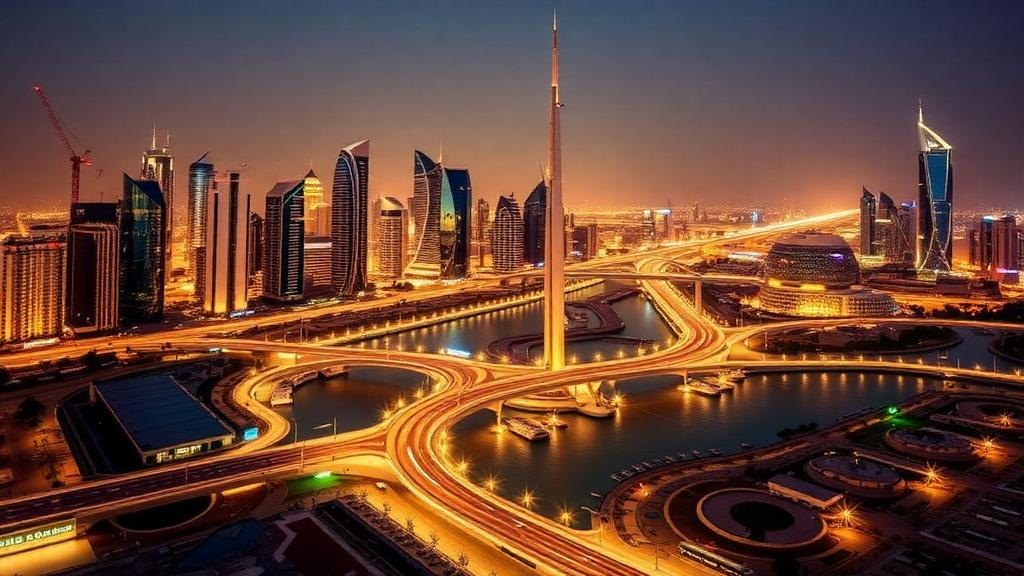
Dubai has spent five decades building itself into one of the world’s most connected cities, a place where ports, airports, logistics corridors, free zones, and regulatory platforms move goods, people, capital, and information across borders at extraordinary speed. A new perspective article published in the journal Discover Sustainability argues that this connectivity-led model, orchestrated almost entirely by the state, has now reached a turning point. Researchers Wafa Barhoumi Hamdi of the University of Sharjah and Abdulaziz Albrithen of United Arab Emirates University examined how sustainability has entered Dubai’s state-coordinated development model, and whether the city’s new policy priorities are backed by evidence of real implementation and measurable outcomes. Their conclusion is nuanced: sustainability has genuinely reshaped the language and direction of Dubai’s planning, but the reviewed evidence does not yet demonstrate city-wide improvements in environmental performance or social inclusion.
The study rests on a qualitative document analysis of 43 academic, policy, and institutional sources, a method that allows researchers to trace how ideas about development have shifted across official strategies, master plans, and scholarly assessments over time. Rather than measuring air quality sensors or energy meters directly, the authors interrogated the documents themselves, asking how Dubai’s growth model was constructed, how it produced recognizable benefits, and where it generated costs. This approach is particularly well suited to Dubai because the city’s transformation has always been narrative-driven as much as material: successive plans, visions, and flagship projects have articulated what the emirate intends to become, and the state’s coordination capacity has converted those statements into physical infrastructure with unusual speed.
The core of that growth model, as the authors describe it, is connectivity-oriented infrastructure. Jebel Ali Port and the logistics corridors linking it to wider regions, one of the world’s busiest international airports, expansive free zones that attract foreign firms with tailored regulation, and platforms that facilitate flows of capital and expertise together created an economy diversified well beyond oil. Connectivity did more than move containers and passengers; it repositioned Dubai within global networks, allowing a small desert emirate to function as an intermediary between continents. State coordination was the essential ingredient. Land allocation, regulatory innovation, and infrastructure investment moved in concert, so that each new free zone, terminal, or corridor reinforced the others. The result was a city whose physical form and economic function were both shaped by the logic of connection.
Yet the same systems that generated prosperity also produced structural costs, and the study catalogs them with care. Connectivity-oriented planning entrenched car dependence, because roads and parking consumed urban space while public transport lagged behind the city’s spatial expansion. Resource use rose steeply as the population grew and the built environment expanded in a hot, arid climate that demands energy-intensive cooling and desalination. Environmental pressures accumulated in the form of emissions, waste, and stress on fragile coastal and desert ecosystems. Perhaps most strikingly, the benefits of connectivity were unevenly distributed: access to urban opportunities, from well-located housing to jobs and services, varied sharply across a socially diverse population, leaving parts of the community with weaker connections to the networks that defined the city’s success.
The pivotal shift identified in the analysis is the Dubai 2040 Urban Master Plan, alongside related policies that have added sustainability priorities to the development agenda. The 2040 plan represents a deliberate attempt to steer growth toward more sustainable patterns, with attention to denser urban form, green spaces, improved mobility, and quality of life. In the authors’ framing, these documents show that sustainability is no longer peripheral to Dubai’s self-conception; it has become a stated objective of the same state apparatus that once prioritized throughput and speed. The question the study poses is whether this reorientation amounts to a genuine transformation of the development model or a layering of new goals onto an old one.
The answer, based on the reviewed sources, is sobering. Hamdi and Albrithen find that while the policy architecture of sustainability is robust on paper, the 43 sources they analyzed do not establish city-wide improvements in environmental performance or social inclusion. Connectivity-led modernization and state coordination still constitute the underlying growth model; sustainability priorities have been added to it rather than replacing it. This distinction matters because it separates two very different claims that are often conflated in urban discourse. A city can adopt ambitious plans, host global climate events, and announce net-zero targets while its underlying spatial structure, transportation system, and economic incentives continue to generate car dependence, high resource consumption, and unequal access.
The study’s technical contribution lies in its insistence on evidence chains linking policy priorities to implementation and outcomes. Document analysis reveals a pattern common to rapidly growing cities: the weakest links occur between planning documents and measurable results. Plans articulate targets, strategies describe programs, but the intermediate evidence showing that programs changed behavior, emissions, consumption patterns, or distributional outcomes is thin or absent in the reviewed literature. For Dubai, this means the city’s celebrated capacity for execution, which so efficiently delivered ports and airports, has not yet been documented as delivering equivalent results for sustainability. The bottleneck is not ambition or coordination but verification, the accumulation of transparent data demonstrating that stated priorities are producing outcomes across the whole city rather than in showcase districts.
Why does this matter beyond the Gulf? Dubai functions as a template for dozens of rapidly urbanizing cities that aspire to leverage connectivity for economic diversification while facing identical environmental constraints. If a state with exceptional coordination power, deep financial resources, and a documented ability to build at speed cannot yet show evidence of city-wide sustainability gains, the study suggests that the challenge is structural rather than administrative. Connectivity-led urbanism optimizes flows; sustainability requires optimizing stocks and distributions, including building stock, energy systems, ecosystems, and access to opportunity. Those are different optimization problems, and the analytical tools, metrics, and governance arrangements suited to one do not automatically serve the other. Cities everywhere that are retrofitting sustainability onto infrastructure built for throughput will recognize the dilemma.
The authors’ characterization of sustainability as a reorientation, rather than a transformation, of Dubai’s development model is deliberately precise. Reorientation implies that the direction of travel has changed, that planning documents now point toward environmental performance and social inclusion as legitimate ends alongside growth. Transformation would imply that the machinery of development has itself been rebuilt so that those outcomes are produced by default. The evidence reviewed supports the first claim and not the second. This framing also identifies what researchers and policymakers should watch next: whether the implementation record catches up with the planning record, whether monitoring systems generate the outcome data that current documents lack, and whether the state’s coordination capacity, so decisive in the connectivity era, can be redeployed to integrate environmental and social objectives into everyday urban operations.
For a city that has often been treated as either a miracle of ambition or a cautionary tale of excess, the study offers something more useful: a measured account of how a development model evolves. Dubai’s connectivity era built the physical and institutional capital that any sustainability transition will need, from transit-adjacent districts to regulatory agility. The open question, on the evidence assembled by Hamdi and Albrithen, is whether the same state-coordinated machine that moved goods, people, capital, and information so effectively can now be redirected to move the city itself, measurably and inclusively, toward environmental performance and shared urban opportunity. The Dubai 2040 Urban Master Plan has set the destination; the reviewed sources indicate that the journey’s proof, in data rather than declarations, is still to come.
Subject of Research: State-coordinated urban development in Dubai and the shift from connectivity-led modernization to sustainability planning
Article Title: Dubai’s state-coordinated urban transformation from connectivity-led modernization toward sustainability planning
Article References: Dubai’s state-coordinated urban transformation from connectivity-led modernization toward sustainability planning. (n.d.). https://doi.org/10.1007/s43621-026-04971-3
Image Credits: AI Generated
DOI: 10.1007/s43621-026-04971-3
Keywords: Dubai, urban transformation, sustainability planning, connectivity-led modernization, state coordination, Dubai 2040 Urban Master Plan, urban policy, car dependence, environmental performance, social inclusion, qualitative document analysis, Discover Sustainability
Cite Scienmag News
Sloane Callahan. (October 14, 2026). Dubai Pivots From Connectivity Machine to Sustainability Blueprint, Study Finds. Scienmag. https://scienmag.com/dubai-pivots-from-connectivity-machine-to-sustainability-blueprint-study-finds/
Sloane Callahan. "Dubai Pivots From Connectivity Machine to Sustainability Blueprint, Study Finds." Scienmag, 14 October 2026, https://scienmag.com/dubai-pivots-from-connectivity-machine-to-sustainability-blueprint-study-finds/. Accessed 14 October 2026.
Sloane Callahan. "Dubai Pivots From Connectivity Machine to Sustainability Blueprint, Study Finds." Scienmag. October 14, 2026. https://scienmag.com/dubai-pivots-from-connectivity-machine-to-sustainability-blueprint-study-finds/


