


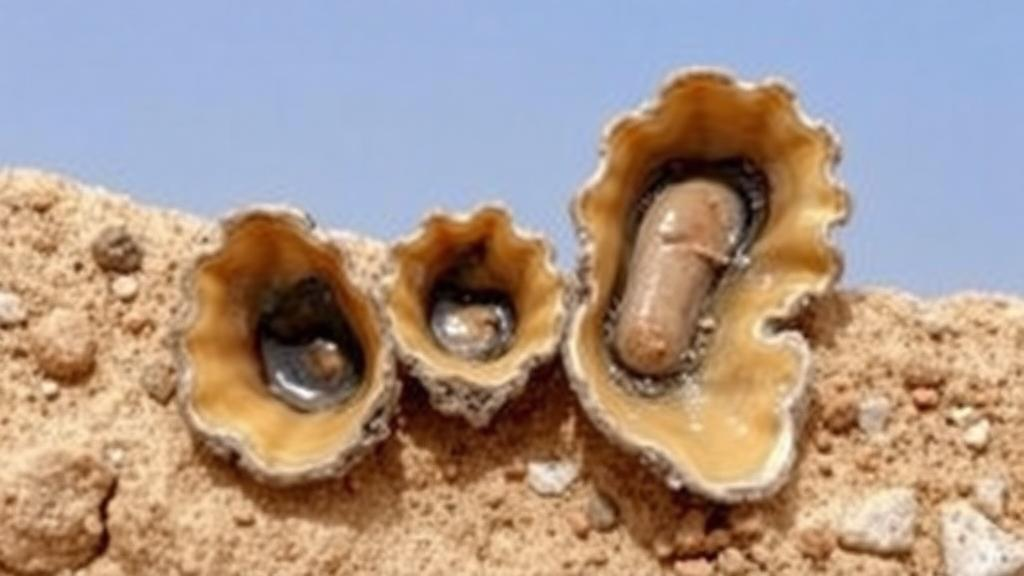
Buried in the river sediments of eastern Sudan lies an unlikely climate archive: the fossilized shells of freshwater oysters that lived, fed, and grew along the Atbara River tens of thousands of years before humans built dams or wrote a single word. A research team led by Aisha Huseen of the Museum für Naturkunde in Berlin has now drilled into these shells layer by layer and read their isotopic chemistry like the rings of a tree, extracting a record of ancient rainfall that stretches back roughly 200,000 years. Their conclusion is striking: the punishing rhythm of wet and dry seasons that defines the eastern Sahel today was already firmly in place when our ancestors roamed these savannas during the Pleistocene.
The shells in question belong to Etheria elliptica, the African freshwater oyster, a bivalve that cements itself to rocks in fast-flowing water and grows by accreting discrete layers of calcium carbonate at its inner surface. Each layer locks in a chemical snapshot of the water in which it formed, recording both the temperature and the isotopic composition of the river at the moment of crystallization. Because shells of the species are typically 2 to 3 centimeters thick and up to 15 centimeters long, with clearly defined growth bands, they are ideal targets for serial stable isotope analysis, the technique of sampling successive growth layers individually to reconstruct environmental change across an animal’s lifetime.
The study, published in E&G Quaternary Science Journal, analyzed eleven fossil shells and three modern shells collected from the middle Atbara River between 2018 and 2022. The fossils came from three localities—Al Sharafa, Al Tomat, and Al Murabaa—within thick Pleistocene river deposits that have been dated using optically stimulated luminescence, or OSL, a technique that measures the time since quartz grains in the sediment were last exposed to sunlight. Those ages place the shell-bearing sediments between roughly 224,000 and 17,000 years old, spanning the late Middle and Late Pleistocene. The stratigraphic sequence is divided into units called the Butana Bridge Synthem and the Khashm El Girba Synthem, with the latter further split into KGS1, KGS2, and KGS3, each carrying its own age range.
The physics behind the oxygen isotope signal is elegantly simple. Rainfall delivers water enriched in the light isotope oxygen-16, lowering the δ18O ratio of river water during the wet season. During the dry season, evaporation preferentially removes the light isotope, concentrating heavier oxygen-18 and raising the ratio. Shells therefore record these swings as alternating depleted and enriched bands, and the overall spread of values within a shell serves as a proxy for the amplitude of seasonality. The researchers used the standard deviation and range of δ18O values within each specimen, rather than counting individual seasonal cycles, because the slowing growth rate of older oysters compresses the layers and makes cycle counting unreliable.
The results show that fossil and modern shells share broadly similar isotopic ranges, evidence that the seasonal contrast between the summer monsoon floods and the dry-season trickle has remained a persistent feature of the Atbara River system since at least about 200,000 years ago. Fossil δ18O values span from −2.4 to +5.9 per mil, while modern shells range from −6.4 to +1.5 per mil. The fossils are, on average, more enriched, which the authors interpret as a possible sign of more evaporative and drier conditions during the Pleistocene. But there is a modern complication: the Atbara is now regulated by two large dams, the Khashm El Girba Dam completed in 1964 and the Upper Atbara–Setit Dam Complex inaugurated in 2017, and altered flow regimes could equally explain the more depleted values in today’s shells.
One shell stands out from the rest. A specimen likely deriving from the oldest unit, BBS1, dated to around 224,000 years ago, shows both high variability and significantly more enriched oxygen values than any later shell, pointing to markedly drier and potentially more seasonal rainfall at that time. This fits with sedimentological work indicating more arid conditions during BBS times. By contrast, the seven shells from the KGS2 interval, roughly 130,000 to 60,000 years old, show the lowest variability of any interval, with a narrow range of about 2 per mil, hinting at slightly wetter conditions and reduced seasonal contrast. The authors suggest these long-term shifts were probably driven by orbital-scale forcing, particularly the precession cycle, which modulates summer insolation at low latitudes and shifts the Intertropical Convergence Zone, the main engine of Sahelian rainfall. A single shell from the younger KGS3 unit yielded depleted values, but X-ray diffraction showed it had partially transformed from aragonite to calcite, a diagenetic alteration that makes its oxygen signal untrustworthy, and it was excluded from interpretation.
Carbon isotopes told a different and more puzzling story. Shell δ13C reflects the dissolved inorganic carbon of the river, which in turn is influenced by atmospheric CO2, catchment vegetation, rock weathering, soil respiration, and the oysters’ own metabolism. Each stratigraphic interval showed a distinct carbon isotope range: the KGS shells were the most enriched, the older BBS shells intermediate, and the modern shells the most depleted. The team proposes that enriched Pleistocene values may reflect the much lower atmospheric CO2 concentrations of ice-age climates, around 260 parts per million during BBS times and roughly 180 parts per million during KGS2, while the depleted values in modern shells align with the post-industrial rise in CO2. Changes in vegetation, weathering, or biological factors could also contribute, and the absence of modern dissolved inorganic carbon data from the Atbara prevents a definitive answer. Notably, carbon and oxygen values showed no correlation, unlike in the Omo River shells studied previously, suggesting that carbon dynamics in the Atbara are decoupled from the seasonal water cycle.
To anchor the shell data, the team also measured the hydrogen and oxygen isotopes of river water itself and constructed the Atbara local meteoric water line from seven samples. The line, expressed as δD equal to 6.53 times δ18O plus 9.56, has a slightly lower slope than the global meteoric water line, pointing to strong evaporation and low relative humidity along the river, a pattern consistent with the water lines of the Blue Nile, White Nile, and main Nile. The inferred moisture sources feeding the Atbara’s rains include the Indian Ocean, the Atlantic Ocean, and recycled continental vapor. Because fossil and modern shells display comparable isotopic ranges, the authors argue that these same moisture sources likely also supplied the region during the Pleistocene, although deuterium cannot be measured in fossil shells to confirm it directly.
Beyond the numbers, the findings carry weight for understanding the deep history of African savannas and the humans who evolved within them. Rainfall magnitude and seasonality govern primary productivity and tree cover across the continent’s drylands, shaping the habitats available to mammals and hominins alike. Hominins have lived in African savannas for over six million years, and the Nile corridor and its tributaries, including the Atbara, may have served as routes providing food and freshwater during dispersals. The Atbara region contributes roughly 14 percent of the Nile’s total discharge, yet its paleoclimate record had remained a blind spot compared to the well-studied East African Rift Valley and South Africa. By demonstrating that strong precipitation seasonality has structured this landscape for at least 200 millennia, the study establishes a baseline against which the habitat context of Pleistocene human populations in the eastern Sahel can now be assessed.
The work is not without its limits, as the authors readily acknowledge. Specimen numbers are modest, particularly for the KGS3 and BBS1–2 intervals, and more modern water samples would be needed to firm up the meteoric water line. Still, the study marks the first application of serial isotope analysis to Etheria shells older than the early Holocene, opening a new window onto semi-arid river systems. Future work combining larger shell collections with modern monitoring of river water chemistry promises to sharpen these reconstructions further, and to reveal whether the relentless seasonal heartbeat of the Sahel will endure as the climate continues to change.
Subject of Research: Reconstruction of Pleistocene to recent rainfall seasonality in eastern Sudan using stable isotope analysis of freshwater oyster shells
Article Title: Paleoseasonality through serial stable isotope analysis of Pleistocene to recent Etheria elliptica shells from the middle Atbara River, eastern Sudan
Article References: Paleoseasonality through serial stable isotope analysis of Pleistocene to recent Etheria elliptica shells from the middle Atbara River, eastern Sudan. (n.d.). https://doi.org/10.5194/egqsj-75-173-2026
Image Credits: AI Generated
DOI: 10.5194/egqsj-75-173-2026
Keywords: paleoclimate, seasonality, stable isotopes, Etheria elliptica, Atbara River, Sudan, Pleistocene, OSL dating, Nile basin, savanna, oxygen isotopes, freshwater bivalves
Cite Scienmag News
Violet Maxwell. (October 14, 2026). Fossil Oysters Reveal 200,000 Years of Unchanging Rainfall Seasons in Sudan. Scienmag. https://scienmag.com/fossil-oysters-reveal-200000-years-of-unchanging-rainfall-seasons-in-sudan/
Violet Maxwell. "Fossil Oysters Reveal 200,000 Years of Unchanging Rainfall Seasons in Sudan." Scienmag, 14 October 2026, https://scienmag.com/fossil-oysters-reveal-200000-years-of-unchanging-rainfall-seasons-in-sudan/. Accessed 14 October 2026.
Violet Maxwell. "Fossil Oysters Reveal 200,000 Years of Unchanging Rainfall Seasons in Sudan." Scienmag. October 14, 2026. https://scienmag.com/fossil-oysters-reveal-200000-years-of-unchanging-rainfall-seasons-in-sudan/


