


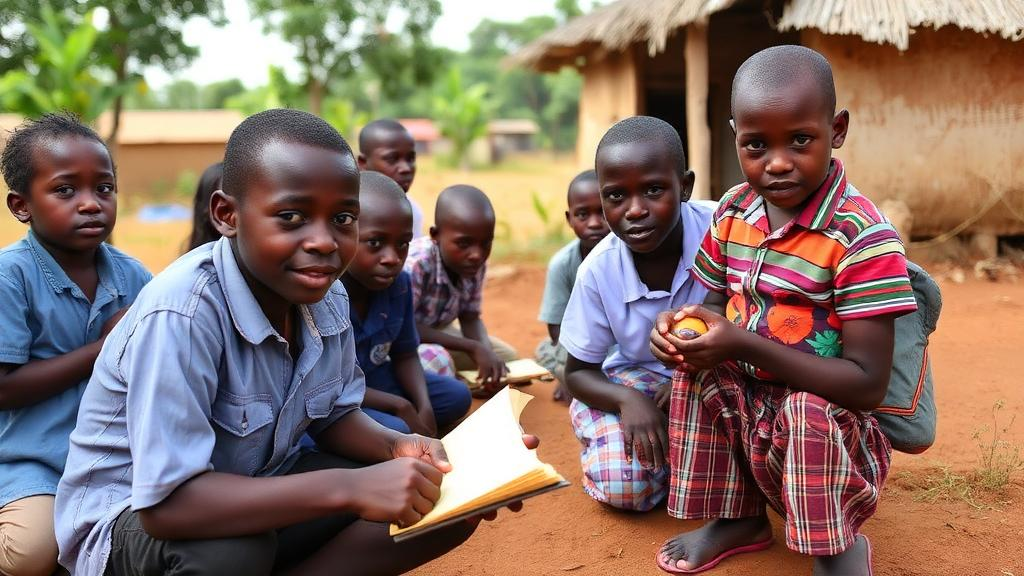
Uganda hosts one of the largest refugee populations in Africa, and for decades the country has been praised for a settlement model that gives displaced people land, freedom of movement, and access to public services. Yet a new study published in Discover Sustainability reveals a stark and troubling picture of the human capital available to refugee households across the country. Analyzing survey data from 1,868 refugee households spread across 13 settlements, researchers from Makerere University found that only 0.5 percent of refugee household heads have attained secondary education or higher. That figure, so close to zero as to be almost incomprehensible in a modern labor market, forms the backbone of a study that asks a deceptively simple question: what happens to a family’s ability to withstand economic shocks when the adults leading it have almost no formal schooling?
The research, led by John Paul Tugume together with Bernard Bashaasha and Elizabeth Ahikiriza, draws on secondary data from the Resilience Index and Measurement Analysis household survey, a joint effort of the Food and Agriculture Organization and the Uganda Bureau of Statistics conducted under the RIMA-II framework. Households were selected using a two-stage stratified random sampling design based on United Nations refugee agency registration lists, giving the sample a statistically grounded claim to represent the wider refugee population living in Uganda’s settlements. The authors constructed a Livelihood Resilience Index using Principal Component Analysis, a statistical technique that condenses many correlated indicators into a smaller set of underlying dimensions, and then validated the index through bootstrap resampling of one thousand replicates and external checks against independent measures.
Human capital, in the framing of the study, is not a single quantity but a bundle of endowments: education, health, and vocational skills. Each component, the researchers argue, contributes differently to a household’s capacity to absorb shocks, adapt to changing conditions, and recover its income and consumption levels after disruption. To capture these differences, the team estimated associations using both Ordinary Least Squares regression and quantile regression at the 10th, 25th, 50th, 75th, and 90th percentiles of the resilience distribution. This dual approach matters because average effects can hide as much as they reveal. A program or endowment that helps households already doing reasonably well may do nothing for those at the bottom, and only by tracing coefficients across the distribution can analysts see where an intervention actually bites.
The quantile results are the technical heart of the paper, and they tell three distinct stories. Health, measured as an indicator of the household head’s physical condition, shows a universal effect: its coefficient of roughly 0.016 is statistically significant across every quantile examined, from the most vulnerable tenth of households to the most resilient. In practical terms, better health among household heads is associated with higher livelihood resilience everywhere along the distribution, making it the one human capital component whose benefits are not rationed by circumstance. For the poorest and most exposed households, this finding suggests that health protection is not merely a welfare concern but a direct investment in economic resilience.
Vocational training tells a very different story. Its effects are concentrated at the upper quantiles of the resilience distribution, the 75th and 90th percentiles, with no detectable effect for households in the lower half. Skills training, in other words, appears to pay off mainly for households that already possess other advantages, such as assets, social networks, or market access, that allow them to convert training into income. For the most vulnerable households, the same training produces no measurable resilience gain. This pattern echoes a long-standing concern in development economics: interventions that require complementary endowments to work tend to bypass the people they are most intended to help, and the study’s quantile evidence gives that concern concrete statistical form in a refugee setting.
Education, the component most often treated as the foundation of human capital, could not be reliably estimated at all. With only 0.5 percent of household heads holding secondary qualifications or above, there is simply too little variation in the data for the regression models to identify an effect. The authors are careful about this limitation, but they also insist on its significance. The near-total absence of post-primary education among refugee household heads is not a statistical nuisance; it is itself the central finding, a fundamental human capital deficit that constrains what any other intervention can achieve and threatens intergenerational mobility, since children raised by parents with no schooling face compounded barriers to educational attainment of their own.
The implications of this distributional picture are considerable for humanitarian policy. Uganda’s refugee response has increasingly emphasized self-reliance, shifting from open-ended aid toward livelihoods programming that expects households to farm, trade, and earn their way to stability. But the study suggests that such programming is being asked to operate on a population whose human capital base has been almost entirely eroded. If vocational training only helps the upper quantiles, and if education is effectively absent, then the resilience of the majority of refugee households rests heavily on a single pillar: the health of the household head. That concentration of dependence is fragile, because a health shock to one adult can cascade directly into a livelihood collapse with no educational or skills buffer to soften the fall.
The methodological choices of the paper deserve attention in their own right. By constructing the Livelihood Resilience Index through Principal Component Analysis rather than ad hoc weighting, the authors let the data determine how indicators combine, and by comparing results across alternative index versions, including variants built from different indicator sets, they show that the health effect is robust to reasonable modeling decisions. The comparison of a small subsample against the full sample of 1,868 households, along with quantile regressions run on a slightly reduced estimation sample of 1,738, reflects an effort to be transparent about how sample composition shapes conclusions. For a field often criticized for averaging away the experiences of the worst-off, the explicit use of quantile regression at five points across the distribution is a model of what careful measurement can look like.
What the study cannot say is as important as what it can. Because the design is cross-sectional and relies on secondary data, the estimated associations do not establish causation; healthier household heads may be more resilient, or more resilient households may be able to protect their health, or both. The education coefficient is unidentified by construction, so no claim can be made about how schooling would translate into resilience among this population. And the data capture household heads only, leaving open questions about the education and skills of other adults in the household and about how intra-household dynamics shape resilience. These are the standard boundaries of observational survey research, and the authors acknowledge them rather than overreaching.
Even within those boundaries, the message is hard to escape. A refugee population in which fewer than one in two hundred household heads has secondary education is a population whose economic future cannot be secured by skills workshops and microenterprise schemes alone. The findings argue for rebuilding the educational base itself, both for current adults whose schooling was interrupted by displacement and for children whose prospects will determine the next generation’s resilience, while simultaneously protecting the health endowment that currently does the heavy lifting for the most vulnerable. As displacement crises multiply worldwide and protracted refugee situations become the norm rather than the exception, this Ugandan evidence offers a sobering quantitative reminder: resilience is built over decades of human capital accumulation, and no short-term program can fully substitute for the schooling that was lost along the way.
Subject of Research: Human capital and livelihood resilience among refugee households in Uganda
Article Title: Educational exclusion and livelihood resilience among refugee households in Uganda
Article References: Tugume, J. P., Bashaasha, B., & Ahikiriza, E. (2026). Educational exclusion and livelihood resilience among refugee households in Uganda. Discover Sustainability. https://doi.org/10.1007/s43621-026-04961-5
Image Credits: AI Generated
DOI: 10.1007/s43621-026-04961-5
Keywords: refugee livelihoods, human capital, education, health, vocational training, resilience, Uganda, quantile regression, RIMA-II, livelihood resilience index, displacement, development economics
Cite Scienmag News
Courtney Benton. (October 14, 2026). Education Gap Leaves Refugee Households in Uganda Struggling to Rebuild Livelihoods. Scienmag. https://scienmag.com/education-gap-leaves-refugee-households-in-uganda-struggling-to-rebuild-livelihoods/
Courtney Benton. "Education Gap Leaves Refugee Households in Uganda Struggling to Rebuild Livelihoods." Scienmag, 14 October 2026, https://scienmag.com/education-gap-leaves-refugee-households-in-uganda-struggling-to-rebuild-livelihoods/. Accessed 14 October 2026.
Courtney Benton. "Education Gap Leaves Refugee Households in Uganda Struggling to Rebuild Livelihoods." Scienmag. October 14, 2026. https://scienmag.com/education-gap-leaves-refugee-households-in-uganda-struggling-to-rebuild-livelihoods/


