


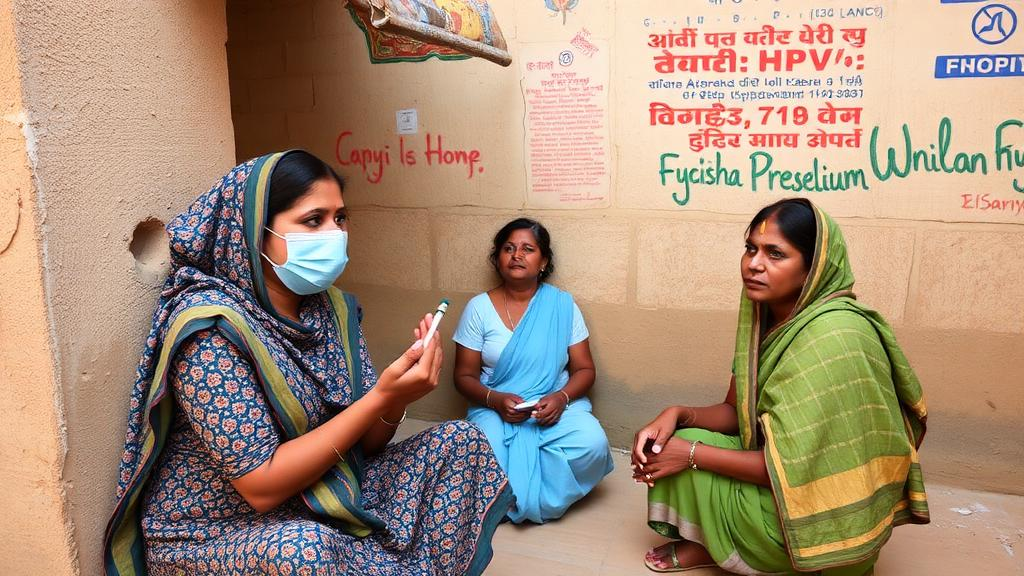
Cervical cancer remains one of the most preventable malignancies in the world, yet in India it continues to claim tens of thousands of lives each year, largely because it is detected too late. A new study published in BMC Health Services Research suggests that a deceptively simple intervention, letting women collect their own screening samples in the privacy of their homes, can dramatically lift screening coverage in communities that public health programs have struggled to reach. In an underserved urban slum in Odisha, a pilot program built around HPV-DNA self-sampling achieved a screening rate of 76 percent among eligible women, a figure that stands in stark contrast to the national picture, where fewer than 2 percent of women report ever being screened for cervical cancer.
The research, led by Susanta Kumar Swain of the Odisha Department of Health and Family Welfare together with colleagues from the Acharya Harihar Post Graduate Institute of Cancer, the Indian Council of Medical Research, and the Norway India Partnership Initiative, set out to test whether a home-based screening model could be delivered through the existing public health system rather than through parallel, donor-driven structures. The team implemented what is known as a screen–triage–treat approach in Thoria Sahi, a settlement in Cuttack, targeting women between the ages of 30 and 65. Data collected between October 2022 and September 2023 were analyzed to measure screening coverage, HPV positivity, follow-up behavior, and treatment outcomes.
The technical logic of the model rests on the biology of the disease itself. Virtually all cases of cervical cancer are caused by persistent infection with high-risk types of human papillomavirus, and detecting the virus’s DNA in cervical cells is a more sensitive screening method than conventional cytology. Crucially, self-collected vaginal samples have been shown in multiple international studies to perform nearly as well as clinician-collected specimens for HPV testing. That property makes self-sampling a powerful tool for communities where cultural norms, modesty concerns, time constraints, and distrust of pelvic examinations keep women away from clinics. In Thoria Sahi, the program leaned on Accredited Social Health Activists, or ASHAs, the frontline community health workers who form the backbone of India’s rural and urban health outreach, to mobilize eligible women and support them in collecting samples at home.
The numbers from the pilot are striking. Of 6,436 women identified as eligible, 4,896 completed screening, a coverage rate of 76 percent. Among those screened, 322 women, or 7 percent, tested positive for high-risk HPV, a prevalence consistent with expectations for a population that had never previously been screened. Each positive result triggered a referral to an Urban Primary Health Centre, where nurses trained in visual inspection with acetic acid, or VIA, performed triage. This two-step design reflects current World Health Organization guidance, which favors HPV-based primary screening followed by a same-day triage test so that women with likely precancerous lesions can be treated immediately rather than lost to follow-up.
Here the pilot encountered the challenge that has undermined many screening programs before it: the follow-up gap. Despite counselling, only 42 percent of HPV-positive women, 135 of 322, returned to a health centre for VIA triage. Of those who did, 38.5 percent were VIA-positive, indicating likely precancerous changes. Among VIA-positive women, 81 percent received thermal ablation on the spot, a low-cost outpatient procedure that uses a heated probe to destroy abnormal cervical tissue. The remainder were referred for colposcopy, biopsy, and further management in line with national guidelines. In total, the program identified and appropriately managed seven cases of precancerous lesions and one case of micro-invasive carcinoma, detections that in an unscreened population would likely have surfaced only years later as advanced, difficult-to-treat disease.
The authors are candid about what the attrition at the triage stage means. A screening program is only as strong as its weakest link, and the drop from 322 HPV-positive women to 135 who completed triage illustrates that testing alone does not guarantee protection. Community-based follow-up by ASHAs confirmed that women who did receive treatment adhered to it and remained well, which suggests the treatment pathway itself functioned smoothly once patients entered it. The bottleneck lay in getting women from a positive home test to the clinic door, a gap shaped by fear, stigma, household obligations, and the practical costs of travel and waiting time. The study’s central lesson, as the authors put it, is that referral and treatment systems must be strengthened from the outset, not retrofitted after a screening campaign has generated a backlog of positive results.
Why does this matter on a global scale? The World Health Organization has set an ambitious goal of eliminating cervical cancer as a public health problem, a target that requires 70 percent of women to be screened with a high-performance test at least twice in their lives by 2030. India, with its enormous population and historically low screening uptake, is pivotal to that effort. National Family Health Survey 5 data showing screening coverage below 2 percent underline how far the country is from the target, and conventional clinic-based approaches have repeatedly failed to close the gap. Self-sampling flips the equation by removing the most intimidating step, the pelvic examination, and by bringing the test to women rather than requiring women to come to the test.
The Odisha pilot is also notable for what it did not do: it did not build a parallel health system. The model was embedded in the public health infrastructure, using government ASHAs for mobilization and follow-up, Urban Primary Health Centres for triage, and designated treatment centres for colposcopy and surgical management. That integration matters for scalability, because vertical programs funded by short-term grants often collapse when the funding ends. By demonstrating that a screen–triage–treat cascade can run through existing public machinery, the study offers a template that state health departments could adapt, provided they invest in supply chains for HPV test kits, laboratory capacity for DNA testing, and training for frontline workers.
The technical details of the cascade deserve attention for anyone designing similar programs. HPV-DNA testing detects the genetic material of high-risk virus types, identifying women at risk before any cellular abnormality appears, which gives clinicians a longer window for intervention than cytology-based screening. VIA, the triage step used here, involves applying dilute acetic acid to the cervix and looking for acetowhite areas that suggest precancerous change; it is inexpensive, requires minimal equipment, and allows immediate see-and-treat decisions. Thermal ablation is appropriate for lesions that meet size and location criteria and is far simpler than excisional procedures, making it feasible at primary care level. The 38.5 percent VIA positivity among HPV-positive women in this pilot is within the range reported in comparable Indian studies, reflecting the fact that most HPV infections clear spontaneously and only a minority progress to lesions.
The study received no external funding and was approved by the State Research and Ethical Committee of the Odisha Department of Health and Family Welfare, with written informed consent obtained from all participants. Its findings arrive at a moment when HPV vaccination is expanding and molecular diagnostics are becoming cheaper, creating a rare window in which elimination of cervical cancer in low-resource settings looks technically achievable. The Odisha experience shows that when the test comes to the woman, coverage can soar; the unfinished work lies in ensuring that a positive result is followed swiftly by triage and treatment. If health systems can close that loop, home-based self-sampling could become one of the most consequential public health tools of the decade, turning a disease that kills quietly into one that is caught early, treated cheaply, and ultimately prevented.
Subject of Research: Home-based HPV-DNA self-sampling for cervical cancer screening in underserved urban communities in India
Article Title: Improving coverage of cervical cancer screening for hard-to-reach women: lessons learned from piloting an innovative home-based screening model in Odisha, India
Article References: Improving coverage of cervical cancer screening for hard-to-reach women: lessons learned from piloting an innovative home-based screening model in Odisha, India. (n.d.). https://doi.org/10.1186/s12913-026-15839-7
Image Credits: AI Generated
DOI: 10.1186/s12913-026-15839-7
Keywords: cervical cancer, HPV-DNA testing, self-sampling, cancer screening, Odisha, India, ASHA health workers, screen-triage-treat, thermal ablation, VIA, public health, urban slums
Cite Scienmag News
Ophelia Keating. (October 13, 2026). Home HPV Self-Testing Reaches 76% of Women in Odisha Slum Pilot. Scienmag. https://scienmag.com/home-hpv-self-testing-reaches-76-of-women-in-odisha-slum-pilot/
Ophelia Keating. "Home HPV Self-Testing Reaches 76% of Women in Odisha Slum Pilot." Scienmag, 13 October 2026, https://scienmag.com/home-hpv-self-testing-reaches-76-of-women-in-odisha-slum-pilot/. Accessed 13 October 2026.
Ophelia Keating. "Home HPV Self-Testing Reaches 76% of Women in Odisha Slum Pilot." Scienmag. October 13, 2026. https://scienmag.com/home-hpv-self-testing-reaches-76-of-women-in-odisha-slum-pilot/


