


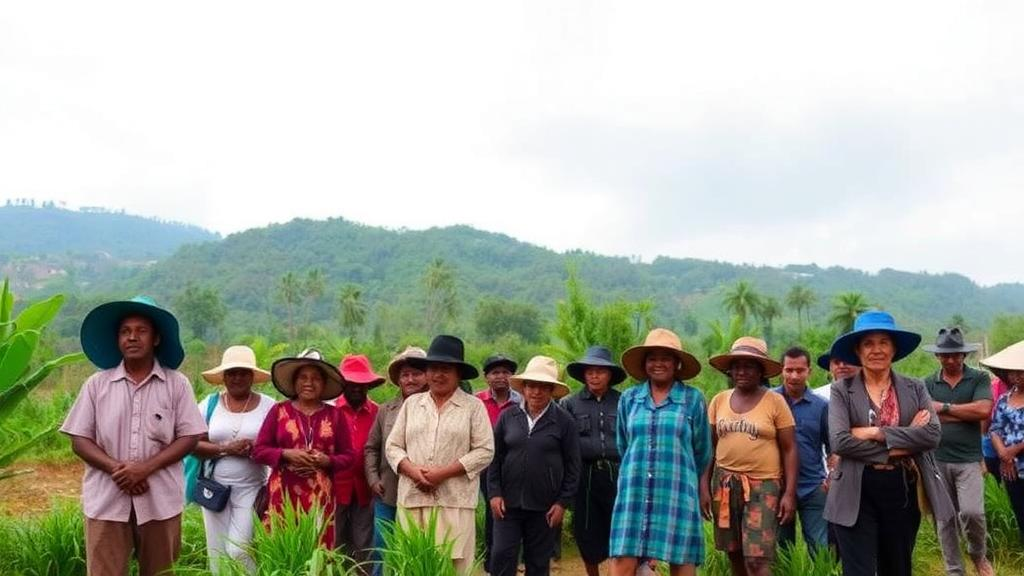
Deep in the forests and foothills of southern Colombia, far from the capital Bogotá and often beyond the effective reach of the state, rural communities have spent decades quietly building their own systems of government. A new study published in Geographica Helvetica by Andrés Felipe Lopez Galvis of the Universidad Externado de Colombia and Martine Guibert of Université Toulouse – Jean Jaurès documents how peasant organizations in conflict zones have constructed forms of bottom-up governance that function alongside, and sometimes in tension with, both the Colombian state and the armed actors contesting its authority. Drawing on 37 semi-structured interviews conducted between 2015 and 2021, together with sustained field observation, the research examines two institutional mechanisms in particular: the Community Action Committees, known locally as Juntas de Acción Comunal or JAC, and the Peasant Reserve Zones, or Zonas de Reserva Campesina, abbreviated as ZRC. Far from being passive victims of violence, the authors argue, these communities have developed what political scientist Ana Arjona calls a genuine ‘power of agency’ – a set of norms regulating local life that are recognized as legitimate, followed by the majority, and deeply anchored in the population.
The historical backdrop is essential to understanding why such institutions emerged at all. Colombia’s internal armed conflict has raged since the 1960s, pitting the national army against guerrilla groups, paramilitary forces, and a shifting cast of other combatants. According to the National Centre for Historical Memory, more than six million people were forcibly displaced from central regions by 2015, many of them resettling precariously along the ‘agricultural frontier’ – the advancing edge of colonization where forest is cleared and new land incorporated into production. These displaced settlers, or colonos, often occupied land without formal titles, sometimes on parcels granted by the state, sometimes simply on territory considered unoccupied. From the 1980s and 1990s onward, the state offered specific perimeters for settlement: resguardos for indigenous populations, collective councils for Afro-descendant communities, and Peasant Reserve Zones for farming families. Yet the application of Plan Colombia, the US-backed counter-narcotics and counter-insurgency program, and the expansion of paramilitary groups controlling commodity and illicit-crop trade pushed the mobile guerrillas back into their historical strongholds, intensifying pressure on the very communities trying to put down roots.
The study traces the genealogy of peasant mobilization to the mid-1980s, during a truce between the FARC and the government. An inquiry led by sociologists including the celebrated chronicler Alfredo Molano among colonos in the Macarena mountains and the Caguán region produced a proposal addressed to the government: grant settlers property rights on land within what would later become a national natural park, provide technical assistance, and in exchange the producers would commit to managing the forest, wildlife, and soils. This proposal prefigured the ZRC model, formally recognized by Law 160 of 1994. Protest marches in 1985 and 1987 toward departmental capitals such as San José del Guaviare, led by peasant families, coca-leaf pickers, and traders, demanded recognition of populations who had occupied their lands for some thirty years since the period of La Violencia. When structural adjustment policies swept through Latin America in the mid-1990s, liberalizing markets and withdrawing the state, the Ministry of Agriculture estimated that at least one million peasants suffered income losses by 1994 – a grievance that fueled renewed mobilization and the demand for reserve zones where families could cultivate land.
The trajectory was brutally interrupted. The Patriotic Union political party, created after the 1984 accord between the FARC, the colonos, and the government in the department of Meta, saw thousands of its members – elected officials, mayors, and two presidential candidates in 1989 – assassinated by paramilitary groups between 1985 and 1990. The collapse of the El Caguán peace process in 2002 and the post-September 11 international context produced Plan Colombia, which strengthened paramilitaries defending large landholdings. Their scorched-earth policy included massacres such as Mapiripán in the department of Meta in 1997, a municipality that had hosted meetings about a pilot Peasant Reserve Zone project and had drawn virulent opposition from large landowners practicing extensive cattle ranching. In this crucible of violence, the researchers show, armed actors themselves became governance providers: guerrillas with deep local roots, particularly the FARC, played mediation roles and could constitute what geographer Robert McColl termed an ‘insurgent state,’ establishing territorial control through refuge spaces and population protection while simultaneously demonstrating the government’s inefficacy.
Against this turbulent canvas, the JAC represent the oldest thread of local self-organization. Created by Law 19 of 1958 as part of a public administration reorganization, they began as urban neighborhood associations and were adapted in rural areas by displaced colonos as forms of intermediation with the state. The first JAC along the Caguán River in Caquetá date to 1972, before the FARC even established themselves there; by 1975, two already held legal personhood and functioned regularly. Theoretically apolitical, these committees of neighbors can receive delegated functions of control, oversight, and management of public services from municipal councils, departmental assemblies, or the national government. In rural areas they rest on the veredas – subdivisions of rural municipalities – and on shared identity and belonging. A former national director of the JAC system claimed the committees contributed to building 30 percent of the nation’s infrastructure: rural roads, community halls, chapels, schools, and markets. During the Caguán negotiations, the JAC even served as mediation spaces between guerrillas and government delegates, and in zones of guerrilla or even paramilitary influence they often became the sole representation of civilian power.
The ZRC, by contrast, are a land-access instrument born of agrarian struggle. Defined by Law 160 of 1994 as geographic zones selected by the general council of the Colombian Institute for Agrarian Reform according to agro-ecological and socioeconomic characteristics, they were regulated nationally by Decree 1777 of 1996, which allowed their creation in all regions rather than only in colonization zones. The first six ZRC emerged from a pilot plan co-financed by the World Bank from 1997. The study focuses on two contrasting cases in the Andean axis: the Pato-Balsillas ZRC in Caquetá, officially recognized in 1997, and the North Cauca ZRC, whose recognition by the National Land Agency remained pending as of 2024 despite years of requests. Pato-Balsillas, a transition zone between Andean and Amazonian systems on the eastern flank of the Eastern Cordillera, experienced four waves of colonization identified by researcher J. González – from quinine and rubber extraction through 1920, early colonization to 1950, ‘colonization by violence’ between 1950 and 1965, and finally flight following army bombardments, after which families returned in a homecoming commemorated annually since 1984 with a festival of ‘the return.’
Today the Pato-Balsillas ZRC spans roughly 74,000 hectares with about 6,250 inhabitants, organized into three towns and 26 vereda committees. It is managed by the Municipal Association of Colonos of the Pato River, AMCOP, whose board includes representatives of every vereda junta and of colonos’ cooperatives producing bananas, milk, and coffee. A social fund, fed by one percent of each agricultural sale by member producers, reallocates resources to members in need. Specialized committees handle conflict resolution, women’s affairs, and youth. The association’s regulatory reach is tangible: residents described to interviewers how suspected thieves are detained, the police called, and outsiders who commit serious offenses collectively expelled after news is spread across every vereda so that no one gives them work. AMCOP also links the community into wider networks – the UNIOS union of social, agrarian, environmental, human rights, peasant, and indigenous organizations, and the departmental coordination COORDOSAC in Caquetá. Crucially, AMCOP protects a buffer zone between the ZRC perimeter and Los Picachos National Natural Park, an arrangement the regional environmental authority CORPOAMAZONIA formally recognizes, following a 1997 agreement that redefined park boundaries and relocated some of the roughly 200 colonist families living inside the park through a mini land-reform program distributing parcels from a large estate.
The North Cauca case shows a different pathway: governance functioning without official recognition. In the fertile Cauca River valley, where sugar-cane expansion from the 1940s concentrated land in large estates and indigenous movements led by Manuel Quintín Lame had long reclaimed ancestral territories, three associations – ASTRACAL, ASTRAZONAC, and ASPROZONAC – carry the ZRC project forward with elected boards registered at the chamber of commerce. Connected to the national agricultural federation FENSUAGRO through the PUPSOC popular unity process, they coordinate recognition of long-established settlers, form ‘peasant territories’ even where families lack titles, and negotiate land acquisition for new arrivals. After the 2013 national agrarian strike, which blocked the Pan-American Highway in Cauca for three months, PUPSOC and the CIMA organization established a permanent dialogue roundtable with the government, strengthening their recognition and securing progress in parcel allocation. Land occupation itself, shared as a strategy by indigenous, Afro-descendant, and peasant organizations alike, remains a lever of spatial appropriation confined largely to the cordillera slopes, with almost no access to valley floor land.
Perhaps the most striking finding concerns environmental governance. The Pato-Balsillas communities maintain a manual of coexistence whose ecological rules are explicit: each junta names an ecological committee to safeguard forest, streams, fauna, and flora; commercial hunting is absolutely prohibited; felling trees or primary and secondary forest older than eight years is banned; violations incur up to fifty days of communal labor or reforestation of the affected zone. The result, documented with reference to FAO and National Land Agency data, is a deforestation rate below one percent within and around the ZRC – a remarkable figure given that its jurisdiction, San Vicente del Caguán, ranked for years among the country’s deforestation hotspots. A parallel experiment in the Cimitarra River valley, the ‘yellow line,’ has marked trees since 1983 to delimit some 70,000 hectares of biodiverse, water-rich territory, later ratified by the peasant association, backed by technical soil studies, and ultimately rewarded with a forest reserve designation and a mining moratorium. The authors conclude that these deep spatial knowledges – of paths, rain cycles, flora, and fauna – combined with learned appropriation of state instruments, give rural organizations local legitimacy and real intermediation power. In a country where the 2016 peace agreement has not ended confrontation with holdout armed groups, they argue, the future of rural territories depends on better interaction between these bottom-up practices and national decision-making – a reconfiguration of the state that, remarkably, is being built from below.
Subject of Research: Bottom-up local governance and collective action by peasant communities in Colombia's armed conflict
Article Title: Action collective et formes locales de gouvernance en contexte de conflit armé en Colombie
Article References: Lopez Galvis, A. F., & Guibert, M. (2026). Action collective et formes locales de gouvernance en contexte de conflit armé en Colombie. Geographica Helvetica, 81(4), 589-601. https://doi.org/10.5194/gh-81-589-2026
Image Credits: AI Generated
Keywords: Colombia, armed conflict, peasant governance, Community Action Committees, Peasant Reserve Zones, land reform, FARC, collective action, rural development, deforestation, bottom-up governance, displacement
Cite Scienmag News
Courtney Benton. (October 13, 2026). How Colombian Peasant Communities Built Their Own Governance Amid Decades of Armed Conflict. Scienmag. https://scienmag.com/how-colombian-peasant-communities-built-their-own-governance-amid-decades-of-armed-conflict/
Courtney Benton. "How Colombian Peasant Communities Built Their Own Governance Amid Decades of Armed Conflict." Scienmag, 13 October 2026, https://scienmag.com/how-colombian-peasant-communities-built-their-own-governance-amid-decades-of-armed-conflict/. Accessed 13 October 2026.
Courtney Benton. "How Colombian Peasant Communities Built Their Own Governance Amid Decades of Armed Conflict." Scienmag. October 13, 2026. https://scienmag.com/how-colombian-peasant-communities-built-their-own-governance-amid-decades-of-armed-conflict/


