


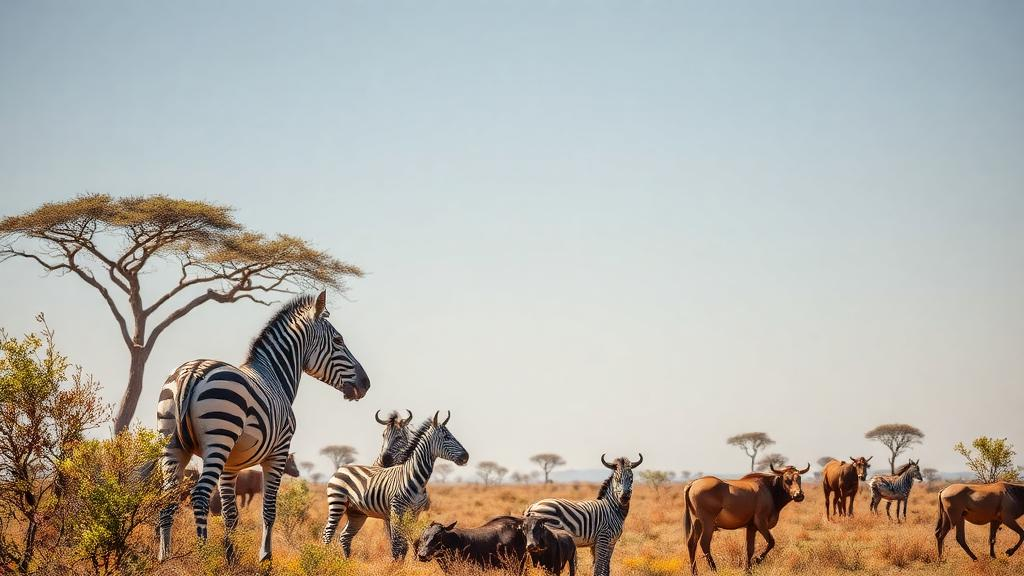
In the grassy plains of Nech Sar National Park in southern Ethiopia, a quiet transformation is underway. Woody shrubs are steadily replacing open grassland, and a decade-long study has now untangled, with unusual precision, the roles that different grazing animals play in this shift. The research, published in Environmental Monitoring and Assessment, surveyed woody plant density across 103 plots along five transects in 2012 and again in 2022, offering a rare ten-year window into the dynamics of woody encroachment inside a protected East African savanna.
Woody encroachment, the densification and spread of trees and shrubs into grass-dominated ecosystems, is one of the most consequential land-cover changes on the African continent. It alters fire regimes, reduces grass production for both wildlife and livestock, changes water budgets through modified evapotranspiration, and can diminish biodiversity by homogenizing open habitats. For protected areas like Nech Sar, which harbor endangered species such as Swayne’s hartebeest, the conversion of open plains into thicket is not merely an aesthetic concern but a direct threat to the ecological integrity the parks were created to defend.
The new study, conducted by Desalegn Wana of Addis Ababa University, set out to test a central hypothesis in savanna ecology: that heavy ungulate grazing promotes woody encroachment. The logic is intuitive. Grazers such as zebra and cattle consume the grasses that would otherwise compete with tree seedlings for water, light, and space. They also reduce the fuel loads that carry the savanna fires which historically kill or suppress young woody plants. Remove or weaken the grass layer, the theory goes, and shrubs gain a foothold from which they rapidly expand. Yet the empirical picture across African savannas has been inconsistent, with some studies finding strong grazing effects and others finding little or even the opposite, prompting ecologists to call for finer-grained analyses that separate the effects of individual herbivore species and their interactions.
Wana’s approach combined field surveys with generalized linear mixed models, a statistical framework well suited to ecological count data with hierarchical structure. The models related woody density to ungulate densities and to the presence of cattle corrals, traditional enclosures where livestock are penned overnight, while accounting for the spatial arrangement of transects. Cattle corrals are a distinctive feature of this system. Domestic herds are moved into the park’s grasslands by surrounding communities, and the corrals concentrate trampling, defecation, and urination in small patches that become nutrient hotspots, famously producing glades of nutrient-rich grass but also, according to the new findings, hotspots of woody establishment.
The headline result is striking. Woody density increased with the presence of cattle corrals, confirming the role of livestock infrastructure in reshaping vegetation. But wild herbivores showed contrasting, species-specific effects. Zebra, the dominant wild grazer on the plains, reduced woody density, consistent with the idea that intense grass consumption by zebras somehow suppresses shrub establishment, perhaps through trampling of seedlings or maintenance of the grass sward in ways that favor competition against woody recruits. Yet this suppressive effect was reversed when cattle activity was present. In 2022, the interaction between corrals and zebra was positive and statistically significant, with a coefficient of 0.10 and a p-value below 0.05. In practical terms, where zebras and corrals co-occurred at high densities, woody density climbed from roughly 600 woody individuals per hectare to more than 2,500 per hectare, a fourfold increase that illustrates how non-linear and context-dependent these ecological interactions can be.
Species-level analyses sharpened the picture further. The invasive shrub Dichrostachys cinerea, a thorny legume notorious across East African rangelands for forming impenetrable stands, was negatively related to zebra presence in both survey years, suggesting the shrub fares better where zebra grazing pressure is low. In contrast, Senegalia mellifera, another aggressive encroacher, increased with zebra and with the zebra-by-corral interaction in 2012, indicating that different woody species respond in opposite directions to the same herbivores. By 2022, the greater kudu, a mixed feeder that browses woody plants, and its interaction with livestock were both negatively related to woody density, with coefficients of negative 1.73 and negative 0.98 respectively and p-values below 0.05. This pattern hints at a role for browsing: kudu, by consuming shoots and seedlings of woody plants, may exert top-down control on encroachment, but that control weakens where livestock activity dominates.
The synthesis that emerges is one of mediated and contingent effects rather than simple causation. Livestock exerted their strongest effects near corrals, where their impact is physically concentrated. Wild ungulate impacts, meanwhile, were filtered through livestock activity: zebra suppression of shrubs flipped into facilitation where cattle were present, and kudu browsing mattered most where livestock were not overwhelming the system. This mutual modification of one herbivore’s effect by another is a refinement of the traditional overgrazing narrative. It is not simply that more animals mean more shrubs; it is which animals, where, and in what combination that determines the trajectory of the vegetation.
Crucially, the study concludes that grazing alone cannot fully explain the encroachment observed at Nech Sar. The author points to the combined effects of bioclimatic factors, low browsing pressure, and reduced fire, alongside grazing, as the likely drivers of the transformation. This multi-causal framing aligns with a broad body of savanna theory in which tree cover is regulated jointly by resources such as water and nutrients, by disturbances such as fire and herbivory, and by the demographic legacies of past land use. Fire suppression, whether through deliberate policy or through the removal of grass fuel by grazers, relaxes a key constraint on woody recruitment. Declines in browsing megafauna, whether through historic extinction or contemporary population reductions, remove another. Rising atmospheric carbon dioxide may further tip the competitive balance toward woody plants, which invest heavily in deep roots and woody tissue. In that light, Nech Sar’s shrub invasion looks less like a single-cause pathology and more like the expected outcome of several dampened checks acting in concert.
The implications for conservation management are sobering but also informative. If zebra grazing alone suppresses some encroachers while the zebra effect reverses near cattle corrals, then managing the spatial footprint of livestock within and around the park becomes a tangible lever. Corral placement, the duration of livestock presence, and the restoration of browsing pressure could all shape the trajectory of woody cover. The negative relationship between kudu and woody density in 2022 suggests that supporting viable browsing ungulate populations may help counteract shrub expansion, although the study’s correlational design cannot prove causation. Similarly, the finding that Dichrostachys cinerea responds negatively to zebra raises the possibility that maintaining healthy wild grazer populations, rather than excluding them, is part of the solution to encroachment, a counterintuitive conclusion for managers accustomed to treating all grazing as a threat.
The research also carries a methodological lesson. By repeating surveys across a decade and modeling herbivore effects at the level of individual species and their interactions, the study reveals dynamics that a single snapshot or a generic grazer category would have obscured. The fourfold increase in woody density at high corral and zebra densities, the flipping of the zebra effect, and the species-specific responses of Dichrostachys cinerea and Senegalia mellifera together demonstrate that savanna responses to herbivory are emergent properties of interacting actors, not simple dose-response curves. As woody encroachment accelerates across sub-Saharan Africa, threatening rangeland livelihoods, carbon storage patterns, and the open habitats on which iconic wildlife depend, studies like this one from Nech Sar provide the fine-grained evidence base that effective management demands. The shrubs are advancing, but the study makes clear that the levers which determine how fast they advance, from corral placement to the fate of zebra and kudu herds, remain at least partly within human hands.
Subject of Research: The effects of wild and domestic ungulate grazing on woody plant encroachment in the savanna of Nech Sar National Park, Ethiopia
Article Title: Impacts of herbivore grazing on woody encroachments in the savanna of an East African protected area
Article References: Wana, D. (2026). Impacts of herbivore grazing on woody encroachments in the savanna of an East African protected area. Environmental Monitoring and Assessment, 198(11), Article 1186. https://doi.org/10.1007/s10661-026-16022-5
Image Credits: AI Generated
DOI: 10.1007/s10661-026-16022-5
Keywords: woody encroachment, savanna ecology, Nech Sar National Park, zebra grazing, livestock corrals, Dichrostachys cinerea, Senegalia mellifera, browsing, fire suppression, Ethiopia, herbivory, protected areas
Cite Scienmag News
William Thompson. (October 13, 2026). Zebra, Cattle and the Shrubs Taking Over an Ethiopian Savanna. Scienmag. https://scienmag.com/zebra-cattle-and-the-shrubs-taking-over-an-ethiopian-savanna/
William Thompson. "Zebra, Cattle and the Shrubs Taking Over an Ethiopian Savanna." Scienmag, 13 October 2026, https://scienmag.com/zebra-cattle-and-the-shrubs-taking-over-an-ethiopian-savanna/. Accessed 13 October 2026.
William Thompson. "Zebra, Cattle and the Shrubs Taking Over an Ethiopian Savanna." Scienmag. October 13, 2026. https://scienmag.com/zebra-cattle-and-the-shrubs-taking-over-an-ethiopian-savanna/


