


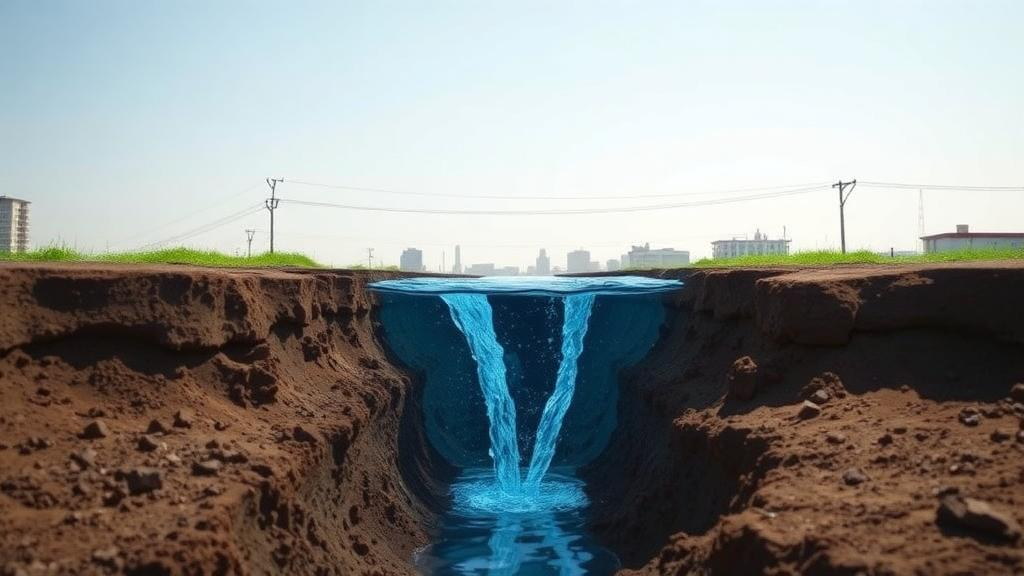
Beneath the bustling streets of Jinan, a city of millions in northern China’s Shandong Province, a slow-motion crisis has been unfolding for decades. A new study published in Environmental Earth Sciences has, for the first time, built the hidden mechanics of that crisis into a working simulation of the entire city, revealing a stark warning: if current trends continue, available water resources in Jinan will fall by 40 percent by 2031, land subsidence will accelerate by 25 percent, and the city’s overall resource-environment carrying capacity will drop by 28 percent. More striking still, the researchers identified a precise tipping point in groundwater stress beyond which degradation of the urban system accelerates rapidly and, in places, irreversibly. The work, led by Linze Le of Nanjing University together with colleagues at the China Institute of Geo-Environment Monitoring, offers one of the most detailed portraits yet of how the ground beneath a city can quietly dictate the limits of growth above it.
The concept at the heart of the study is resource-environment carrying capacity, often abbreviated RECC, a measure of how much population, economic activity, and land development a region’s water, land, ecosystems, and geology can sustain without slipping into degradation. Traditional assessments of carrying capacity have typically relied on static snapshots: researchers weigh a basket of indicators at a given moment, classify the result as safe or overloaded, and move on. The team behind the new research argues that this approach misses something essential. Real urban systems behave less like a snapshot and more like a machine of interlocking gears, where population growth drives water demand, water demand drives groundwater extraction, extraction drives subsidence, and subsidence in turn eats away at the usable land and infrastructure that development depends on. Ignoring those feedback loops, they contend, means missing the moments when gradual pressure tips into rapid collapse.
To capture those dynamics, the researchers constructed a city-scale system dynamics model, a computational framework that traces how stocks and flows of material and population evolve year by year under reinforcing and balancing feedbacks. Their model links six interacting subsystems: population and economy, land, water resources, ecology, environment, and, unusually, the geological environment itself. In total, the system draws on more than 180 indicators, from 41 variables describing the water balance to 57 tracking ecological condition and 28 characterizing geological stability. Critically, rather than treating groundwater depletion and land subsidence as fixed background constraints, the team made them endogenous, meaning the model itself computes how groundwater levels and ground deformation evolve in response to the city’s own water consumption, and how those changes then feed back into development capacity. A geological feedback factor accumulates the effects of groundwater decline, cumulative subsidence, and geological hazard intensity over time, with a decay parameter controlling how much of past stress persists in the system.
Jinan proved an ideal proving ground for this framework. The city sits at the transition between the North China Plain and the Taihang-Yimeng Mountains, where thick Quaternary sediments overlie carbonate bedrock in a coupled porous-karst aquifer system that is both highly productive and highly vulnerable. Per capita water resources in Jinan fall far below the national average, making groundwater a pillar of urban supply. Decades of intensive pumping drove water tables down and triggered localized land subsidence before the South-to-North Water Diversion Project and strict groundwater management brought levels partially back. Yet, as the study emphasizes, geology remembers. Aquifer compaction and delayed subsurface responses continue to shape what the land above can bear, even as water levels recover, a hysteresis that static assessments systematically overlook.
The model’s reliability was tested against historical observations using two standard performance metrics, the coefficient of determination and the Nash-Sutcliffe efficiency. Both ranged from 0.87 to 0.97 across subsystems, well above the accepted thresholds of 0.6 and 0.5 respectively, indicating that the simulation reproduces the city’s recent history with high fidelity. Population, land, and economic indicators showed the tightest fits, while the geological subsystem carried somewhat more uncertainty, a reflection of the inherent complexity of tracking aquifer dynamics and deformation across a heterogeneous karst-porous system. A sensitivity analysis using one thousand Monte Carlo perturbations of the indicator weights confirmed that the model’s conclusions rest on the structure of the system rather than on any particular weighting choice, with warning classifications agreeing across more than 90 percent of perturbed runs and state-transition timing shifting by less than 0.6 years.
Running the model forward under a business-as-usual trajectory produced sobering results. Water use exceedance climbs from 0.70 to 1.05, meaning demand increasingly outstrips sustainable supply, while total available water falls from 4.0 billion to 2.4 billion cubic meters. The water pollution index nearly doubles, from 90 to 170. The groundwater recovery index deteriorates to minus 0.35, and land subsidence accelerates from 10.0 to 12.5 millimeters per year. Most telling is the shifting balance of constraints: water resources’ share of total carrying-capacity limitation grows from 31 percent to 41 percent, while the geological contribution rises from 15 percent to 30 percent. By 2031, water and geological constraints together account for 71 percent of all limitations on the city, a decisive shift from growth-limited to resource-and-geology-limited development.
The most consequential finding is the tipping point. As groundwater stress climbs, the response of carrying capacity is not linear. At a groundwater stress level of approximately 1.15, corresponding to a groundwater recovery index of minus 0.15, the fitted response curve bends sharply, and the rate of RECC decline accelerates dramatically. This is the signature of a threshold-triggered transition, the kind of nonlinear behavior that resilience theorists have documented in lakes, forests, and fisheries, now quantified for an urban water-geology system. The practical implication is profound: monitoring average resource availability alone can lull planners into complacency, because the system may appear stable right up until the slow variable crosses its threshold and rapid degradation begins. Groundwater conditions, the authors argue, should serve as leading indicators of systemic instability rather than as lagging bookkeeping entries.
Against that bleak baseline, the team tested a resource-optimization scenario built on realistic, historically achievable adjustments: moderated population growth, reduced per-capita domestic water quotas, tighter industrial and agricultural water intensity, and lower wastewater discharge coefficients. The results are striking. Available water resources increase by 56 percent relative to business-as-usual, water pollution drops by 64 percent, land subsidence falls by 31 percent, and the groundwater recovery index improves to a positive 0.45. High-level warnings are delayed by two to three years, buying precious time for adaptation, and most subsystems remain within low-to-moderate risk ranges through 2031. The economic cost is modest: per-capita GDP reaches about 92 percent of the business-as-usual level, roughly 230,000 versus 250,000 yuan. The optimization scenario also fundamentally restructures the city’s constraint hierarchy, shifting dominant limitations away from water and geology toward ecological and land-use regulation, a healthier configuration in which pressures are diffuse rather than concentrated on a single depleting slow variable.
The broader significance of the study extends well beyond Jinan. Groundwater-dependent regions worldwide, from the North China Plain to California’s Central Valley and northwestern India, face the same dynamic: persistent extraction causes subsidence, ecosystem degradation, and durable limits on development, while recovery policies can ease but never fully erase the geological legacy of past depletion. By embedding groundwater-geology feedbacks directly into carrying-capacity assessment and pairing them with threshold-based early-warning monitoring, the framework offers cities a way to detect emerging instability before it becomes visible in conventional indicators. The authors acknowledge limitations, including reliance on historical parameters, the absence of explicit spatial heterogeneity, and the challenge of uncertain future climate and socioeconomic trajectories, and they point toward coupling with agent-based and land-use models as the next step. But the central message stands: in water-scarce cities, the deepest constraints on the future may lie underground, and the surest way to avoid a tipping point is to watch the water table not as a symptom, but as the city’s most honest early-warning signal.
Subject of Research: Dynamic simulation and early warning of urban resource-environment carrying capacity under groundwater-geological feedbacks in Jinan, China
Article Title: Geologically constrained dynamic evolution and early warning of urban resource-environment carrying capacity: a case study of Jinan, China
Article References: Geologically constrained dynamic evolution and early warning of urban resource-environment carrying capacity: a case study of Jinan, China. (n.d.). https://doi.org/10.1007/s12665-026-13148-0
Image Credits: AI Generated
DOI: 10.1007/s12665-026-13148-0
Keywords: groundwater depletion, land subsidence, carrying capacity, system dynamics, early warning, Jinan, water scarcity, tipping point, urban sustainability, North China Plain, aquifer recovery, scenario analysis
Cite Scienmag News
Sloane Callahan. (October 12, 2026). Underground Warning: Groundwater Tipping Point Threatens City Water Future. Scienmag. https://scienmag.com/underground-warning-groundwater-tipping-point-threatens-city-water-future/
Sloane Callahan. "Underground Warning: Groundwater Tipping Point Threatens City Water Future." Scienmag, 12 October 2026, https://scienmag.com/underground-warning-groundwater-tipping-point-threatens-city-water-future/. Accessed 12 October 2026.
Sloane Callahan. "Underground Warning: Groundwater Tipping Point Threatens City Water Future." Scienmag. October 12, 2026. https://scienmag.com/underground-warning-groundwater-tipping-point-threatens-city-water-future/


