


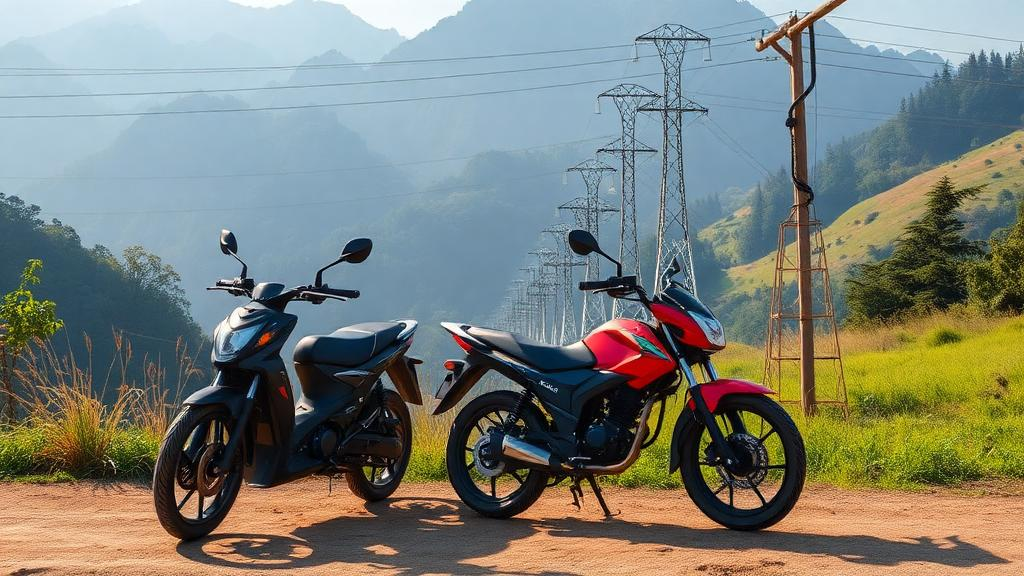
In the remote mountains of northern Laos, where long power lines snake through some of the most challenging terrain in Southeast Asia, a modest fleet of electric two-wheelers may hold the key to steadying a struggling electricity network. New research published in the journal Results in Engineering has used detailed power-system simulations to ask a deceptively simple question: if a few hundred electric scooters parked near the end of a weak distribution feeder discharged their batteries back into the grid during times of stress, how much would that help? The answer, according to the study, is a measurable but carefully bounded improvement, one that offers a template for how small electric vehicles could become distributed power plants in places where conventional grid upgrades are slow, expensive, or geographically impractical.
The setting is Phongsaly Province, a rugged region where Laos has built its reputation as the so-called Battery of Southeast Asia on the strength of its abundant hydropower. National installed generation capacity nearly doubled between 2015 and 2023, rising from 6,273 megawatts to 12,757 megawatts. Yet that headline growth conceals a persistent problem at the provincial level. Long radial feeders in mountainous terrain accumulate significant electrical impedance over distance, so customers at the far ends of the network experience chronic voltage sags, frequent outages, and little redundancy when something goes wrong. The evening peak, between 18:00 and 22:00, when households switch on cooking appliances, lighting, and entertainment, places acute stress on infrastructure that has little margin to spare.
The reliability statistics for the study area are striking. Muang Khua Substation Feeder 6, one of the feeders examined in the research, recorded an average of 151.33 interruptions per customer per year between 2021 and 2023, according to records from Electricité du Laos North. The average total interruption duration reached 1,145.67 minutes per customer per year, with an average restoration time of 7.57 minutes per interruption. Weather-related and environmental factors appear among the reported causes of outages, reflecting the network’s exposure to mountain conditions. These figures describe a system operating under sustained pressure, where even modest additional demand at the wrong moment can push marginal buses toward unacceptable voltage levels.
The research team, led by Chan Thavysak with colleagues Panlop Sintuya and Worajit Setthapun, built an aggregated equivalent model of the Bounneua–Muang Khua 22 kilovolt distribution network in PowerWorld Simulator, a widely used professional power-system analysis package. Their approach deliberately constrained the vehicle-to-grid scenario in an unusual and scientifically rigorous way. Rather than assuming the bidirectional inverters on electric vehicles could supply both active and reactive power, the researchers modeled active-power-only injection, fixing reactive power at zero because the reactive capability of their experimental inverter had not been validated over the modeled operating range. This conservative choice isolates the pure effect of local real-power injection on feeder voltage, a contribution that is often entangled with reactive-power support in less careful analyses.
The fleet scenario was grounded in local data. The studied feeder serves 5,225 electricity customers, and a 15 percent participation rate yields 783.75 potential participants, rounded to 784 electric two-wheelers. Each vehicle was assigned a rated alternating-current discharge output of 1.5 kilowatts, giving an aggregated injection of 1.176 megawatts delivered directly into the network model. The team was careful to note that this figure represents power on the grid side of the inverter; battery-side energy consumption would be higher once conversion losses are accounted for. Laboratory measurements at the adiCET research facility in Thailand, conducted under vehicle-to-home conditions, showed inverter efficiencies rising from 64.83 percent at low loads to 93.87 percent at high loads, with a peak of 97.47 percent, though the researchers emphasized that these measurements did not extend to the full 1.5 kilowatt operating point assumed in the simulation.
The central result comes from P-V continuation analysis, a technique that progressively ramps load on the network while tracking how bus voltages decline, revealing how much additional stress a feeder can absorb before reaching a critical threshold. Using 0.95 per-unit voltage as the operational comparison threshold, the base case without vehicle-to-grid support reached that limit at a nominal continuation shift of 16.184 megawatts. With the 1.176 megawatt vehicle fleet injecting power at the terminal bus, the same threshold was not reached until 17.157 megawatts, an increase of 0.973 megawatts, or roughly 6.01 percent in relative terms. At the initial operating point, the terminal bus voltage rose from approximately 0.9899 to 0.9922 per unit, a modest but meaningful gain achieved entirely without reactive-power compensation or direct voltage regulation.
Recognizing that assuming every participating scooter is plugged in and fully charged simultaneously is an optimistic upper bound, the researchers ran additional sensitivity cases at 25, 50, 75, and 100 percent fleet availability, corresponding to 196, 392, 588, and 784 available vehicles. The continuation-margin gains scaled almost linearly with available power: 1.50 percent at 25 percent availability, 3.05 percent at 50 percent, 4.52 percent at 75 percent, and the full 6.01 percent at complete availability. This monotonic relationship demonstrates that the voltage-support benefit is approximately proportional to the aggregated active-power injection, giving grid planners a transparent rule of thumb for estimating what partial participation might achieve. It also underscores that the headline figure depends on a synchronized, fully available fleet, an assumption that real-world mobility patterns, battery states of charge, and user behavior would erode.
The study is notable as much for what it declines to claim as for what it demonstrates. The authors explicitly state that the 6.01 percent margin improvement is a comparative sensitivity metric under a specified ramping procedure, not a 6 percent increase in physical feeder capacity or a validated voltage-collapse improvement. They also decline to convert historical outage statistics into projected reliability gains, noting that the available records cannot establish which interruptions would have been prevented by voltage support. The simulation itself is a balanced, steady-state, positive-sequence assessment that does not capture phase unbalance, harmonics, transients, communication delays, or protection behavior. The laboratory inverter tests were performed under vehicle-to-home conditions at power levels well below the modeled 1.5 kilowatt per-vehicle output, so they serve as supporting context rather than validation of grid-connected operation.
These caveats point toward a clear research trajectory. The authors identify several priorities for future work: experimentally mapping the full active-reactive power capability of bidirectional inverters, calibrating the feeder model section by section with field measurements, incorporating stochastic models of vehicle availability and battery state of charge, extending the analysis to unbalanced three-phase operation, and eventually conducting hardware-in-the-loop testing and a controlled grid-connected pilot. A practical deployment would also need to satisfy interconnection requirements such as anti-islanding protection, fault response, and communication performance. The fixed-injection scenario modeled here represents what the fleet could contribute if fully dispatched, whereas a real controller would activate discharge only when measured voltage actually fell below the operational threshold, a distinction the study handles with unusual transparency.
For Laos and other countries with long, weak rural feeders, the significance of this work lies in its reproducible framework rather than any single number. It shows that small electric two-wheelers, vehicles far more common than passenger cars across much of Asia, can be quantified as distributed grid-support resources using standard power-system tools, and that even active-power-only operation yields a measurable steady-state benefit at a voltage-sensitive terminal bus. As electric two-wheeler adoption accelerates across Southeast Asia, fleets that today are seen purely as transport could double as a decentralized buffer against voltage stress, buying time for utilities that cannot afford immediate network reinforcement. The Phongsaly analysis suggests that the value of that buffer, while moderate, is real, predictable, and ready to be tested in the field.
Subject of Research: Vehicle-to-grid voltage support assessment for a weak mountainous distribution feeder in Laos
Article Title: PowerWorld-Based Assessment of Active-Power-Only Vehicle-to-Grid Voltage Support for a Weak 22 kV Mountainous Feeder in Phongsaly, Laos
Article References: Thavysak, C., Sintuya, P., & Setthapun, W. (2026). PowerWorld-Based Assessment of Active-Power-Only Vehicle-to-Grid Voltage Support for a Weak 22 kV Mountainous Feeder in Phongsaly, Laos. Results in Engineering, 32, Article 113381. https://doi.org/10.1016/j.rineng.2026.113381
Image Credits: AI Generated
DOI: 10.1016/j.rineng.2026.113381
Keywords: vehicle-to-grid, electric two-wheelers, voltage stability, distribution network, PowerWorld Simulator, P-V continuation analysis, Laos, Phongsaly, rural electrification, bidirectional inverter, grid reliability, distributed energy resources
Cite Scienmag News
Faith Mcneil. (October 12, 2026). Electric Motorbikes Could Prop Up a Fragile Mountain Grid in Laos. Scienmag. https://scienmag.com/electric-motorbikes-could-prop-up-a-fragile-mountain-grid-in-laos/
Faith Mcneil. "Electric Motorbikes Could Prop Up a Fragile Mountain Grid in Laos." Scienmag, 12 October 2026, https://scienmag.com/electric-motorbikes-could-prop-up-a-fragile-mountain-grid-in-laos/. Accessed 12 October 2026.
Faith Mcneil. "Electric Motorbikes Could Prop Up a Fragile Mountain Grid in Laos." Scienmag. October 12, 2026. https://scienmag.com/electric-motorbikes-could-prop-up-a-fragile-mountain-grid-in-laos/


