


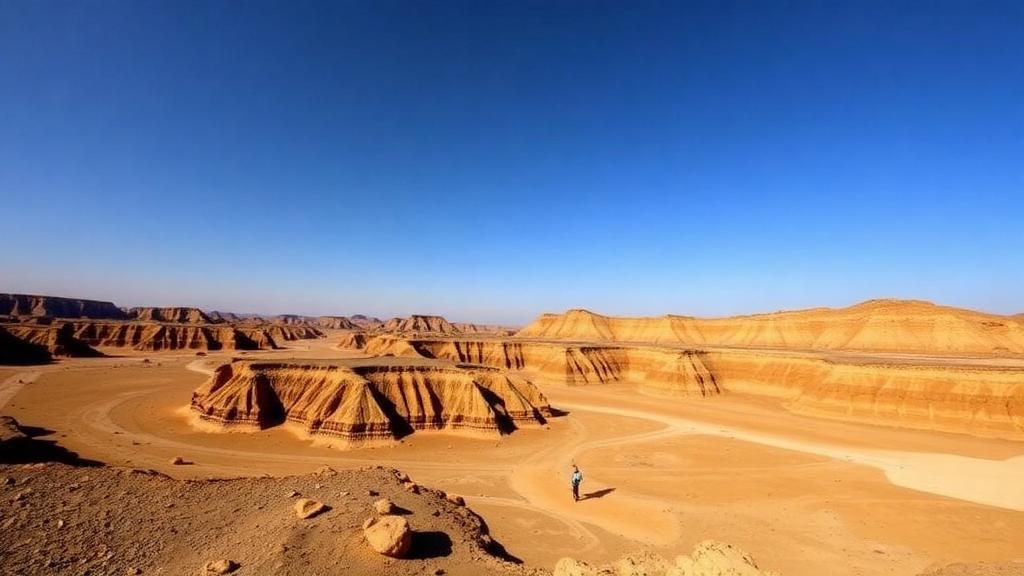
Along a narrow stretch of Eritrea’s Red Sea coast, where the African continent is literally tearing itself apart, scientists have mapped out one of the world’s most extraordinary concentrations of geological and archaeological heritage. A new review published in Discover Geoscience argues that the Gulf of Zula and the Danakil Depression—together dubbed the Zula-Danakil corridor—form a model “rift–reef–refugium” landscape that could anchor a thriving geotourism industry. The corridor packs volcanic cones, fossil reef terraces, geothermal springs, a million-year-old human ancestor, and an ancient Indian Ocean port into roughly 4,000 square kilometers of some of the most forbidding terrain on Earth.
The scientific case for the region is staggering. In the Danakil Depression, researchers in 1995 unearthed a Homo erectus cranium designated UA 31, dated to approximately one million years ago, at the Uadi Alad locality within the Buia-Dandiero study area. Homo erectus was the first member of the human lineage to combine a large brain, long legs, and advanced survival skills, including the control of fire and possibly cooking. The same sedimentary basins have yielded dense clusters of Acheulean handaxes and cleavers—symmetrical stone tools that reflect sophisticated technological learning a million years before the present—alongside fossils of elephants, hippos, rhinoceroses, giraffes, and crocodiles that document a landscape far lusher than today’s hyper-arid desert.
Just as remarkable is what lies along the coast. At Abdur, on the eastern margin of the Gulf of Zula, archaeologists in the late 1990s discovered stone artifacts embedded within a fossil coral reef dated to roughly 125,000 years ago. The reef formed during Marine Isotope Stage 5e, a warm interglacial period when global sea level stood about eight meters higher than it does today. The find represents rare direct evidence of early humans living on a Red Sea shoreline during the last interglacial, and it has fueled the hypothesis that Eritrea’s 1,350-kilometer coastline served as a dispersal corridor for populations leaving Africa. From the Gulf of Zula, migrating groups could have trekked north along the western littoral toward the Sinai Peninsula and onward into Asia and Europe.
The corridor’s geology tells an equally dramatic story. The Gulf of Zula itself is a 40-kilometer-long marine bay formed as sea floor spreading propagated from the Red Sea into the Danakil Depression between roughly four and five million years ago. The Danakil Depression’s floor consists of thinned continental crust that may be as little as 14 kilometers thick in places, and the region has experienced repeated volcanism, faulting, and sedimentation over the past 34 million years. The Danakil Depression has been recognized by the International Union of Geological Sciences as one of the world’s 100 iconic geological heritage sites, a distinction shared by only the most exceptional landscapes on the planet.
Scattered across this rift floor are landforms of striking beauty and scientific value. Near the village of Irafaile rises the Dola volcanic cone, about 145 meters high with an 800-meter-wide crater rim, possibly formed when magma interacted explosively with external water in a process known as hydrovolcanism. Around the Alid rhyolite dome, some 25 kilometers south of Irafaile, a series of volcanic cones of varying sizes punctuates the landscape. Several hot springs along the southern margin of the Gulf and at the Alid dome attest to active heat flow beneath the thinning crust. Such springs are increasingly recognized as one of the fastest-growing sectors of world tourism, and studies in neighboring Ethiopia have documented therapeutic effects of hot spring bathing for musculoskeletal disorders, including rheumatoid arthritis.
The fossil reefs add another dimension. The Abdur Reef Limestone, composed of brain and branching corals, echinoderms, and mollusks, preserves a visible archive of sea-level and climate fluctuations that scientists say can be used to teach the public about future climate risks. During the Last Interglacial, the reef grew in a shallow, calm embayment; beneath it lies the older Buri Sequence, which records alternating shallow marine and lake environments. Because coastlines are being reshaped today by climate-driven sea level rise, the authors argue these exposed sequences offer visitors a tangible, place-based lesson in coastal vulnerability that no museum exhibit can replicate.
Human history layers on top of deep time. On the northwestern periphery of the Gulf of Zula stands Adulis, an ancient port town that flourished from roughly 1000 BC to 700 CE as a commercial gateway linking African, Asian, and Mediterranean civilizations. Recent excavations have exposed intact walls of palace and temple complexes whose elegant stone alignment testifies to advanced masonry skills and a highly structured society. One study of the site’s political economy suggests Adulis operated as an independent state, and archaeological accounts indicate its inhabitants deployed war elephants—a sign of sophisticated military logistics. Nearby, the Gelalo NW site on the Buri Peninsula, dated to the eighth millennium before present, yielded obsidian microliths and shell beads that demonstrate long-distance transport of marine resources to inland settlements as a risk-buffering strategy.
The region’s living cultures are integral to its appeal. The corridor is home to Saho and Afar communities whose nomadic pastoralism, artisan fishing, and indigenous knowledge systems represent time-tested adaptations to coastal and arid environments. The authors propose embedding these vernacular lifeways into tourism products—community-managed homestays, guided walks highlighting traditional navigation and resource use, and storytelling at volcanic and geothermal sites—so that visitor spending flows directly to residents. Salt mining in the Buri Peninsula’s Dagat salt-pan field, historically exchanged for grain and livestock, adds further cultural depth to the geoheritage narrative.
Why should Eritrea invest in geotourism now? The authors cite the economic power of heritage tourism, noting that the United States National Park Service generated $55.6 billion in economic output in 2023 alone. For Eritrea, geotourism offers a non-extractive, climate-resilient revenue stream that could create jobs in hospitality, transportation, and crafts while improving infrastructure that benefits other industries. Tourism can also serve as soft diplomacy, fostering people-to-people exchanges that build trust in a region with a history of conflict, and it can elevate the profile of a young nation whose extraordinary landscapes remain largely unknown internationally. Drawing on Self-Determination Theory, the authors note that tourists are intrinsically motivated by escape, relaxation, wonder, and knowledge—qualities the corridor delivers in abundance.
Realizing this potential demands serious groundwork. The authors call for a national geosite inventory combining geological mapping, condition assessments, and community consultation; formal protection of the Abdur reef, Buia-Dandiero localities, Adulis, and Buri Peninsula sites as geo-archaeological zones with buffer areas restricting quarrying and off-road vehicles; and pursuit of UNESCO Global Geopark status for the corridor. They propose branding the region as a “deep-time” living learning laboratory, with interpretive centers at Foro, Gelalo, Buia, and Adulis, QR-code audio guides, and exhibits at airports and embassies. Existing access is promising—a drivable coastal road from Massawa to Assab offers near-continuous views of the seascape, and lodging exists at Gelalo—but reliable transportation networks, communication systems, and visitor facilities remain essential. If safeguarded through enforceable policy and sustained research, the authors conclude, these rift, reef, fossil, and archaeological archives could become enduring pillars of education and development, reminding the world that even its most remote and forbidding terrains may hold the richest chapters of the human story.
Subject of Research: Geotourism potential of geoheritage and archaeo-paleontological sites in Eritrea's Gulf of Zula–Danakil corridor
Article Title: The geotourism potential of geosites and archaeo-paleontological landscape in the Gulf of Zula–Danakil corridor, Eritrea
Article References: Beyin, A., & Medin, T. (2026). The geotourism potential of geosites and archaeo-paleontological landscape in the Gulf of Zula–Danakil corridor, Eritrea. Discover Geoscience, 4(1), Article 399. https://doi.org/10.1007/s44288-026-00762-5
Image Credits: AI Generated
DOI: 10.1007/s44288-026-00762-5
Keywords: geotourism, Eritrea, Gulf of Zula, Danakil Depression, geoheritage, Homo erectus, Abdur reef, Adulis, East African Rift, human evolution, volcanic cones, hot springs
Cite Scienmag News
Violet Maxwell. (October 12, 2026). Eritrea’s Zula-Danakil Corridor Emerges as a Deep-Time Geotourism Powerhouse. Scienmag. https://scienmag.com/eritreas-zula-danakil-corridor-emerges-as-a-deep-time-geotourism-powerhouse/
Violet Maxwell. "Eritrea’s Zula-Danakil Corridor Emerges as a Deep-Time Geotourism Powerhouse." Scienmag, 12 October 2026, https://scienmag.com/eritreas-zula-danakil-corridor-emerges-as-a-deep-time-geotourism-powerhouse/. Accessed 12 October 2026.
Violet Maxwell. "Eritrea’s Zula-Danakil Corridor Emerges as a Deep-Time Geotourism Powerhouse." Scienmag. October 12, 2026. https://scienmag.com/eritreas-zula-danakil-corridor-emerges-as-a-deep-time-geotourism-powerhouse/


