


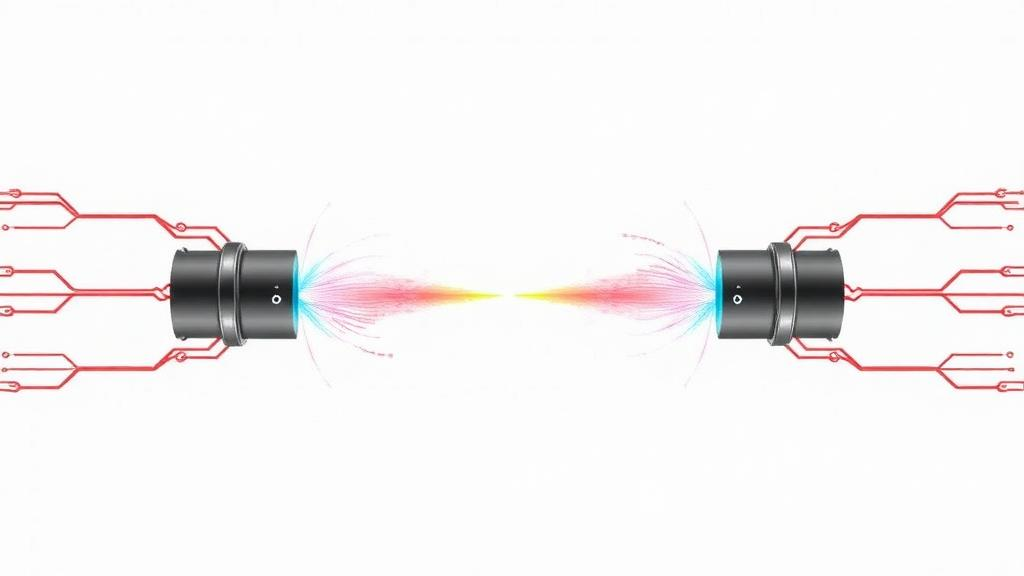
Quantum teleportation has long been one of the most captivating promises of quantum information science: the ability to transfer an unknown quantum state from one location to another without physically moving the particle that carries it. Since Charles Bennett and his colleagues laid out the original protocol in 1993, researchers have steadily pushed the idea from abstract theory toward practical hardware. Now a team of physicists has taken a step further along that road, examining how quantum information can flow in both directions at once through a realistic, noisy spin channel — and how carefully shaped control pulses can rescue the fragile entanglement that makes such two-way transfer possible.
The study, published in the journal Quantum Information Processing by M. Y. Abd-Rabbou and colleagues at institutions including the University of Chinese Academy of Sciences, Al-Azhar University, Prince Sattam bin Abdulaziz University and Imam Mohammad Ibn Saud Islamic University, tackles a problem that is easy to state but hard to solve. Bidirectional quantum teleportation allows two parties to exchange quantum states simultaneously, a capability that would be enormously valuable in distributed quantum networks. But the physical channels that carry the entanglement between the parties are never perfect. They are built from real spins embedded in real environments, and those environments conspire to degrade the very correlations the protocol depends on.
At the heart of the new work is a specific choice of channel: an open Heisenberg XYZ spin system. The Heisenberg model describes interacting quantum spins whose exchange couplings can differ along the x, y and z axes — hence the three letters. Such systems are natural candidates for solid-state quantum communication because entanglement can be generated and distributed directly through the intrinsic spin-spin interactions of the material. Yet the authors go beyond the standard model by adding a term known as the Dzyaloshinskii–Moriya interaction, an antisymmetric spin-orbit coupling that arises in certain magnetic materials when inversion symmetry is broken.
That antisymmetric term turns out to be far more than a small correction. Because it breaks the exchange symmetry between the two communicating parties, it induces a fundamental directional asymmetry in the information transfer. In plain terms, teleporting a state from Alice to Bob through the channel does not behave in the same way as teleporting a state from Bob back to Alice. The fidelity of the reconstructed state — a measure of how closely the output matches the intended input — becomes direction-dependent. For engineers designing a future quantum network, this asymmetry is a crucial practical consideration: the same physical link may perform differently depending on which way the information is being sent.
To quantify how well the protocol survives in an imperfect world, the researchers subjected the channel to two of the most common and damaging forms of environmental noise: Markovian amplitude damping and pure dephasing. Amplitude damping models the loss of energy from the system to its surroundings — the quantum analogue of a qubit slowly relaxing to its ground state — while pure dephasing scrambles the relative phases between quantum states without exchanging energy. Both processes erode entanglement, and both are unavoidable features of real devices. The team evaluated the performance of the bidirectional teleportation protocol using directional state fidelities, tracking separately how well each direction of communication fares as the noise acts on the shared channel.
But fidelity alone does not tell the whole story. The authors also turned to quantum Fisher information, a cornerstone of quantum metrology that measures how much information a quantum state can carry about an unknown parameter. In this context, the quantum Fisher information serves as a sensitive probe of how much useful quantum information survives the teleportation process in each direction. By computing it under the same noisy conditions, the researchers gained a second, independent window onto the degradation of the channel — one that connects the teleportation protocol to the broader framework of quantum estimation and precision measurement.
The most forward-looking element of the study, however, is its use of active control to fight back against decoherence. The team applied DRAG pulses — Derivative Removal by Adiabatic Gate pulses — a technique first developed by Motzoi, Gambetta, Rebentrost and Wilhelm in 2009 to eliminate leakage in weakly nonlinear qubits. In superconducting and other weakly anharmonic systems, driving a qubit too hard can accidentally populate states outside the computational two-level subspace, corrupting the operation. DRAG pulses counteract this by adding a carefully calibrated quadrature component to the control signal, which suppresses the unwanted transitions before they accumulate.
In the context of the teleportation channel, the DRAG scheme serves a different but equally vital purpose: actively protecting the distributed entanglement that both directions of the protocol rely upon. The authors show that the optimized quadrature correction suppresses computational leakage and elevates the performance bounds across all of the evaluated metrics — the directional fidelities and the quantum Fisher information alike. In other words, precise pulse engineering does not merely prevent errors in individual gates; it raises the ceiling on how well the entire two-way teleportation process can perform in the presence of both intrinsic channel asymmetry and environmental noise. The numerical results establish the operational limits of asymmetric quantum communication channels and demonstrate, in the authors’ words, the necessity of precise pulse calibration for maintaining a quantum advantage.
The work sits within a rapidly growing literature on bidirectional teleportation. Since Kiktenko, Popov and Fedorov showed in 2016 that even a single imperfect Bell state can support two-way transfer, proposals have proliferated: schemes using 2n Bell states for arbitrary numbers of qubits, asymmetric protocols teleporting different numbers of qubits in each direction, controlled versions mediated by multi-qubit cluster states, and extensions to continuous variables and high-dimensional systems. Recent studies have also probed how correlated noise, memory effects, amplitude damping and dephasing degrade bidirectional protocols. What distinguishes the new contribution is its combination of a physically grounded, asymmetric spin channel — complete with the Dzyaloshinskii–Moriya interaction — with a modern pulse-control strategy, treating the channel and its control as a single integrated problem rather than two separate ones.
The implications reach beyond teleportation itself. Spin chains with Dzyaloshinskii–Moriya interactions are relevant to spintronics, quantum optics and the design of entanglement-distribution hardware, and DRAG-style pulse shaping is already a workhorse of superconducting-qubit and Rydberg-atom experiments. By mapping out exactly how directional asymmetry and decoherence constrain performance — and by showing how calibrated pulses push those constraints back — the study offers a practical recipe for anyone building quantum links where information must flow both ways. As quantum networks edge closer to reality, the lesson is clear: the quality of a quantum channel is not fixed by its material alone, but by how cleverly we drive it. The full article is available in Quantum Information Processing, volume 25, article 341.
Subject of Research: Bidirectional quantum teleportation through a noisy Heisenberg XYZ spin channel with Dzyaloshinskii–Moriya interaction and DRAG pulse control
Article Title: Bidirectional quantum teleportation through an open Heisenberg XYZ with Dzyaloshinskii–Moriya interaction channel driven by DRAG pulses
Article References: Abd-Rabbou, M. Y., Aljuaydi, F., Jaradat, E. K., & Alghwali, A. S. A. (2026). Bidirectional quantum teleportation through an open Heisenberg XYZ with Dzyaloshinskii–Moriya interaction channel driven by DRAG pulses. Quantum Information Processing, 25(10), Article 341. https://doi.org/10.1007/s11128-026-05348-1
Image Credits: AI Generated
DOI: 10.1007/s11128-026-05348-1
Keywords: quantum teleportation, bidirectional teleportation, Heisenberg XYZ model, Dzyaloshinskii–Moriya interaction, DRAG pulses, decoherence, quantum Fisher information, entanglement, amplitude damping, dephasing, quantum networks, spintronics
Cite Scienmag News
Katie Riggs. (October 12, 2026). Quantum Teleportation Goes Both Ways: Asymmetric Spin Channels Meet DRAG Pulse Control. Scienmag. https://scienmag.com/quantum-teleportation-goes-both-ways-asymmetric-spin-channels-meet-drag-pulse-control/
Katie Riggs. "Quantum Teleportation Goes Both Ways: Asymmetric Spin Channels Meet DRAG Pulse Control." Scienmag, 12 October 2026, https://scienmag.com/quantum-teleportation-goes-both-ways-asymmetric-spin-channels-meet-drag-pulse-control/. Accessed 12 October 2026.
Katie Riggs. "Quantum Teleportation Goes Both Ways: Asymmetric Spin Channels Meet DRAG Pulse Control." Scienmag. October 12, 2026. https://scienmag.com/quantum-teleportation-goes-both-ways-asymmetric-spin-channels-meet-drag-pulse-control/


