


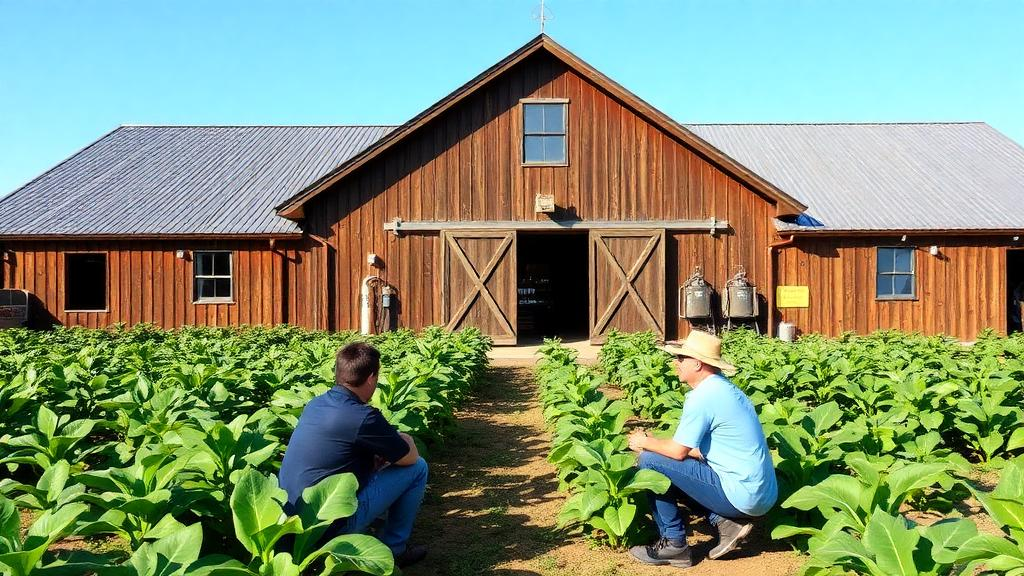
In the tobacco-farming communities of East Java, Indonesia, generations of farmers have cured their harvest inside a traditional barn known as the Gudang Atag, a bamboo structure whose ventilation gaps, layered banana-leaf roofing and thermal behavior embody principles of heat transfer, airflow regulation and material science. A new study published in Discover Education suggests that this vernacular architecture, long invisible to formal schooling, can become the centerpiece of a radically different approach to rural STEM education, one that treats farming wisdom not as folklore but as a legitimate foundation for engineering design.
The research, led by Rif’ati Dina Handayani of Universitas Jember together with colleagues at Universitas Sebelas Maret, examined how twelve tenth-grade students from Pendhalungan farming families translated their tacit knowledge of tobacco curing into engineering design practices. The team employed a qualitative case study design, observing four sessions of a project-based learning module in a rural secondary school physics classroom and analyzing student-generated artifacts, including design sketches, worksheets and prototype documentation. All participants came from households engaged in tobacco farming and curing, and none had previously encountered formal engineering design instruction.
The motivation behind the study lies in a persistent equity problem. STEM curricula worldwide are frequently criticized for being urban-centric, privileging metropolitan examples and forms of technical representation while overlooking rural perspectives. The authors cite Indonesian national planning data indicating that only 18.47 percent of students graduate in STEM fields, a figure far below neighboring Malaysia, where roughly 42 percent of middle school students choose STEM pathways. Crucially, the researchers argue that this low enrollment reflects not a lack of interest but a form of epistemic alienation, in which students perceive school science as disconnected from their lived experiences and community knowledge.
Theoretically, the study draws on the Funds of Knowledge framework, which recognizes household and community expertise as legitimate cognitive resources, and on Third Space Theory, which describes hybrid learning environments where everyday knowledge intersects productively with formal academic discourse. In this framing, the Gudang Atag functions as a bridge between two worlds: the first space of students’ tacit agrarian knowledge and the second space of physics and engineering concepts embedded in the curriculum. When students examined the barn’s thermodynamic and environmental control mechanisms, a hybrid space emerged in which experiential expertise could be mobilized to interpret and articulate scientific principles.
The classroom results were striking. Rather than relying on conventional two-dimensional technical drawings, students demonstrated sophisticated problem-solving through direct hands-on experimentation, material adaptation and the creative use of locally available resources such as bamboo and klaras, dried banana leaves. During the prototyping phase, students in one group negotiated how the physical density and arrangement of klaras would control moisture within their model, explicitly recalling that a barn roof packed too tightly prevents water vapor from escaping and causes curing leaves to rot. Another group conceptualized the curing structure as an adjustable ventilation system, proposing to loosen the leaf bindings at the base so that incoming air could push hot air out through the roof.
These exchanges reveal something more profound than simple recall. Students were not treating local materials as symbolic cultural decorations but as functional engineering variables for regulating airflow, temperature and structural stability. When initial trials exposed problems such as insufficient airflow or excessive heat retention, they modified their physical prototypes directly rather than revising paper designs, iterating through cycles of building, testing and refinement. The researchers interpret this behavior as epistemic agency, a form of knowledge generation through material experimentation that mirrors the iterative, practice-based processes through which the Gudang Atag itself was refined across generations.
Yet the study also uncovered a significant pedagogical tension. Students’ initial sketches consisted of simple functional outlines without measurements or detailed structural representation, and their final prototypes often diverged substantially from those drawings. The authors caution against reading this as a cognitive deficit. In rural farming communities, structural knowledge is typically transmitted through practice and visual-spatial intuition rather than structured drafting, so the sketches served as flexible conceptual anchors rather than formal engineering plans. When freed from rigid drafting conventions, students bypassed conventional barriers by demonstrating strong material-based reasoning. The friction, the study argues, lies in assessment systems that equate engineering competence with mastery of dominant two-dimensional abstract representation.
An equally revealing dynamic appeared during the final presentation session. The same students who had confidently led prototype construction, coordinating tasks and stabilizing bamboo frames together, became hesitant to speak publicly and delegated explanations to teammates. The researchers label this the builders-versus-speakers paradox, a confidence gap in which strong practical engineering competence coexists with anxiety about formal academic communication. They argue that culturally responsive STEM education must therefore extend beyond the design phase to how academic dissemination is evaluated, providing structured scaffolding in technical drawing, spatial planning and scientific communication rather than abruptly returning students to conventional high-pressure presentation formats.
The study’s discussion also highlights the role of language. Group discussions featured what the authors call intellectual code-switching, in which students alternated between vernacular agrarian expressions and formal scientific terminology to explain ideas to peers. Rather than viewing this hybrid discourse as a sign of conceptual confusion, the researchers theorize it as a sophisticated linguistic asset, a high-level translation process in which local knowledge serves as a cognitive and epistemological link. The familiar cultural context also catalyzed collaboration, with group members sharing materials, assisting one another with structural assembly and jointly troubleshooting mechanical problems during construction.
The authors propose a translational model showing how community agrarian experiences are converted into engineering design solutions through ecological reasoning, material experimentation and iterative testing, positioning rural knowledge as a primary epistemic architecture rather than a motivational hook. They acknowledge limitations: the case is deeply embedded in one cultural setting, the intervention spanned only four sessions, and the qualitative data did not include standardized measures of cognitive gains. Future work, they suggest, should combine classroom observation with quantitative assessment, track longer-term effects on communication confidence and STEM identity, and test the framework with other forms of indigenous technology. For now, the message is clear: when rural students are allowed to build on what their communities already know, engineering stops being a foreign language and becomes a native one.
Subject of Research: Integrating traditional agricultural knowledge into culturally responsive STEM engineering design education in rural Indonesia
Article Title: Reimagining rural STEM by integrating traditional agricultural knowledge into engineering design practices through culturally responsive approaches
Article References: Reimagining rural STEM by integrating traditional agricultural knowledge into engineering design practices through culturally responsive approaches. (n.d.). https://doi.org/10.1007/s44217-026-02266-3
Image Credits: AI Generated
DOI: 10.1007/s44217-026-02266-3
Keywords: STEM education, culturally responsive teaching, engineering design, rural education, traditional agricultural knowledge, Indonesia, funds of knowledge, Third Space theory, tobacco curing, thermodynamics, qualitative case study, educational equity
Cite Scienmag News
Denise Maddox. (October 12, 2026). Tobacco Barns as Classrooms: Rural Students Turn Farming Wisdom Into Engineering. Scienmag. https://scienmag.com/tobacco-barns-as-classrooms-rural-students-turn-farming-wisdom-into-engineering/
Denise Maddox. "Tobacco Barns as Classrooms: Rural Students Turn Farming Wisdom Into Engineering." Scienmag, 12 October 2026, https://scienmag.com/tobacco-barns-as-classrooms-rural-students-turn-farming-wisdom-into-engineering/. Accessed 12 October 2026.
Denise Maddox. "Tobacco Barns as Classrooms: Rural Students Turn Farming Wisdom Into Engineering." Scienmag. October 12, 2026. https://scienmag.com/tobacco-barns-as-classrooms-rural-students-turn-farming-wisdom-into-engineering/


