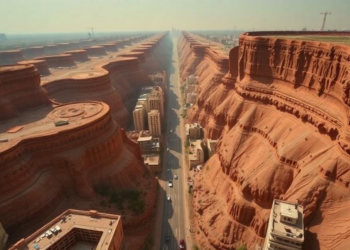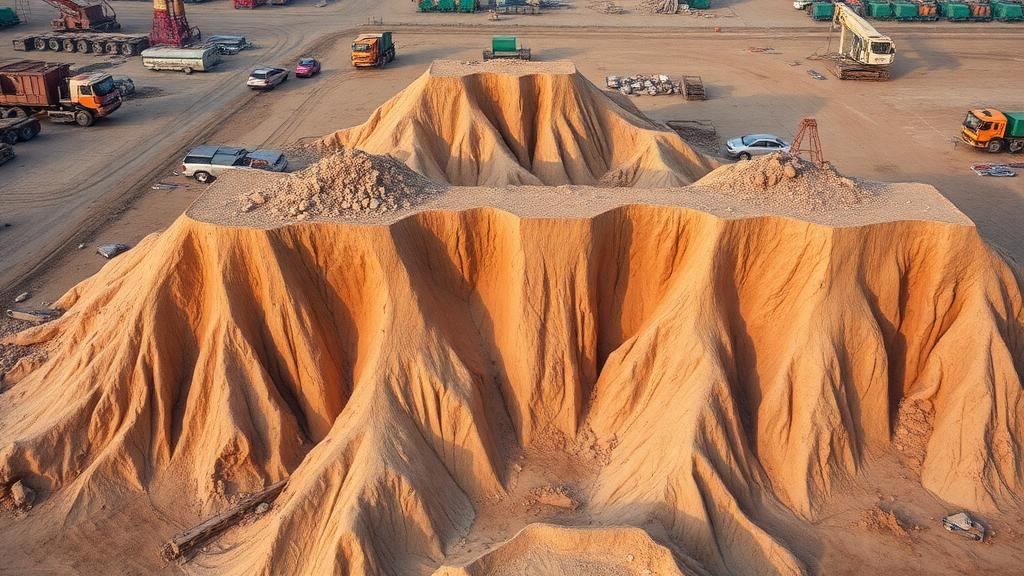
On China’s Loess Plateau, engineers are doing something that sounds almost mythological: slicing the tops off mountains and pouring the excavated earth into deep gullies to conjure flat, buildable land out of a famously broken landscape. These engineered landforms, known as loess high-fill foundations, can rise more than 80 meters above the valley floor, and they now underpin entire new urban districts such as Yan’an New District and Lanzhou New District, along with major airport projects. The problem is that the material they are made of, compacted loess, is one of the most temperamental soils in geotechnical engineering, and no one has ever built fills of this scale before. A new centrifuge modeling study published in Environmental Earth Sciences now offers the most continuous picture yet of how these colossal foundations deform from the moment the first lift of soil is placed until long after construction ends.
The research team, led by Jie Cao, Jiwen Zhang and Ning Han of the China Jikan Research Institute of Engineering Investigation and Design, together with Qingyi Mu of Chang’an University, tackled a stubborn experimental gap. Laboratory element tests such as one-dimensional compression and triaxial tests can isolate the influence of moisture and compaction, but they cannot capture how an entire foundation evolves as a body. Ordinary 1-g physical models fail to reproduce the enormous self-weight stresses of a real fill, and field monitoring campaigns, while valuable, run for years, demand heavy resources, and often yield discontinuous records. Satellite techniques such as InSAR and UAV surveys mostly catch only post-construction surface movement. Centrifuge modeling solves the stress problem elegantly: by spinning a small model at up to 200 times Earth’s gravity, the machine makes a scaled-down fill feel its own full prototype-scale weight.
The experiments were carried out on the CKY-200 geotechnical centrifuge at the Yangtze River Scientific Research Institute, a machine with a nominal radius of 4 meters and a maximum acceleration of 200 g. The team used remolded Q2 loess sampled directly from an excavation face in Yan’an New District, the same kind of material actually being dumped into the gullies. The soil, with a specific gravity of 2.71, a maximum dry density of 1.72 grams per cubic centimeter and an optimum moisture content of 16.1 percent, was compacted layer by layer into a custom partitioned container, with each lift scarified to prevent weak interlayer planes. Laser displacement sensors tracked surface settlement continuously, miniature earth pressure cells recorded stresses inside the fill, and eleven layers of settlement markers embedded in one model allowed deformation to be mapped through depth against a glass sidewall.
Three test series isolated the key variables one at a time: moisture content at a fixed compaction degree of 0.80, compaction degree at optimum moisture, and fill height at 15, 25 and 35 meters in prototype scale. Loading mimicked real construction in cycles, with stepped 10-g increments representing filling periods and constant-load holds representing pauses between lifts. After construction, the centrifuge kept spinning to simulate the post-construction stage, and the models were then subjected to simulated rainfall and, in one case, full immersion to probe the notorious water sensitivity of loess. Data were recorded once per second throughout, giving an unusually complete settlement time series for a system of this kind.
The headline finding is stark: under these laterally confined conditions, 85 to 95 percent of total settlement is generated during construction itself, driven by consolidation of the unsaturated loess, while creep accounts for only the remaining 5 to 15 percent. That proportion of consolidation-driven settlement grows with wetter soil, poorer compaction and taller fills. Total settlement, unsurprisingly, increases with higher moisture content, lower compaction degree and greater fill height. But the study’s real contribution lies in the shape of the settlement curves. During early construction cycles, the curves undulate in a wave-like pattern of alternating fast and slow settlement. As the fill densifies, they transform into a step-like pattern: long, nearly stagnant platforms interrupted by abrupt settlement jumps, the signature of intermittent yielding events in which stored energy is suddenly released as the soil skeleton collapses into a more stable arrangement.
This step-like behavior persisted into the post-construction stage, and its character depended on the soil’s initial stiffness and thickness. Stiffer or thicker fills yielded in a high-frequency, low-amplitude mode, releasing energy in many small, frequent events and deforming uniformly. Softer or thinner fills showed long stable plateaus punctuated by concentrated, sudden settlement after prolonged quiet periods. The researchers also found pronounced hysteresis: settlement lagged behind loading because each construction cycle was too short for the soil to fully stabilize, meaning an apparently quiescent fill may simply be accumulating strain for its next yielding episode. For engineers, this is a warning that a surface that looks stable is not necessarily at equilibrium, and that premature loading or poor drainage during that apparent calm can trigger sudden differential settlement.
The internal anatomy of the settlement proved equally revealing. Deeper layers settled far more than shallow ones, with deep-layer settlement reaching roughly 80 to 95 percent of the shallow-layer values in relative terms, yet the settlement increment did not grow monotonically with depth. Instead it fluctuated, especially near the surface and the container sides. Horizontally, deep layers settled more in the middle than at the edges, while shallow layers did the opposite. The team interprets this differential movement as a spontaneous form of soil arching: faster-settling zones in the deep fill act like a trapdoor, deflecting overburden stress laterally toward stiffer supports and creating unloading zones above. Earth pressure measurements supported this picture, with deep pressures eventually exceeding theoretical overburden values while shallow pressures stayed below, and the earth pressure coefficient rising with depth as the fill densified.
Water emerged as the enduring villain. Rainfall infiltration caused settlement to increase sharply, with the wetting-induced increment largest where prior settlement had already loosened the soil structure, and rebound after unloading was correspondingly small because plastic deformation had exhausted the soil’s elastic recovery. Even more striking, soils with different initial compaction degrees converged to similar total post-construction settlement, yet the loosely compacted ones remained far more sensitive to rainfall. In other words, equal settlement does not mean equal risk: a poorly compacted fill that has finished settling can still lurch dramatically when wetted. After full immersion, the soil’s resistance to deformation weakened further, settlement became governed almost entirely by load increments, and even after construction, post-construction and rainfall phases, the fill retained measurable remaining settlement potential.
The authors frame the mechanism through the staged consolidation of unsaturated soil. Upon loading, the soil first deforms elastically through grain contacts and bound water films. Then pore air, connected to the atmosphere, is rapidly expelled or dissolved, driving the largest compression. Next, as saturation rises, pore water pressure dissipates while water attacks the soil skeleton itself, dissolving intergranular cements, thinning the contractile skin that generates matric suction, softening clay particles and lowering the yield stress, so the fill keeps compressing even under constant load. Finally, under sustained stress, grains creep and rearrange slowly toward an optimal packing. Compaction variability across the fill makes this process spatially uneven, producing the alternating concave and convex zones that drive the observed wave-like and step-like surface behavior.
The practical implications are direct. Because settlement lags loading, construction rates on loess high fills should be strictly controlled with deliberate intermittent pauses, so that sudden yielding happens during scheduled breaks rather than beneath finished works. And because insufficient compaction can spontaneously generate soil arching that redistributes stresses even without any buried structures, designers of these laterally confined fills need to account for stress fields that depart substantially from simple overburden calculations. The team cautions that their rigid-walled models approximate one-dimensional compression in narrow gully terrain and that time scales were deliberately not converted to prototype values, so the results illuminate mechanisms and relative influences rather than delivering direct design numbers. Still, for projects with no engineering precedent, knowing that the danger is concentrated in construction-stage consolidation, that the soil yields in stealthy steps, and that water remains a long-term threat is exactly the mechanistic foundation the next generation of mountain-moving cities will be built on.
Subject of Research: One-dimensional settlement behavior of compacted loess high-fill foundations studied with geotechnical centrifuge model tests
Article Title: One-dimensional settlement characteristics of loess high-fill foundations: insights from centrifuge model tests
Article References: One-dimensional settlement characteristics of loess high-fill foundations: insights from centrifuge model tests. (n.d.). https://doi.org/10.1007/s12665-026-13167-x
Image Credits: AI Generated
DOI: 10.1007/s12665-026-13167-x
Keywords: loess, high-fill foundation, centrifuge model test, settlement, consolidation, compaction degree, moisture content, soil arching, Loess Plateau, geotechnical engineering, creep, wetting collapse
Cite Scienmag News
Violet Maxwell. (October 12, 2026). Centrifuge tests reveal how China’s giant loess landfills sink and settle. Scienmag. https://scienmag.com/centrifuge-tests-reveal-how-chinas-giant-loess-landfills-sink-and-settle/
Violet Maxwell. "Centrifuge tests reveal how China’s giant loess landfills sink and settle." Scienmag, 12 October 2026, https://scienmag.com/centrifuge-tests-reveal-how-chinas-giant-loess-landfills-sink-and-settle/. Accessed 12 October 2026.
Violet Maxwell. "Centrifuge tests reveal how China’s giant loess landfills sink and settle." Scienmag. October 12, 2026. https://scienmag.com/centrifuge-tests-reveal-how-chinas-giant-loess-landfills-sink-and-settle/