


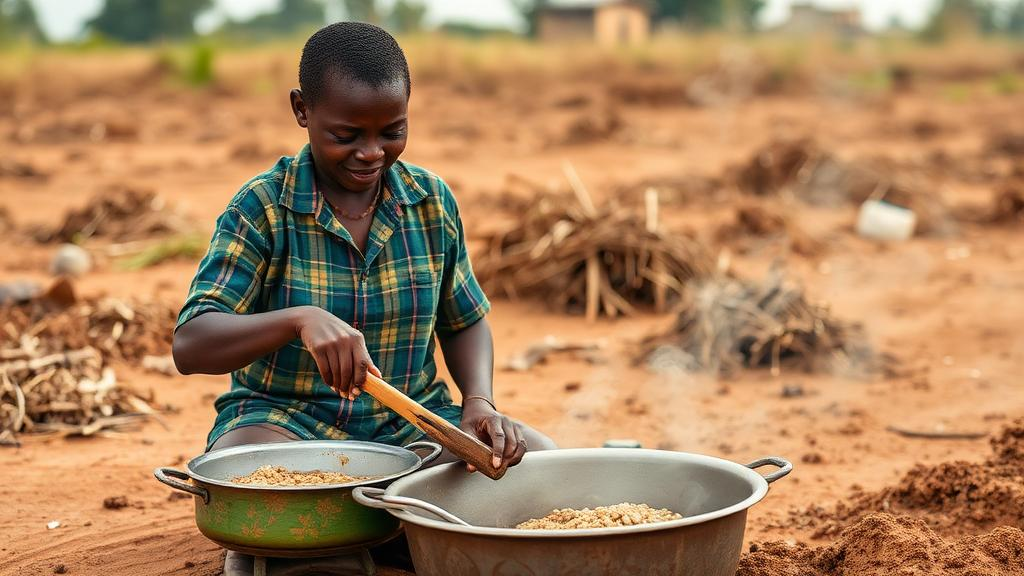
Pollution is quietly draining one of Africa’s fastest-growing economies at a rate that few policymakers have been able to quantify until now. A new health-economic modelling study, published in the journal Environmental Challenges, estimates that ambient air pollution and biological water pollution together cost Uganda approximately USD 4.34 billion every year, a figure equivalent to roughly 8.1 percent of the country’s 2024 gross domestic product. The analysis, conducted by Michael Guterbock, Arnold Hagens and Maria Bermudez in collaboration with the Global Alliance on Health and Pollution, is one of the first attempts to place a comprehensive economic price tag on both pollution streams simultaneously in a sub-Saharan African nation. Beyond simply totalling the damage, the researchers evaluated six intervention scenarios over a fifteen-year horizon and found that some of the cheapest available measures, particularly a switch from biomass stoves to electric cooking, could return nearly twenty dollars in averted health and economic losses for every dollar spent.
The scale of exposure in Uganda is stark. The country is home to roughly 50 million people, a population projected to double between 2024 and 2054, and more than 94 percent of households still rely on solid biomass fuels such as wood and charcoal for cooking. Residential biomass combustion alone contributes 28.8 percent of the nation’s fine particulate pollution, with open burning of waste and rising vehicular emissions in urbanising areas adding further burden. National mean annual concentrations of PM2.5, the microscopic particles small enough to penetrate deep into the lungs and enter the bloodstream, stand at 13 micrograms per cubic metre, well above the World Health Organization guideline of 5 micrograms. On the water side, although 75 percent of urban and 67 percent of rural residents have access to improved water sources, compliance with drinking water treatment standards remains limited and basic sanitation coverage reaches only 48 percent of the population nationally.
To translate these exposures into economic terms, the team built a static health-economic model in the tradition of the comparative risk assessment methodology that underpins the Global Burden of Disease study. For ambient air pollution, they used PM2.5 concentration data from the AirQo monitoring network, averaged across measurements from 2021 to mid-2025, and applied exposure-response relationships derived from meta-regression Bayesian kernel smoothing curves to estimate population attributable fractions for eight health outcomes: ischaemic heart disease, stroke, lower respiratory infections, chronic obstructive pulmonary disease, lung cancer, type 2 diabetes, asthma and low birth weight. Asthma, which is not among the standard PM2.5 risk-outcome pairs, was modelled separately using a dedicated attributable-fraction source. For water pollution, the researchers drew on Global Burden of Disease summary exposure values for unsafe water, unsafe sanitation and absent handwashing facilities to estimate attributable fractions for diarrhoeal diseases, typhoid fever, paratyphoid fever, and upper and lower respiratory infections.
The economic accounting rested on three pillars: health care treatment costs, productivity losses and the cost of premature death. Chronic conditions such as diabetes, COPD, ischaemic heart disease and asthma were costed annually and discounted at 3.5 percent from the average age of onset until premature death, an approach that makes asthma extraordinarily expensive in present-value terms. Because asthma typically begins at around 11.5 years of age and lasts a lifetime, each incident case carries a discounted lifetime cost of USD 2,910. Productivity losses were calculated using a friction period of 60 days, assuming people are economically productive only between ages 20 and 65, with daily losses derived from gross domestic product divided across the working-age population. Premature deaths were valued using a value of a statistical life for Uganda of approximately USD 73,452, derived from the WHO BAR-HAP tool.
The results reveal a burden of startling magnitude. Ambient air pollution was linked to an estimated 608,907 new cases and 7,378 deaths annually, generating an economic burden of USD 1.48 billion per year. Asthma dominated the financial toll, accounting for USD 913.5 million, or 62 percent of the air pollution total, driven overwhelmingly by treatment costs of a lifelong disease beginning in childhood. Lower respiratory infections contributed USD 177.1 million, type 2 diabetes USD 112.0 million, stroke USD 93.3 million and low birth weight outcomes USD 81.3 million. Water pollution proved even costlier: approximately 45.8 million incident cases and 8,961 deaths each year, imposing an annual economic burden of USD 2.86 billion. Diarrhoeal disease alone accounted for USD 2.05 billion, more than 70 percent of the water pollution total, reflecting the sheer frequency of short but debilitating episodes across a population where unsafe water, sanitation and hygiene exposures remain widespread.
Perhaps the most striking demographic finding is how heavily the burden falls on children. Individuals under 15 years of age account for 67 percent of the economic burden of air pollution, 74.8 percent of reported cases and 30.5 percent of related deaths, a pattern driven by the early onset of asthma and the prominence of lower respiratory infections and low birth weight in the youngest age groups. For water pollution, children under 15 represent 34.2 percent of the economic burden, 55.4 percent of cases and 49.1 percent of deaths. In a country where the population is set to double within three decades, these figures suggest that pollution is systematically eroding the health and economic potential of the very generation on whom future development depends.
The intervention analysis offers a clear hierarchy of investment priorities. Replacing biomass stoves with electric cookstoves in the 20 percent of biomass-using households connected to the national grid, at an assumed cost of USD 25 per stove, would reduce ambient PM2.5 by 5.76 percent, averting an estimated 35,073 cases and 425 deaths annually. Over fifteen years, the programme would cost USD 50.3 million and avert USD 981.8 million in economic burden, yielding a return on investment of 19.5. A 30 percent reduction in open fires, which contribute about 20.6 percent of PM2.5 pollution, would avert roughly 456 deaths and USD 1.05 billion in burden over the same period, while a 20 percent reduction in road-transport-related pollution in urban areas would avert 66 deaths annually. On the water side, a public awareness campaign reducing unsafe conditions by 20 percent would avert 5.98 million cases and 1,112 deaths per year, worth USD 4.23 billion over fifteen years, while expanded sanitation and piped water access would avert 3.04 million cases and reducing surface water contamination 4.43 million cases annually.
The researchers stress-tested their model with an extensive one-way sensitivity analysis, varying each parameter across its evidence-based uncertainty range. For air pollution, the total burden proved most sensitive to asthma treatment costs, which moved the estimate between minus 30.0 and plus 59.9 percent, followed by Global Burden of Disease asthma incidence and the value of a statistical life. For water pollution, diarrhoeal treatment costs and the value of a statistical life were the dominant drivers. Crucially, the return on investment for the clean cooking scenario remained between 11.8 and 41.0 across every parameter variation and discount rate tested, confirming that the investment case is robust even under conservative assumptions. The authors also quantified the overlap between the two pollution streams, since both contribute to lower respiratory infections through largely independent causal pathways: particulate inhalation impairs pulmonary defences, while poor hygiene sustains pathogen transmission. After adjusting for this overlap, the combined burden was 46.42 million cases, 16,020 deaths and USD 4.32 billion per year.
The study’s limitations are acknowledged candidly. The static framework does not capture dynamic shifts in population growth, urbanisation or technology adoption; some treatment costs were transferred from comparable sub-Saharan settings; and the estimates likely understate the true burden because they cover a limited set of disease endpoints and exclude co-benefits such as fuel cost savings, which can reach 75 percent for households switching to electric cooking. Even so, the findings arrive at a decisive moment for Ugandan policy. The country’s Health and Pollution Action Plan, developed with the Global Alliance on Health and Pollution, now has an economic evidence base demonstrating that pollution control is not a luxury for wealthy nations but one of the highest-return investments available to a developing economy. With funding from UK International Development through the Department for Environment, Food and Rural Affairs, the analysis makes the case that every dollar spent on clean cooking, sanitation and awareness campaigns in Uganda returns many times its cost in lives, health and national prosperity.
Subject of Research: Economic burden of ambient air and water pollution and the return on investment of mitigation interventions in Uganda
Article Title: Investment case for air and water pollution reduction in Uganda
Article References: Guterbock, M., Hagens, A., & Bermudez, M. (2026). Investment case for air and water pollution reduction in Uganda. Environmental Challenges, 25, Article 101679. https://doi.org/10.1016/j.envc.2026.101679
Image Credits: AI Generated
DOI: 10.1016/j.envc.2026.101679
Keywords: Uganda, air pollution, water pollution, PM2.5, clean cooking, health economics, return on investment, sanitation, diarrhoeal disease, asthma, Global Burden of Disease, public health
Cite Scienmag News
Sloane Callahan. (October 12, 2026). Pollution costs Uganda billions each year, but clean cooking pays for itself. Scienmag. https://scienmag.com/pollution-costs-uganda-billions-each-year-but-clean-cooking-pays-for-itself/
Sloane Callahan. "Pollution costs Uganda billions each year, but clean cooking pays for itself." Scienmag, 12 October 2026, https://scienmag.com/pollution-costs-uganda-billions-each-year-but-clean-cooking-pays-for-itself/. Accessed 12 October 2026.
Sloane Callahan. "Pollution costs Uganda billions each year, but clean cooking pays for itself." Scienmag. October 12, 2026. https://scienmag.com/pollution-costs-uganda-billions-each-year-but-clean-cooking-pays-for-itself/


