


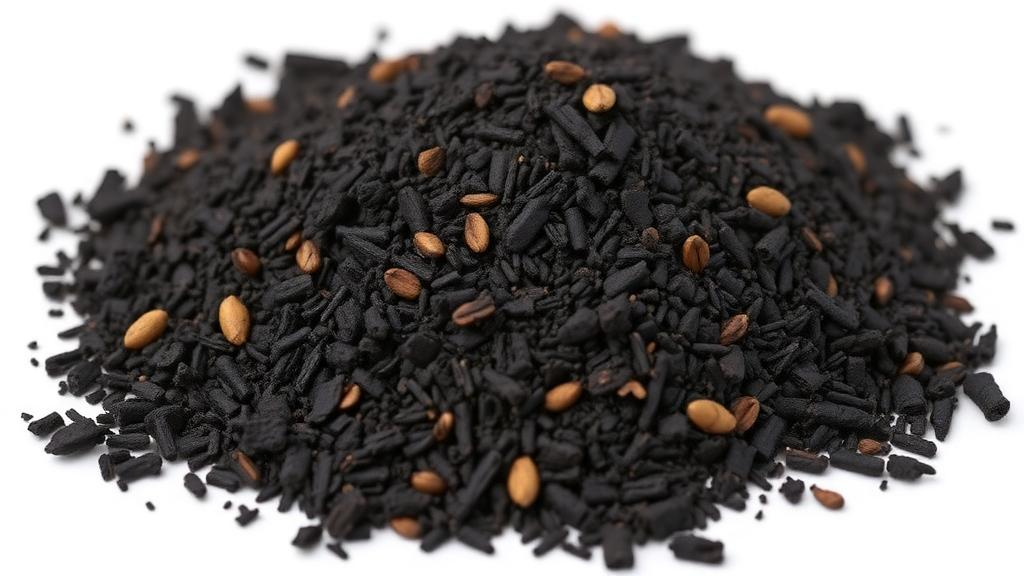
Rice, the staple crop that feeds more than half of humanity, has a chromium problem. In contaminated paddy fields across South and East Asia, the heavy metal creeps from flooded soils into rice grains, quietly entering the food supply of billions. A new study published in Environmental Science and Pollution Research offers a strikingly elegant countermeasure: a biochar made from vinasse, a sugary industrial waste product of ethanol and sugar production, that has been chemically supercharged with potassium ferrate. In a 120-day pot experiment with rice grown in soil spiked with 300 milligrams of chromium per kilogram, the modified material slashed chromium accumulation in the harvested grains by 95.2 percent compared with untreated soil, while simultaneously driving the reduction of the metal’s most dangerous form, hexavalent chromium, in the rhizosphere. The finding, reported by Min Xu, Yinchen Da and colleagues at Sichuan Agricultural University, suggests that two waste streams, one agricultural and one industrial, can be fused into a single shield for food safety.
The chemistry behind the material explains much of its power. Potassium ferrate, K2FeO4, is an unusual compound: a strong oxidant in its own right that decomposes to leave behind reactive iron oxides. When vinasse biochar is treated with it, the porous carbon matrix becomes decorated with iron-bearing phases and gains a higher density of surface functional groups. In the new experiment, the team compared four treatments: an unamended control, a 1 percent dose of unmodified vinasse biochar, a 1 percent dose of biochar modified with ferric chloride, and a 1 percent dose of the potassium ferrate-modified version, abbreviated KFB. After a full growing season, the differences were dramatic. Grain chromium concentrations in the KFB treatment were 20.1 times lower than in the control, 5.3 times lower than with plain biochar, and 4.1 times lower than with the ferric chloride variant, making the ferrate route decisively the most effective modification strategy.
Central to the protective mechanism is a phenomenon that rice plants themselves initiate: the formation of iron plaque. Under the waterlogged, oxygen-poor conditions of a paddy, rice roots leak oxygen into the rhizosphere, oxidizing dissolved ferrous iron and precipitating it as reddish coatings of iron oxides on the root surface. These coatings act as a chemical gatekeeper, sequestering metal ions before they can cross into the plant’s vascular system. The researchers quantified plaque formation using dithionite-citrate-bicarbonate extraction, a standard technique that dissolves the amorphous and crystalline iron oxides of the plaque. KFB boosted DCB-extractable iron by 49.7 percent relative to the unamended control, by 58.3 percent relative to plain biochar, and by 31.5 percent relative to the ferric chloride-modified material, indicating a far thicker and more reactive root barrier.
More chromium trapped on the plaque means less chromium reaching the grain, and the correlation held across the dataset. The KFB treatment also produced the highest concentrations of Fe(II), the reduced form of iron, and of free iron oxides in the soil, both of which were positively associated with plaque formation and with the complexation of chromium. This dual role, supplying both oxidized iron for plaque building and reduced iron for reductive transformations, is a distinctive feature of the ferrate modification. Ordinary iron salts tend to deliver only one side of that redox pairing, whereas the ferrate-treated biochar appears to sustain a dynamic iron cycle in the rhizosphere that continuously feeds the plant’s own defense architecture.
The second pillar of the mechanism is the direct transformation of hexavalent chromium, Cr(VI), into its trivalent counterpart, Cr(III). The distinction matters enormously for toxicology. Cr(VI), typically present as chromate and dichromate anions, is mobile in soil, readily taken up by roots through transport pathways meant for essential nutrients, and is a recognized carcinogen. Cr(III), by contrast, is far less mobile, binds strongly to soil particles and organic matter, and is an essential trace element at low doses. In the study, the reduction rate of Cr(VI) peaked at 90.6 percent in the KFB-amended soil, exceeding the 83.9 to 87.6 percent achieved by the other treatments. The abundance of Fe(II) generated by the modified biochar provides electrons that chemically reduce Cr(VI), while the carbon matrix itself can act as an electron shuttle, facilitating transfer from microbial and organic electron donors to the chromate anion.
Sequential extraction of the soil revealed where the chromium ended up. Across all biochar treatments, the dominant reservoir was the iron-manganese oxide-bound fraction, which accounted for 56.3 to 58.9 percent of total soil chromium, and KFB produced the highest content of this fraction of any treatment. Iron and manganese oxides have high affinities for chromium ions, adsorbing them onto their surfaces and, in the case of Cr(III), coprecipitating them into mixed hydroxide phases. Elevated soil organic matter in the biochar-amended pots further promoted immobilization, because humified organic ligands form stable complexes with Cr(III), locking it away from both plant roots and leaching waters. Together, these shifts in chromium speciation represent a conversion of a bioavailable hazard into a geochemically sequestered one.
The choice of feedstock is part of the story’s appeal. Vinasse, the dark, potassium-rich stillage left over after the distillation of ethanol from sugarcane or molasses, is produced in staggering volumes by the global biofuel and sugar industries and poses its own disposal challenges when applied raw to land. Converting it to biochar through pyrolysis stabilizes its carbon and nutrients, and prior work by some of the same team showed that potassium ferrate-modified vinasse biochar could also immobilize cadmium in contaminated soils. The new results extend that remediation platform to chromium and, crucially, demonstrate the effect within a complete soil-plant system over an entire growing season rather than in simplified aqueous tests, addressing a gap the authors identified in how modified biochars influence chromium’s journey from soil to grain.
The implications for food safety are concrete. National food safety standards, including China’s GB 2762-2022, set maximum permissible levels of contaminants such as chromium in rice, and contaminated paddies in mining-affected and industrialized regions routinely exceed them. A soil amendment that can be produced from a waste stream, applied at a modest 1 percent dose, and cut grain chromium by more than 95 percent in a single season would be a valuable tool for farmers and regulators alike. Because the mechanism operates through the plant’s own iron plaque, it complements rather than replaces agronomic measures such as continuous flooding, which earlier studies have shown also stimulates plaque formation and reduces chromium uptake. The authors note that chromium in the treated soils was predominantly locked into iron-manganese oxide and organic matter-bound fractions, the least bioavailable pools in the sequential extraction scheme.
Caveats remain before field deployment. The experiment used artificially spiked soil at 300 milligrams of chromium per kilogram, a level representing serious contamination, and pot conditions do not fully reproduce the hydrology, microbial communities, and scale of real paddies. Long-term studies would need to confirm that the sequestered chromium remains stable across seasons, that the amendment does not alter nutrient cycling or methane emissions in problematic ways, and that the economics of ferrate treatment scale to farm use. Nevertheless, the study provides a mechanistically grounded demonstration that a single, waste-derived material can intervene at multiple points in a contaminant’s journey, reducing it in the soil, thickening the plant’s chemical gatekeeper, and ultimately keeping it out of the grain. For the millions of hectares of chromium-affected rice land worldwide, that multi-pronged design may prove to be exactly the kind of practical, circular-economy solution the field has been searching for.
Subject of Research: Use of potassium ferrate-modified vinasse biochar to immobilize chromium and reduce its accumulation in rice grains in contaminated paddy soil
Article Title: K2FeO4-modified vinasse biochar reduces chromium accumulation in rice grains and enhances Cr(VI) reduction in paddy soil
Article References: Xu, M., Da, Y., Gao, Y., Wu, J., Chen, C., Long, L., Deng, M., Zhang, B., Yang, G., & Ma, J. (2026). K2FeO4-modified vinasse biochar reduces chromium accumulation in rice grains and enhances Cr(VI) reduction in paddy soil. Environmental Science and Pollution Research, 33(28), 14201-14216. https://doi.org/10.1007/s11356-026-38191-z
Image Credits: AI Generated
DOI: 10.1007/s11356-026-38191-z
Keywords: biochar, chromium, Cr(VI) reduction, rice, iron plaque, paddy soil, soil remediation, potassium ferrate, vinasse, heavy metal immobilization, food safety, rhizosphere
Cite Scienmag News
Alan Morgan. (October 12, 2026). Waste-Derived Biochar Supercharges Rice Defenses Against Toxic Chromium. Scienmag. https://scienmag.com/waste-derived-biochar-supercharges-rice-defenses-against-toxic-chromium/
Alan Morgan. "Waste-Derived Biochar Supercharges Rice Defenses Against Toxic Chromium." Scienmag, 12 October 2026, https://scienmag.com/waste-derived-biochar-supercharges-rice-defenses-against-toxic-chromium/. Accessed 12 October 2026.
Alan Morgan. "Waste-Derived Biochar Supercharges Rice Defenses Against Toxic Chromium." Scienmag. October 12, 2026. https://scienmag.com/waste-derived-biochar-supercharges-rice-defenses-against-toxic-chromium/


