


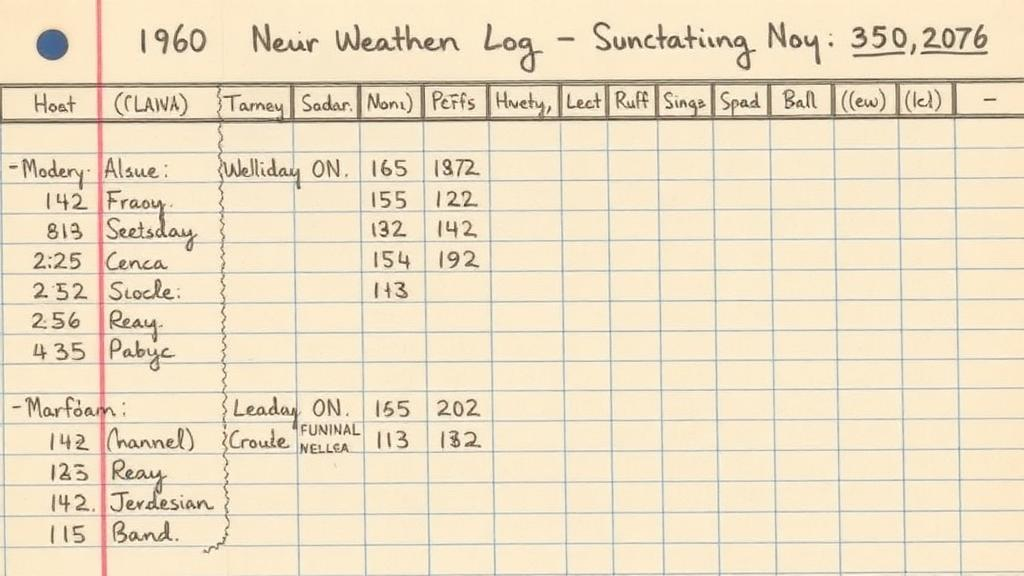
Deep inside the archives of the Institut National pour l’Etude et la Recherche Agronomiques (INERA) in Yangambi, in the Democratic Republic of the Congo, tens of thousands of handwritten weather sheets have been quietly decaying for decades. Recorded by station observers with pen and paper, these monthly tables of temperatures and rainfall constitute one of the richest untapped climate records in Central Africa. A new study led by researchers at Vrije Universiteit Brussel (VUB), published in the journal Earth System Dynamics, has now turned this fragile paper legacy into a digital dataset spanning more than a century, and the findings are striking: the number of hot days per year in the Congo Basin nearly doubled between the 1960s and the 1980s, providing the first long-term observational evidence of intensifying heat extremes in a region that global climate assessments have long struggled to characterize.
The rescue operation began in earnest in 2023, when Derrick Muheki, a PhD researcher at VUB and lead author of the study, joined two field campaigns in the Democratic Republic of the Congo. Working alongside INERA staff and colleagues from Ghent University, the team photographed more than 9,000 handwritten monthly sheets of weather observations collected at 37 stations distributed across the country. Some of these records were also recovered from the State Archives of Belgium, a legacy of the colonial-era meteorological networks that once operated across Central Africa. The physical condition of the documents added urgency to the effort. Part of the INERA archive had been damaged by fire only months before Muheki’s visit, a near-loss that underscored how vulnerable such irreplaceable records remain.
Photographing the sheets was only the first step. Converting more than 9,000 images of cursive handwriting into usable numbers would have taken years of manual transcription, so the team relied on MeteoSaver, an open-source software tool developed by Muheki at VUB in collaboration with the Ghent Centre for Digital Humanities. The software automates the transcription of digitized weather records into digital spreadsheets, bridging the gap between historical scans and quantitative climate analysis. Its performance has drawn attention well beyond the climate community: TIME recognized MeteoSaver among its Best Inventions of 2025 as a special mention, highlighting how data rescue has become a technological frontier in its own right.
The resulting database, published openly on Zenodo, contains more than one million daily and sometimes sub-daily weather observations. Together with previously rescued records, it represents one of the largest climate datasets ever assembled for the Congo Basin, a region that had until now been largely overlooked by the international research community. The archive covers observations from 1908 to 2023 and includes daily maximum, minimum and average temperatures, daily precipitation, and dry- and wet-bulb temperatures measured three times a day at the 37 stations. Although each station covers a different period, most records begin in the 1960s and end in the 1990s, an abrupt truncation that reflects the Congo wars and the nationwide institutional breakdown that followed.
Once the transcribed data were quality-controlled and analyzed, a consistent warming signal emerged across the basin. Between 1961 and 1990, daily maximum temperatures rose by about 0.7 degrees Celsius, minimum temperatures by 0.3 degrees Celsius, and average temperatures by 0.5 degrees Celsius, corresponding to warming of tenths of a degree per decade. Crucially, the trend did not stop when the INERA records end. Using weather stations with longer continuous records, the researchers show that the warming of the Congo Basin continues into the 2000s, confirming that the signal detected in the rescued archives is part of an ongoing, accelerating pattern rather than a relic of the twentieth century.
The most consequential findings concern extremes. Each successive decade shows an increase in the number of hot days per year, and the hot days themselves are getting hotter, while the number of cold days decreases, mirroring patterns observed across the globe. On average, the number of hot days per year nearly doubled between the 1960s and the 1980s. For the millions of people living in the Congo Basin, many of whom depend on rain-fed agriculture and have limited access to cooling or healthcare, such a shift in the frequency of extreme heat carries direct consequences for labor productivity, food security and human health.
Rainfall extremes show a similar intensification. Examining precipitation records from three weather stations, the authors found that the number of heavy rainfall events doubled at two of these stations in the 1980s compared with the 1960s. The observed increase in both the frequency and intensity of weather extremes in the DRC is consistent with global trends linked to rising temperatures driven by continued fossil fuel emissions. In a region where infrastructure is often fragile and flood defenses sparse, a doubling of heavy rainfall events translates into heightened risks of flooding, landslides and disruption to river transport along the Congo River and its tributaries.
The scientific significance of the study extends beyond the regional numbers. Central Africa remains one of the few regions where the most recent Intergovernmental Panel on Climate Change report could not confirm an increase in hot extremes, largely because of the absence of past observations and scientific studies. Wim Thiery, senior author of the study and professor at VUB, emphasized that the new observational evidence fills a critical gap in a data-sparse yet climatically significant region. The Congo Basin is home to the world’s second-largest tropical rainforest, a major carbon sink, and its climate dynamics influence rainfall patterns far beyond its borders. Reliable historical observations are therefore essential both for understanding regional change and for evaluating and improving the climate models used to project its future.
The work also carries a pointed message about global scientific equity. Thiery noted that the findings highlight the urgent need for more data rescue projects, especially in data-sparse regions, to close knowledge gaps on climate trends. Regions in the Global South are least responsible for the greenhouse gas emissions driving climate change yet suffer the brunt of its impacts, and robust historical records are a prerequisite for informed adaptation planning and a just transition. Muheki, who witnessed the fragility of the archives firsthand, described the urgency of the work: seeing how vulnerable the paper records were, and knowing that part of the archive had already burned, made clear that decades of irreplaceable data could have been lost. Accessing more of these records, he said, will help improve reconstructions of climate history and projections of future climate change in a part of the world where adaptation to climate impacts is already a necessity.
The study, authored by an international team spanning VUB’s Water and Climate Department, Ghent University’s Congo Basin Centre of expertise and Ghent Centre for Digital Humanities, BlueGreen Labs, INERA in Yangambi and Kinshasa, the University of Reading, the Royal Museum for Central Africa, Université de Kisangani, Université de Kinshasa, Maynooth University, the Royal Library of Belgium and the Center for Geological and Mining Research in Kinshasa, demonstrates what patient archival work combined with modern machine-assisted transcription can achieve. The two field campaigns were documented in a Nature News article in September 2025, and the open-access database now invites researchers worldwide to build on the rescued observations. For a region that has been nearly invisible in global climate datasets, the Congo Basin finally has a documented warming history, and it was written by hand.
Subject of Research: Historical weather data rescue and warming trends in the Congo Basin
Article Title: Hot days become twice as common between 1960 and 1990 in the Congo Basin: Proofs rescued from paper archives
Article References: Hot days become twice as common between 1960 and 1990 in the Congo Basin: Proofs rescued from paper archives. (n.d.). Original publication
Image Credits: AI Generated
DOI: Not provided
Keywords: Congo Basin, climate change, data rescue, heat extremes, Democratic Republic of the Congo, INERA, MeteoSaver, Vrije Universiteit Brussel, Earth System Dynamics, historical weather records, heavy rainfall, IPCC
Cite Scienmag News
Russell Cooper. (October 12, 2026). Rescued handwritten weather logs reveal Congo Basin hot days doubled since the 1960s. Scienmag. https://scienmag.com/rescued-handwritten-weather-logs-reveal-congo-basin-hot-days-doubled-since-the-1960s/
Russell Cooper. "Rescued handwritten weather logs reveal Congo Basin hot days doubled since the 1960s." Scienmag, 12 October 2026, https://scienmag.com/rescued-handwritten-weather-logs-reveal-congo-basin-hot-days-doubled-since-the-1960s/. Accessed 12 October 2026.
Russell Cooper. "Rescued handwritten weather logs reveal Congo Basin hot days doubled since the 1960s." Scienmag. October 12, 2026. https://scienmag.com/rescued-handwritten-weather-logs-reveal-congo-basin-hot-days-doubled-since-the-1960s/


