


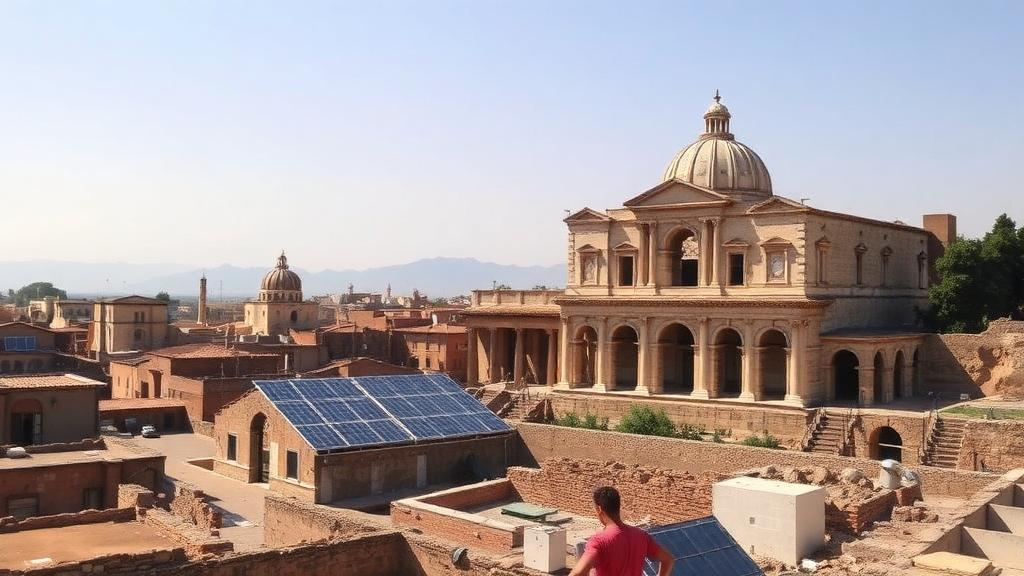
The rooftops of Pompeii, the ancient Roman city buried by the eruption of Mount Vesuvius in 79 AD, are getting a new kind of guardian. Researchers at the University of Salerno, working with the Archaeological Park of Pompeii, have unveiled HydraML, a hybrid automated machine learning system that scans drone imagery of archaeological sites and flags damaged roofs before small problems become catastrophic ones. The system, described in the journal Neural Computing and Applications, achieves accuracy that rivals or exceeds state-of-the-art deep learning methods while consuming dramatically less energy, a combination that places it at the forefront of what researchers call sustainable artificial intelligence.
The challenge the team set out to solve is one familiar to anyone who manages a vast heritage site. Pompeii covers roughly 44 excavated hectares and contains approximately 1,500 buildings, and every one of them, along with its frescoes, statues, and structural elements, is slowly deteriorating under the open sky. Continuous monitoring is essential, but human inspection of every roof is slow, expensive, and sometimes dangerous. Drones offer a solution: they can fly over inaccessible areas and capture high-resolution, georeferenced photographs. Yet the raw images are only the beginning. Someone, or something, must interpret thousands of aerial photographs and decide which roofs need urgent attention.
HydraML’s answer is a two-stage pipeline that blends the strengths of deep learning with the efficiency of classical machine learning. In the first stage, a deep neural network, selected automatically by a deep AutoML process built on Amazon’s AutoGluon framework, examines each drone image and extracts a rich numerical representation, or embedding, of what it sees. Rather than using this network to make the final decision, HydraML passes those embeddings through a mathematical compression step based on the Fuzzy-Transform, a technique rooted in fuzzy set theory that reduces the dimensionality of the feature space while preserving the information that matters for classification. The compressed features then feed into a second AutoML system, which automatically selects and trains the best traditional classifier for the task.
This hybrid design is what sets HydraML apart from earlier approaches. Previous combinations of deep and classical methods required researchers to manually choose and tune both the feature extractor and the final classifier, a laborious process involving extensive hyperparameter optimization. By bringing both stages into the AutoML paradigm, HydraML becomes something close to plug-and-play: users specify only a training time budget for the deep component and a few parameters for the fuzzy compression, and the system handles the rest. The Fuzzy-Transform compression also pays dividends before training even begins, because smaller images mean less energy spent transmitting data from drone to cloud.
The mathematical heart of the compression step is elegant in its simplicity. The Fuzzy-Transform partitions an image or feature matrix using overlapping basic functions, which can be sinusoidal, Gaussian, or pi-shaped, each covering a neighborhood of the data. By projecting the original matrix onto these functions, the method produces a much smaller compressed representation. Crucially, prior theoretical work has shown that under reasonable conditions, a learning system trained on Fuzzy-Transform-compressed data can achieve error rates of the same order as one trained on the original data. In HydraML’s experiments, compressing 768-dimensional deep embeddings down to a 12-by-16 grid roughly halved both classifier training time and CPU energy consumption on the Pompeii datasets, with almost no loss in predictive performance.
To test the system, the researchers built two novel datasets from orthophotos of Pompeii captured between June 2023 and September 2024 by a DJI Matrice 300 RTK drone flying at 80 meters, equipped with a Zenmuse L1 camera. Nine orthophotos, each roughly 10 gigabytes, were georeferenced so that any pixel could be traced back to its exact location on the ground. With the help of domain experts, the team curated PompeiiTile, containing 1,327 images of tiled roofs labeled as normal, broken, or covered in weedy vegetation, and PompeiiFlat, containing 922 images of flat roofs labeled as normal, broken conduits, stained, or weedy. Careful data augmentation, applied separately to each cross-validation fold to avoid leakage, balanced the training and validation sets.
The results were striking. On PompeiiTile, HydraML using a cosine fuzzy partition achieved an F1-score of 0.9406, with an accuracy of 0.9404 and the lowest variance among all tested methods, signaling unusual stability. On PompeiiFlat it reached an F1-score of 0.9117. To probe generalization beyond cultural heritage, the team also evaluated HydraML on RescueNet, a publicly available dataset of 8,354 aerial images collected after Hurricane Michael struck Florida in 2018, categorized by FEMA-inspired damage grades from no damage to total destruction. There, HydraML achieved an F1-score of 0.8686, outperforming a DenseNet201-based hybrid approach and a VGG16-based transfer learning method, and beating the standalone deep AutoML system by 1.30 percentage points.
The energy savings may prove even more consequential than the accuracy gains. On the urban dataset, HydraML cut GPU energy consumption by about 62.5 percent compared with a DenseNet201-SVM hybrid, dropping from roughly 139,000 joules to 52,000 joules. On PompeiiTile, reducing training from 480 to 300 seconds saved around 40.92 percent of GPU energy, and on PompeiiFlat the system saved 43.64 percent of GPU energy and 12.28 percent of CPU energy relative to the standalone deep AutoML baseline. Notably, HydraML beat that baseline even though it added just 20 seconds for compression and classical classifier training. The team measured power directly, sampling CPU and GPU draw every 100 milliseconds during training and integrating over time, giving the comparison unusual rigor.
Beyond simply detecting damage, HydraML can grade its severity. Using the same deep embeddings without retraining the expensive neural stage, the system trains additional classifiers to sort each detected problem into small, medium, or high severity. It distinguished broken-tile severity with an F1-score of 0.97, and performed well on vegetation and conduit issues, though it struggled with damp patches on flat roofs, where F1 barely exceeded 0.75. Most classification errors occurred between adjacent severity levels, a difficulty the researchers note also plagues human experts defining the ground truth. This severity information matters because heritage managers use vulnerability indices to prioritize interventions, and accurate severity grading feeds directly into maintenance planning.
The system is not infallible, and the researchers are candid about its failure modes. Dirt and mold on tiles can mimic missing tiles, shadows on flat roofs can be mistaken for damp stains, and dry, reddish vegetation is harder to spot than lush green growth. In one telling example, a clearly broken roof section at the edge of an image was classified as normal because the model focused on the center. The team also acknowledges that the Pompeii datasets contain relatively few original samples and that the approach has not yet been tested at other archaeological sites. Still, the researchers point out that false positives are the safer error: a wrongly flagged roof gets checked by an expert, whereas a missed problem can quietly destroy irreplaceable frescoes and structures. With the code released openly and the Pompeii datasets available on request, HydraML offers heritage sites worldwide a template for monitoring that is simultaneously smarter, faster, and greener.
Subject of Research: A hybrid automated machine learning approach using deep learning, Fuzzy-Transform compression, and UAV imagery to classify damaged roofs at the archaeological site of Pompeii
Article Title: HydraML: a hybrid damaged roofs automated machine learning classifier for cultural heritage
Article References: Colace, F., De Santo, M., Gaeta, R., & Zuchtriegel, G. (2026). HydraML: a hybrid damaged roofs automated machine learning classifier for cultural heritage. Neural Computing and Applications, 38(19), Article 798. https://doi.org/10.1007/s00521-026-12499-w
Image Credits: AI Generated
DOI: 10.1007/s00521-026-12499-w
Keywords: HydraML, automated machine learning, cultural heritage, Pompeii, deep learning, Fuzzy-Transform, roof damage classification, UAV imagery, sustainable AI, AutoGluon, energy efficiency, archaeological site monitoring
Cite Scienmag News
Blake Davidson. (October 12, 2026). AI Watches Over Pompeii: Hybrid Machine Learning Spots Damaged Roofs While Saving Energy. Scienmag. https://scienmag.com/ai-watches-over-pompeii-hybrid-machine-learning-spots-damaged-roofs-while-saving-energy/
Blake Davidson. "AI Watches Over Pompeii: Hybrid Machine Learning Spots Damaged Roofs While Saving Energy." Scienmag, 12 October 2026, https://scienmag.com/ai-watches-over-pompeii-hybrid-machine-learning-spots-damaged-roofs-while-saving-energy/. Accessed 12 October 2026.
Blake Davidson. "AI Watches Over Pompeii: Hybrid Machine Learning Spots Damaged Roofs While Saving Energy." Scienmag. October 12, 2026. https://scienmag.com/ai-watches-over-pompeii-hybrid-machine-learning-spots-damaged-roofs-while-saving-energy/


