


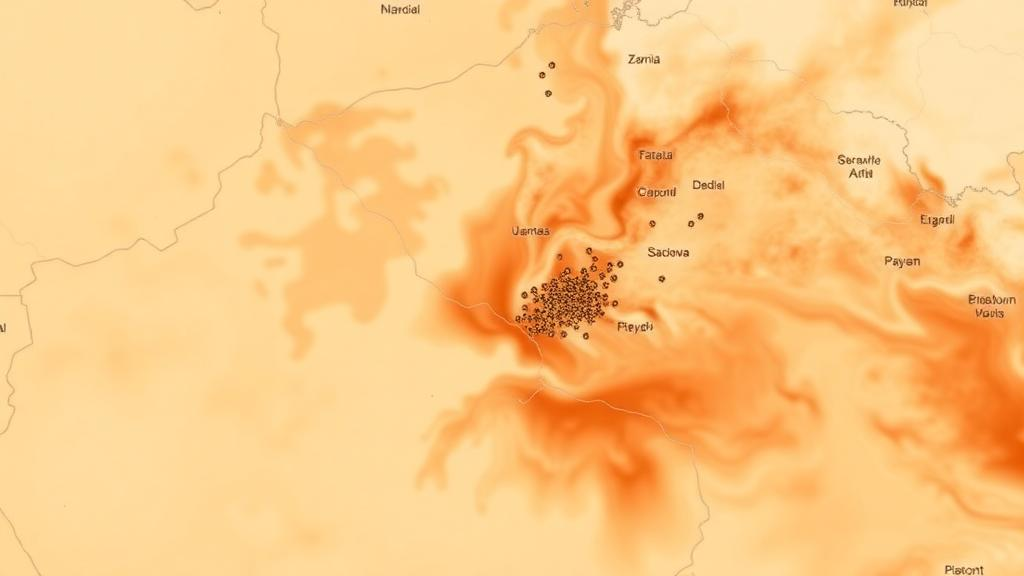
Fine particulate matter smaller than 2.5 micrometers across, known as PM2.5, is small enough to slip past the body’s natural defenses and lodge deep in the lungs, and in few places is it a more persistent problem than in Riyadh, the sprawling capital of Saudi Arabia. A new seven-year analysis published in Environmental Monitoring and Assessment has now charted how these microscopic particles varied across the city during spring seasons from 2016 to 2022, drawing on sixteen ground-based monitoring stations, satellite-derived vegetation data, and geographic information system mapping to build one of the most detailed pictures yet of the capital’s air quality dynamics. The findings reveal a city where pollution levels swing dramatically from year to year, where the southern and central districts consistently bear the heaviest burden, and where the greening of the urban landscape offers only an inconsistent shield against the dust-laden desert air.
The research team, led by Yousef Salem of King Saud University together with colleagues from Yarmouk University, Oregon State University, and King Saud University, focused on the spring season deliberately. Spring in Riyadh sits at the intersection of several competing influences: regional dust storms sweeping in from the Arabian Peninsula’s vast desert source regions, rising temperatures that alter atmospheric mixing, shifting wind patterns, and the seasonal growth of vegetation within and around the city. By isolating spring across seven consecutive years, the researchers could examine how these factors interact without the confounding effects of winter temperature inversions or summer’s extreme heat.
The headline numbers are striking. The highest seasonal average PM2.5 concentration recorded during the study period was 94.6 micrograms per cubic meter in 2018, a level nearly ten times the annual guideline value of 5 micrograms per cubic meter set by the World Health Organization. Just two years later, in 2020, the seasonal average dropped to 55.0 micrograms per cubic meter, the lowest of the entire record. That nearly forty percent decline between 2018 and 2020 is remarkable for a pollutant whose sources in Riyadh are dominated by natural dust rather than combustible fuel emissions, and it underscores how sensitive the city’s air quality is to year-to-year variability in dust storm activity and regional meteorology.
The timing of the 2020 low is unlikely to be a coincidence. The COVID-19 pandemic brought widespread restrictions on traffic and construction activity across Saudi Arabia in that year, and studies around the world documented measurable drops in urban air pollution during lockdowns. While the study does not attempt a formal attribution, the coincidence of the lowest spring PM2.5 average with the pandemic year aligns with a broader global pattern in which reduced human activity temporarily cleared urban skies. In a dust-dominated environment, however, even the most dramatic suppression of anthropogenic activity could only bring the seasonal average down to a level still roughly eleven times the WHO guideline, a sobering reminder of the limits of local emission control in a region where the desert itself is a relentless particle source.
Methodologically, the study combined three analytical approaches. Descriptive statistics characterized the central tendency and variability of PM2.5 at each of the sixteen monitoring stations. Correlation analysis tested the statistical relationships between particle concentrations and three key meteorological parameters: wind speed, air temperature, and relative humidity. Finally, GIS-based spatial distribution mapping, a technique rooted in geostatistical interpolation methods originally formalized for ArcGIS environments, translated the point measurements into continuous concentration surfaces across the city, allowing the researchers to visualize pollution hotspots and compare them against satellite-derived estimates of fractional vegetation cover, or FVC, a remote sensing metric that quantifies the proportion of ground surface covered by green vegetation.
The spatial patterns that emerged were consistent with the geography of a rapidly growing desert metropolis. Elevated PM2.5 concentrations clustered mainly in southern and central Riyadh, areas that combine dense urban development, heavy traffic corridors, and proximity to open, sparsely vegetated land that readily supplies dust to the atmosphere. Riyadh’s population has surged past seven million according to the 2022 national census, and the construction boom that accompanies such growth generates substantial fugitive dust, a problem serious enough that the Royal Commission for Riyadh City has launched dedicated programs to mitigate dust emissions from construction activities. The concentration of pollution in the south and center suggests that both local anthropogenic sources and the transport of windblown dust converge on these districts.
The meteorological correlations, while directionally sensible, proved statistically inconclusive. PM2.5 showed a moderate positive association with temperature, consistent with the expectation that warmer conditions enhance convective mixing, lift more dust from the surface, and promote the photochemical aging of aerosols. Relative humidity and wind speed both displayed weak negative associations with particle concentrations, which at first glance seems counterintuitive for wind, since stronger winds are the very mechanism that mobilizes desert dust. The explanation lies in the dual role of wind: at low speeds, wind accumulates and stagnates local pollution, while at higher speeds it disperses it, and in semi-arid climates the relationship between wind and dust concentration is famously nonlinear. None of these meteorological correlations reached statistical significance, a result the authors interpret as evidence that no single weather variable dominates Riyadh’s springtime particle budget; instead, the interplay of dust events, local emissions, and atmospheric conditions produces a system too complex to be captured by simple linear correlation.
The vegetation analysis delivered the study’s most nuanced and arguably most important finding. Across the seven spring seasons examined, a statistically significant inverse correlation between fractional vegetation cover and PM2.5 emerged in only one year, 2016, when the Spearman rank correlation coefficient reached minus 0.539 with a p-value of 0.031 across the sixteen monitoring stations. In every other year, the relationship was weak and statistically non-significant. This single-year significance is a cautionary tale for urban planning. Vegetation can intercept and deposit airborne particles through the rough surfaces of leaves and the disruption of airflow near the ground, a mechanism well documented in the literature on urban green infrastructure, from street canyon barriers to citywide tree canopies. But the new results show that in an arid environment battered by regional dust storms, the mitigating capacity of vegetation is not a reliable, year-in, year-out service. During intense dust episodes, the sheer flux of particles overwhelms what any realistic urban canopy can absorb, and in dry years the vegetation itself may be sparse or stressed.
For Riyadh’s planners, the implications cut in two directions. On one hand, the 2016 result demonstrates that greening can measurably reduce fine particle concentrations under favorable conditions, lending scientific support to the city’s ambitious tree-planting and green space initiatives, including the broader Saudi Green Initiative that aims to transform the urban environment. On the other hand, the inconsistency of the vegetation effect across years argues against treating urban forestry as a substitute for source control. The study’s authors emphasize that Riyadh’s air quality reflects the combined influence of meteorological conditions, dust activity, and human emissions, and that effective management therefore requires integrated monitoring rather than any single-lever intervention. The findings arrive at a moment when Saudi Arabia’s Ministry of Environment, Water and Agriculture has enacted executive air quality regulations, giving the scientific evidence a direct policy audience.
The broader scientific context makes the Riyadh case study globally relevant. Fine particulate matter is consistently ranked among the deadliest environmental pollutants worldwide, with global burden of disease studies attributing millions of premature deaths each year to long-term exposure, and the Middle East stands out as a region where natural dust and anthropogenic pollution intertwine in ways that temperate, industrialized cities rarely experience. By documenting seven years of springtime variability with station-level data and rigorous spatial analysis, the King Saud University-led team has provided a template for how rapidly growing desert cities can quantify their particle problem, test the promises of green infrastructure against real-world data, and identify the neighborhoods, in Riyadh’s case the south and center, where interventions will matter most. The message that emerges from the dust and data is clear: in the arid cities of the twenty-first century, cleaner air will demand both greener streets and smarter management of the desert at the doorstep.
Subject of Research: Spatiotemporal variation of springtime PM2.5 concentrations and their relationships with vegetation cover and meteorological factors in Riyadh, Saudi Arabia
Article Title: Spatiotemporal variation of PM₂.₅ and its relationship with vegetation cover and meteorological factors during spring (2016–2022) in Riyadh, Saudi Arabia
Article References: Salem, Y., Ghrefat, H., Hadadi, N., Rushdi, A. I., & Alharbi, H. A. (2026). Spatiotemporal variation of PM₂.₅ and its relationship with vegetation cover and meteorological factors during spring (2016–2022) in Riyadh, Saudi Arabia. Environmental Monitoring and Assessment, 198(11), Article 1179. https://doi.org/10.1007/s10661-026-16057-8
Image Credits: AI Generated
DOI: 10.1007/s10661-026-16057-8
Keywords: PM2.5, air pollution, Riyadh, Saudi Arabia, dust storms, vegetation cover, meteorology, air quality monitoring, GIS mapping, urban greening, environmental health, Environmental Monitoring and Assessment
Cite Scienmag News
Russell Cooper. (October 12, 2026). Riyadh’s Spring Air Pollution Mapped Across Seven Years of Dust and Heat. Scienmag. https://scienmag.com/riyadhs-spring-air-pollution-mapped-across-seven-years-of-dust-and-heat/
Russell Cooper. "Riyadh’s Spring Air Pollution Mapped Across Seven Years of Dust and Heat." Scienmag, 12 October 2026, https://scienmag.com/riyadhs-spring-air-pollution-mapped-across-seven-years-of-dust-and-heat/. Accessed 12 October 2026.
Russell Cooper. "Riyadh’s Spring Air Pollution Mapped Across Seven Years of Dust and Heat." Scienmag. October 12, 2026. https://scienmag.com/riyadhs-spring-air-pollution-mapped-across-seven-years-of-dust-and-heat/


