


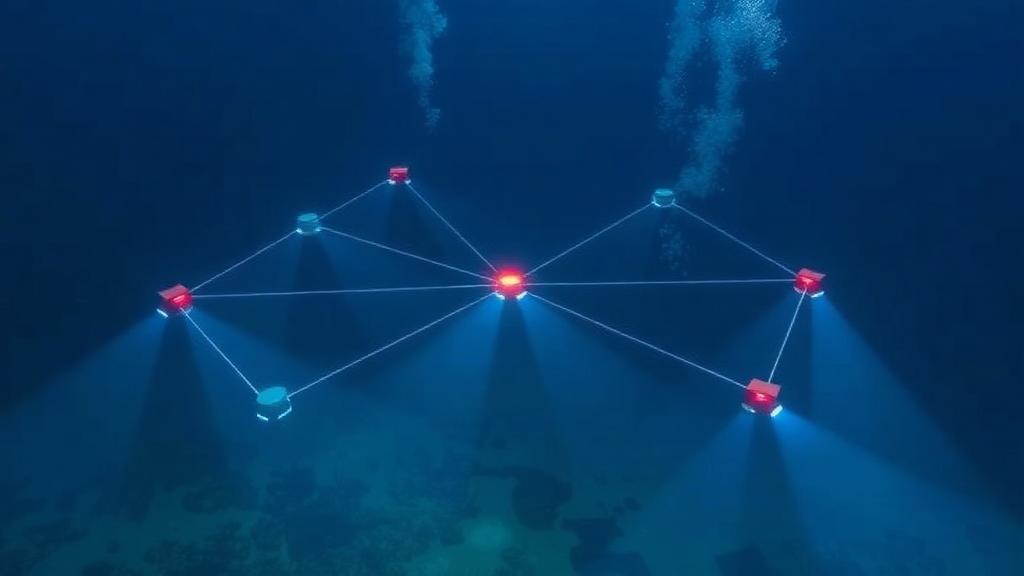
Beneath the ocean’s surface, one of the most difficult communication problems in modern engineering plays out silently every day. Radio waves, which carry our calls and data across continents with ease, are absorbed almost completely by seawater, so underwater networks must rely on sound instead. Acoustic signals travel slowly, links drop without warning, and the battery-powered sensors that form these networks cannot easily be recharged once deployed. A new study published in Scientific Reports tackles this stubborn challenge with an unexpected tool: a form of cooperative artificial intelligence that lets underwater sensors learn, as a team, how to route their data home.
The research, conducted by Adi Surendra Mohanraju M and Anjaneyulu Lokam of the National Institute of Technology, Warangal, together with Kiran Dasari of the Manipal Institute of Technology, introduces a routing framework for Underwater Acoustic Sensor Networks, or UASNs, built on cooperative multi-agent reinforcement learning. The work was funded through open access support from the Manipal Academy of Higher Education, and the authors report no competing interests. Their central idea is deceptively simple: instead of programming fixed routing rules into every sensor, let each node learn its own forwarding policy through experience, while the team as a whole is trained to act in a coordinated way.
To understand why this matters, it helps to appreciate just how hostile the underwater channel is. Acoustic signals propagate at roughly 1,500 meters per second, five orders of magnitude slower than light, which produces high and variable propagation delays. Bandwidth is scarce, multipath reflections from the surface and seafloor garble transmissions, and the topology of the network shifts constantly as currents move the sensors around. Traditional routing protocols, which assume relatively stable links and predictable neighbors, struggle under these conditions. Every wasted transmission drains a battery that may need to last for months, so inefficiency is not merely inconvenient; it shortens the operational life of the entire network.
The researchers frame the routing problem mathematically as a Decentralized Partially Observable Markov Decision Process, abbreviated Dec-POMDP. In this formulation, each relay node in the network is treated as an autonomous routing agent that must make decisions using only locally available information. No individual sensor can see the whole network; it knows only what it can measure about itself and its immediate surroundings. This partial observability is precisely what makes the problem hard, and it is also what makes it realistic, because in a real deployment no underwater node can afford the communication overhead of constantly sharing global state information across a slow acoustic channel.
Training such a team of independent agents is notoriously difficult, since each learner’s environment changes as the others adapt. The authors sidestep this with a paradigm known as Centralized Training and Decentralized Execution, or CTDE. During a simulated training phase, a centralized algorithm can observe the joint behavior of all agents and guide them toward cooperative policies. Once training is complete, however, each node executes its own trained local Q-network using only its local observations, requiring no central coordinator at runtime. The specific algorithm chosen for the centralized phase is QMIX, a method designed for exactly this kind of cooperative multi-agent setting.
QMIX works by learning a mixing network that combines the individual action-value estimates of each agent into a single team value, under a monotonicity constraint that ensures the agents’ contributions add up coherently. In practical terms, each underwater sensor builds a local observation vector from four kinds of information: its residual energy, its relative forwarding progress toward the sink node that collects the data, an estimate of the quality of its communication links, and the availability of neighboring nodes. The action space consists of cooperative next-hop selection, meaning each agent’s decision is which neighboring node should receive the packet it is forwarding. This design keeps the on-board computation light enough for resource-constrained sensor hardware while still allowing sophisticated, context-sensitive decisions.
The learning process is steered by a reward function tailored specifically to the demands of underwater acoustic networking. Rather than rewarding raw throughput alone, the function jointly optimizes packet delivery reliability, energy efficiency, and network lifetime. Agents earn positive rewards for reliably forwarding packets toward the sink and receive penalties for inefficient routing decisions, such as squandering energy on transmissions that fail or send data along wasteful paths. Over many training episodes, this shaping pressure encourages the emergence of routing behavior that balances immediate delivery success against the long-term sustainability of the network, a trade-off that hand-designed protocols often handle poorly.
The authors evaluated their framework through extensive simulations, comparing it against representative routing protocols across the metrics that matter most in this domain: packet delivery rate, end-to-end delay, and network lifetime. According to the study, the proposed approach consistently outperformed the comparison protocols on all of these measures. The reported gains are significant because the three metrics tend to pull against one another. A protocol can boost delivery rates by flooding the network with redundant copies, at a devastating energy cost, or conserve energy by transmitting rarely, at the cost of lost packets. A learned policy that improves all three simultaneously suggests it has discovered genuinely better routing strategies rather than merely trading one weakness for another.
The implications extend well beyond the simulation environment. UASNs underpin a growing range of scientific and commercial activities, from oceanographic monitoring and climate research to offshore infrastructure inspection, aquaculture management, and early-warning systems for natural hazards such as tsunamis and submarine landslides. Every one of these applications depends on sensors that can keep reporting data reliably for as long as possible on a fixed energy budget. A routing layer that adapts intelligently to changing link conditions and node availability could extend mission durations, reduce the need for costly recovery and redeployment of hardware, and improve the quality of the scientific records these networks produce.
The work also illustrates a broader trend in networking research: the migration of multi-agent reinforcement learning from game-playing benchmarks into the unglamorous but critical infrastructure of distributed systems. By modeling a physical engineering problem as a Dec-POMDP and applying the CTDE recipe with QMIX, the researchers demonstrate a template that could plausibly be adapted to other challenged network environments, including satellite constellations, subterranean sensor grids, and disaster-response mesh networks. The authors describe their framework as an effective, scalable, and intelligent routing solution for next-generation underwater acoustic sensor networks. If the simulation results hold up in real deployments, the oceans’ silent sensor webs may soon be guided not by static rules written in advance, but by cooperative policies learned through experience, one packet at a time.
Subject of Research: Cooperative multi-agent reinforcement learning for energy-efficient routing in underwater acoustic sensor networks
Article Title: A QMIX-driven routing protocol for dynamic Underwater Acoustic Sensor Networks
Article References: M, A. S. M., Lokam, A., & Dasari, K. (2026). A QMIX-driven routing protocol for dynamic Underwater Acoustic Sensor Networks. Scientific Reports. https://doi.org/10.1038/s41598-026-74771-2
Image Credits: AI Generated
DOI: 10.1038/s41598-026-74771-2
Keywords: Underwater Acoustic Sensor Networks, multi-agent reinforcement learning, QMIX, routing protocols, Dec-POMDP, centralized training decentralized execution, energy efficiency, network lifetime, packet delivery rate, acoustic communication, Scientific Reports, intelligent routing
Cite Scienmag News
Denise Maddox. (October 12, 2026). Underwater Sensor Networks Learn to Route Themselves with Team-Based AI. Scienmag. https://scienmag.com/underwater-sensor-networks-learn-to-route-themselves-with-team-based-ai/
Denise Maddox. "Underwater Sensor Networks Learn to Route Themselves with Team-Based AI." Scienmag, 12 October 2026, https://scienmag.com/underwater-sensor-networks-learn-to-route-themselves-with-team-based-ai/. Accessed 12 October 2026.
Denise Maddox. "Underwater Sensor Networks Learn to Route Themselves with Team-Based AI." Scienmag. October 12, 2026. https://scienmag.com/underwater-sensor-networks-learn-to-route-themselves-with-team-based-ai/


