


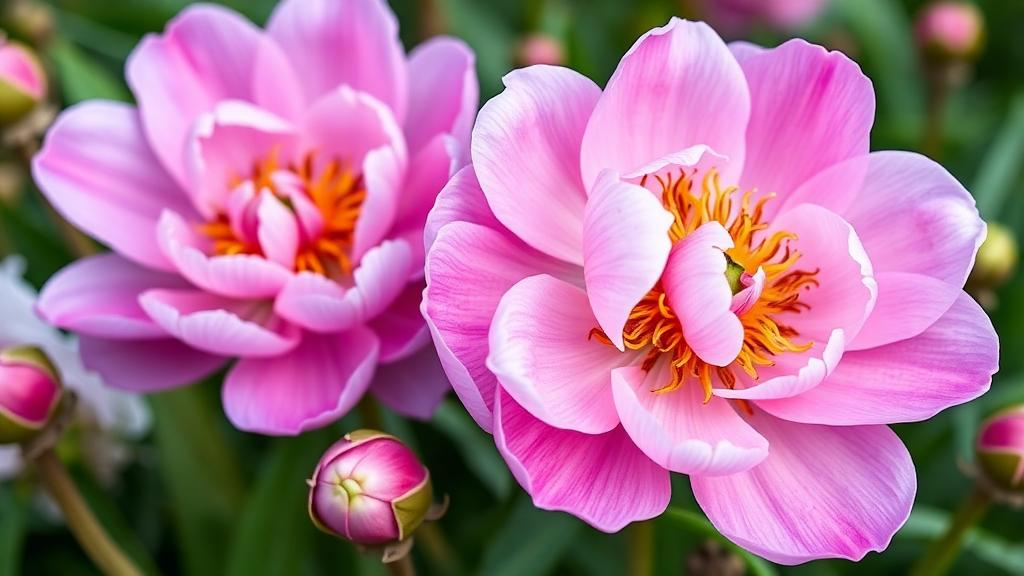
Iran’s wild peonies have long been admired by botanists and gardeners alike, yet the genetic architecture of these striking plants has remained largely a mystery. A new study published in BMC Plant Biology has now delivered the most detailed picture to date of the genetic diversity and population structure of five labeled Iranian Paeonia taxa, combining microsatellite markers with morphological measurements in a framework explicitly designed to cope with the complications of polyploid genomes. The research, led by Mohammad Fazli and Nima Ahmadi of Tarbiat Modares University in Tehran together with Jose Inaki Hormaza and Nerea Larranaga of IHSM La Mayora in Málaga, Spain, offers both a celebration of the country’s peony heritage and a sober warning about how much of that heritage remains scientifically uncharted.
Peonies of the genus Paeonia are among the most iconic ornamental plants in the world, and Iran sits within an important center of diversity for the genus. The Iranian flora includes taxa such as Paeonia wendelboi, Paeonia tomentosa, Paeonia wittmanniana, Paeonia archibaldii and field-assigned representatives of Paeonia mascula, many of which grow in fragmented mountain habitats and face pressure from habitat loss and uncontrolled collection. Understanding how genetic variation is distributed across these plants is not merely an academic exercise. It determines which populations conservationists should prioritize, which landraces and wild relatives breeders can draw upon, and whether the current taxonomic labels applied in the field actually correspond to coherent biological lineages.
The technical challenge the researchers faced is one that haunts much of polyploid plant genetics. Many peonies carry more than two copies of each chromosome, which means that at any given microsatellite locus a single individual may carry several different alleles, and conventional genotyping methods cannot always determine exactly how many copies of each allele are present. Rather than guessing at this so-called allele dosage, the team adopted a dosage-agnostic, polyploid-aware framework that treats alleles simply as present or absent in each genotype. This approach sacrifices some statistical power but avoids building entire analyses on unreliable dosage calls, making the results far more reproducible for organisms whose ploidy levels are uncertain or variable.
In total, seventy-two genotypes representing the five labeled taxa were screened at nine polymorphic simple sequence repeat loci. The analysis of molecular variance revealed a striking split: 31.35 percent of the detected SSR variation was attributable to differences among the labeled taxa, with a differentiation statistic of 0.3135 that was highly significant, while the remaining 68.65 percent resided within taxa. In other words, most of the genetic diversity of Iranian peonies is packed inside each taxon rather than separating one species cleanly from another. That pattern is a double-edged sword. It signals that individual populations harbor a wealth of unique variation worth protecting, but it also means that species boundaries drawn from morphology alone may not map neatly onto genetic reality.
Ordination analyses sharpened that message. The first two principal coordinate axes accounted for 38.93 percent of the reported variation and cleanly separated Paeonia wendelboi from the closely entangled Paeonia tomentosa and Paeonia wittmanniana complex. A discriminant analysis of principal components, a method that finds the axes best separating predefined groups, assigned 66 of the 72 genotypes, or 91.7 percent, to the label expected from their field identification. Crucially, every single discordant assignment involved Paeonia tomentosa or Paeonia wittmanniana, suggesting that these two taxa are genetically intertwined to a degree that challenges their current treatment as fully separate species. When the researchers used a threshold-based approach to define multilocus genotype groups, they recovered forty-one distinct groups across the sampled plants, underscoring how finely structured the variation is even within a modest number of loci.
The diversity estimates themselves told a conservation-relevant story. Paeonia wendelboi showed comparatively low genetic diversity, with a Simpson’s index of 0.785 and only eight multilocus genotype groups detected among thirty-two samples, whereas Paeonia tomentosa was far more variable, with a Simpson’s index of 0.941 and nineteen groups among just twenty-four samples. Low diversity in Paeonia wendelboi could reflect historical bottlenecks, restricted gene flow, or sampling of a genetically narrow species, and it flags this taxon as potentially vulnerable. Populations with reduced genetic diversity have less evolutionary flexibility in the face of climate change, disease, and habitat fragmentation, making Paeonia wendelboi a natural priority for conservation sampling and ex situ collection.
To connect genes with form, the team descriptively integrated their SSR data with a previously generated dataset of locality-level means for fifteen morphological traits. A principal component analysis of the morphology found that the first component alone explained 68.02 percent of the sample-weighted variation, indicating that a single dominant axis of shape and size differences, likely reflecting overall vegetative and floral architecture, distinguishes the sampled localities. An exploratory matrix correlation between the genetic and morphological datasets yielded a coefficient of 0.510, a moderate association suggesting that morphology does carry a genuine genetic signal in these peonies, but that a substantial fraction of the variation in traits is shaped by factors other than the neutral marker variation captured by the microsatellites. Mean Sørensen dissimilarity across three pairwise taxon comparisons was 0.535, with the turnover component of dissimilarity exceeding the nestedness-resultant component, meaning that populations differ mainly by replacing alleles and genotypes rather than by simply losing subsets of a shared pool.
Perhaps the most scientifically honest part of the study lies in its sensitivity analyses and stated limitations. When the authors repeated their analyses after globally excluding two loci, Loc6 and Loc9, the broad genetic separation of Paeonia wendelboi persisted robustly in the seven-locus dataset. The fine-scale separation between Paeonia tomentosa and Paeonia wittmanniana, however, proved sensitive to the marker set used, dissolving in some sensitivity runs. Meanwhile, inference for Paeonia archibaldii and the field-assigned Paeonia mascula accession was explicitly limited by small sample sizes. The authors are careful not to overclaim: their results provide a reproducible baseline, not a final taxonomic verdict, and they call for expanded cytogenetic work to pin down ploidy levels and genome-wide studies to resolve species boundaries with far greater resolution than nine microsatellite loci can deliver.
Why should a study of Iranian peonies capture wider attention? Because it exemplifies a methodological shift sweeping through plant conservation genetics. Polyploid crops and wild relatives, from bananas and potatoes to many ornamentals, have long resisted standard population genetic toolkits, and dosage-agnostic frameworks like the one deployed here offer a way to extract reliable signal without costly whole-genome sequencing. The finding that nearly seventy percent of variation lies within taxa also carries a universal lesson for conservation planning: protecting a single reserve per species is not enough. Multiple genetically distinct populations must be safeguarded to capture the full breadth of variation, and the forty-one multilocus genotype groups identified here provide a concrete, data-driven shopping list for seed collectors and gene bank curators.
The study, supported by Tarbiat Modares University and the Iran National Science Foundation under project number 4021138, and conducted in collaboration with Spanish researchers at IHSM La Mayora, ultimately reads as both a milestone and an invitation. It establishes the first rigorous multilocus baseline for Iranian Paeonia, demonstrates that Paeonia wendelboi is a genuinely distinct and genetically depauperate lineage deserving urgent attention, and exposes the Paeonia tomentosa and Paeonia wittmanniana complex as a fascinating evolutionary puzzle in which morphology, genetics and taxonomy only partially align. As genome-wide tools become accessible for non-model ornamentals, the mountains of Iran may yet yield a fully resolved peony family tree, and this study has laid the essential first stones of that foundation.
Subject of Research: Genetic diversity and population structure of Iranian Paeonia taxa assessed with SSR markers and morphological traits
Article Title: Genetic diversity and population structure of five Iranian Paeonia taxa revealed by SSR markers and morphological traits
Article References: Fazli, M., Ahmadi, N., Hormaza, J. I., & Larranaga, N. (2026). Genetic diversity and population structure of five Iranian Paeonia taxa revealed by SSR markers and morphological traits. BMC Plant Biology. https://doi.org/10.1186/s12870-026-10055-1
Image Credits: AI Generated
DOI: 10.1186/s12870-026-10055-1
Keywords: Paeonia, genetic diversity, SSR markers, polyploidy, population structure, multilocus genotypes, Iran, plant conservation, microsatellites, morphological traits, DAPC, BMC Plant Biology
Cite Scienmag News
Juliet Wilcox. (October 11, 2026). Hidden Genetic Wealth of Iran’s Wild Peonies Mapped by Microsatellite Markers. Scienmag. https://scienmag.com/hidden-genetic-wealth-of-irans-wild-peonies-mapped-by-microsatellite-markers/
Juliet Wilcox. "Hidden Genetic Wealth of Iran’s Wild Peonies Mapped by Microsatellite Markers." Scienmag, 11 October 2026, https://scienmag.com/hidden-genetic-wealth-of-irans-wild-peonies-mapped-by-microsatellite-markers/. Accessed 11 October 2026.
Juliet Wilcox. "Hidden Genetic Wealth of Iran’s Wild Peonies Mapped by Microsatellite Markers." Scienmag. October 11, 2026. https://scienmag.com/hidden-genetic-wealth-of-irans-wild-peonies-mapped-by-microsatellite-markers/


