


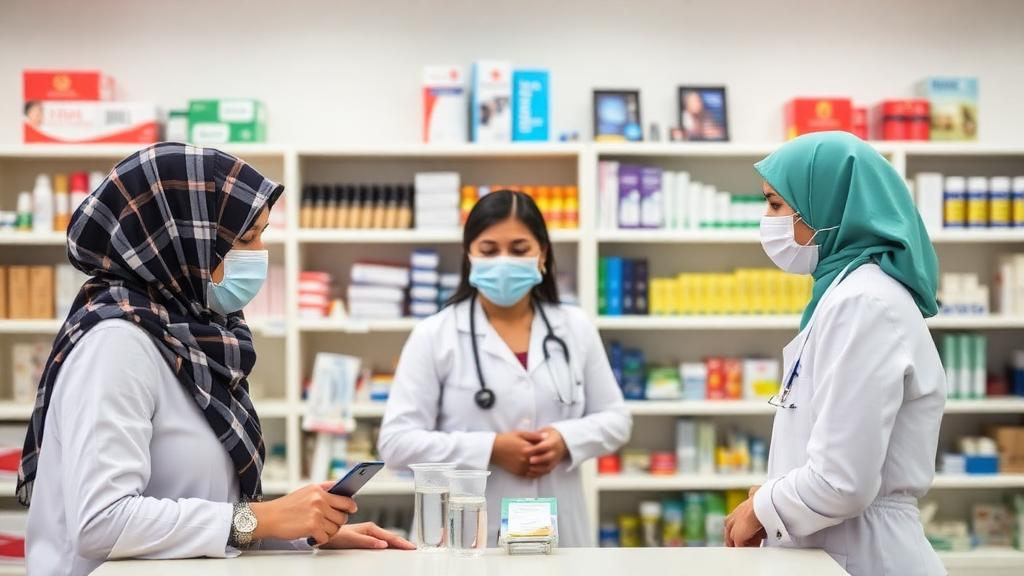
Community pharmacies are often the first and sometimes the only point of contact between refugees and a host country’s health system. In Türkiye, which hosts one of the largest refugee populations in the world, that front line has been staffed for more than a decade by pharmacy professionals who dispense medicines, interpret prescriptions, and offer reassurance to patients who may speak little or no Turkish. A new qualitative study published in SN Social Sciences by Canan Çınar of Çankırı Karatekin University and Elif Erbay of Ankara University examines how these professionals actually experience that work, and the picture that emerges is one of improvisation, empathy, and quiet strain.
The researchers chose a phenomenological hermeneutic approach, a qualitative tradition that seeks to understand not just what people do but how they interpret and make meaning of their lived experiences. Rather than measuring outcomes with surveys or statistics, the method asks participants to describe their encounters in depth and then probes those descriptions for the underlying structures of meaning. This is well suited to a question like the one Çınar and Erbay posed: what is it like, day after day, to provide pharmaceutical services to Syrian refugees navigating an unfamiliar health system?
Data collection rested on semi-structured, in-depth interviews conducted with eight pharmacy professionals. Some interviews took place face to face, others by telephone, and all were digitally recorded, transcribed, and then reviewed thoroughly by the researchers before analysis. Semi-structured interviewing is a deliberate choice in this kind of research: it provides a common framework of questions while leaving room for participants to raise themes the researchers had not anticipated. The small sample size is typical of phenomenological studies, where the goal is depth of insight into a shared experience rather than statistical generalization across a population.
From the transcripts, the researchers extracted three overarching themes: perceptions and attitudes toward Syrians, adaptations in the working environment, and coping with difficulties. The first theme captures how pharmacy professionals view the refugee population they serve, a dimension that shapes every subsequent interaction. Attitudes in healthcare settings are not static; they are formed and reformed through repeated encounters, and the study treats them as an integral part of the service experience rather than a background variable.
The second theme, adaptations in the working environment, describes the practical changes pharmacists made to keep serving patients effectively. Language barriers emerged as the central challenge. When a patient cannot describe symptoms in Turkish and the pharmacist cannot read a prescription written in Arabic, the risk of misunderstanding is immediate and consequential. In the absence of formal interpreter services, professionals improvised, relying on gestures, drawings, translation applications, bilingual family members, and whatever fragments of shared vocabulary they could assemble. Each workaround carries its own risks, since a family member translating medical information may filter, soften, or distort it, and machine translation remains unreliable for nuanced health communication.
Cultural differences compounded the linguistic ones. Expectations about medication, adherence, and the role of the pharmacist vary across health cultures, and misunderstandings about how and why medicines should be taken can undermine treatment. The study highlights that these were not abstract cultural notes but daily operational realities, surfacing in consultations, in questions about dosing, and in the emotional texture of encounters between people who have fled war and the professionals who serve them.
The third theme, coping with difficulties, brings the emotional dimension of the work into focus. Çınar and Erbay emphasize that their findings illuminate not only practical adaptations but also the emotional burdens pharmacy professionals faced. Serving a traumatized population within a strained system exacts a psychological toll, and the study argues that this burden has been largely invisible in discussions of refugee healthcare, which tend to center on physicians, nurses, and hospitals. Pharmacists, by contrast, work in dispersed community settings where they absorb the pressures of the front line with less institutional support.
Systemic limitations ran through all three themes. The authors point to the need for interpreter services as a concrete, actionable gap: a professional interpreter in the pharmacy would reduce the risk of medication errors, relieve pharmacists of an improvised translation role they were never trained for, and improve the dignity and accuracy of consultations. The finding aligns with a broader international literature the authors cite, including studies of pharmacists serving Syrian refugees in Germany, Jordan, and Lebanon, and qualitative work on refugee healthcare barriers in Australia, Malaysia, and across sixteen European countries. Across these settings, language access recurs as the single most consequential modifiable barrier.
The study also situates itself within the scale of the displacement crisis. Türkiye’s refugee population grew rapidly after 2011, and the United Nations Refugee Agency’s global trends reports document the magnitude of forced displacement worldwide. Previous Turkish studies have documented difficulties refugees face in primary care and in hospital settings, including communication problems and unmet expectations, and a World Bank background paper on the Syrian case in Türkiye has weighed both the successes and the challenges of the response. What the new study adds is the pharmacy counter perspective, a vantage point close to where patients actually obtain medicines.
Methodologically, the authors ground their work in established qualitative traditions, drawing on Colaizzi’s phenomenological analysis procedure and on methodological references from Creswell, Lincoln and Guba, and van Manen, among others. The study received ethical approval from the Ankara University Ethics Committee, and informed consent was obtained from all participants, with procedures conducted in accordance with the Helsinki Declaration. The authors report no competing interests and no external funding. The paper carries a poignant dedication to the memory of Saad Ismail, a Syrian student of the authors who lost his life in the earthquakes that struck Türkiye on February 6, 2023, a reminder that the populations and the people who study them are bound together in the same fragile circumstances.
The practical implications are clear. If community pharmacists are de facto primary care providers for refugee populations, then health policy should equip them accordingly: funded interpreter access, cultural competence training, and clearer referral pathways to physicians and social services. For the global health community, the study is a reminder that healthcare systems are only as accessible as their most local interfaces, and that in Türkiye those interfaces are often staffed by pharmacists improvising across a language divide. Understanding their experience, the authors argue, is a necessary step toward building services that work for everyone who walks through the door.
Subject of Research: Pharmacy professionals' lived experiences providing healthcare services to Syrian refugees in Türkiye
Article Title: The voice of pharmacy professionals: experiences in providing services to Syrian refugees in Türkiye
Article References: Çınar, C., & Erbay, E. (2026). The voice of pharmacy professionals: experiences in providing services to Syrian refugees in Türkiye. SN Social Sciences, 6(9), Article 427. https://doi.org/10.1007/s43545-026-01728-7
Image Credits: AI Generated
DOI: 10.1007/s43545-026-01728-7
Keywords: Syrian refugees, pharmacy professionals, refugee healthcare, Türkiye, qualitative research, phenomenology, language barriers, interpreter services, community pharmacists, health communication, cultural differences, healthcare access
Cite Scienmag News
Courtney Benton. (October 11, 2026). Behind the Counter: How Turkish Pharmacists Cope with Language Barriers in Refugee Care. Scienmag. https://scienmag.com/behind-the-counter-how-turkish-pharmacists-cope-with-language-barriers-in-refugee-care/
Courtney Benton. "Behind the Counter: How Turkish Pharmacists Cope with Language Barriers in Refugee Care." Scienmag, 11 October 2026, https://scienmag.com/behind-the-counter-how-turkish-pharmacists-cope-with-language-barriers-in-refugee-care/. Accessed 11 October 2026.
Courtney Benton. "Behind the Counter: How Turkish Pharmacists Cope with Language Barriers in Refugee Care." Scienmag. October 11, 2026. https://scienmag.com/behind-the-counter-how-turkish-pharmacists-cope-with-language-barriers-in-refugee-care/


