


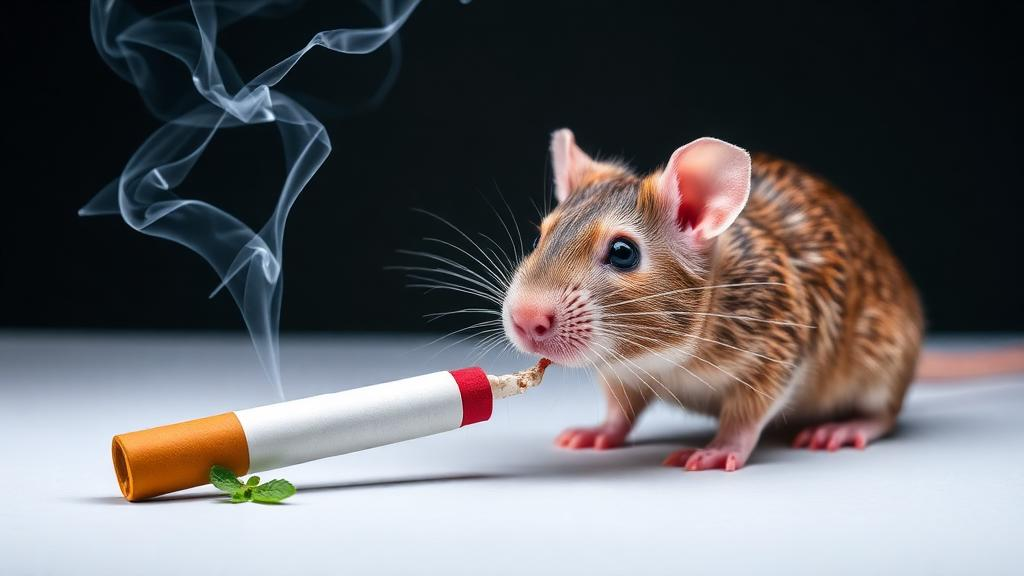
Menthol, the mint-flavored compound found in many cigarettes and e-cigarettes, may be doing far more than making inhaled nicotine taste cool and smooth. A new peer-reviewed study published in ACS Chemical Neuroscience reports that male rats exposed to e-cigarette aerosols containing both nicotine and menthol experienced nicotine’s physiological effects more strongly and for a longer period of time than animals exposed to nicotine alone. The research, conducted by Seong Shoon Yoon, Sooyeun Lee, and colleagues, adds to a growing body of evidence suggesting that flavoring agents are not chemically inert passengers in vaping products but active participants that can reshape how the body handles nicotine.
The central question the Korean research team set out to answer was deceptively simple: what happens when menthol and nicotine are inhaled together in an aerosol, rather than studied separately? Although previous work had hinted that menthol can influence nicotine-related responses in the body and in behavior, comparatively little was known about how the two compounds interact when delivered simultaneously through an e-cigarette device. That gap matters, because menthol is one of the most widely used flavorings in both traditional combustible cigarettes and electronic nicotine delivery systems, and regulators around the world continue to debate whether mentholated products should face restrictions.
To answer the question rigorously, the researchers took an unusually controlled approach. Rather than purchasing commercial vaping liquids, which contain a complex mixture of solvents, sweeteners, and flavoring chemicals, the team formulated their own e-cigarette liquids in which nicotine and menthol were the only additives. This design choice is scientifically important: by keeping the formulation minimal, the researchers could attribute differences between experimental groups to menthol itself rather than to any of the dozens of other compounds that typically populate flavored vape liquids. The study involved 81 male rats, a sample size large enough to support meaningful comparisons between exposure conditions.
The exposure protocol was designed to mimic real-world vaping patterns as closely as laboratory conditions allow. During aerosol exposure sessions, each rat was placed in a clear inhalation chamber, and nicotine or menthol aerosols were delivered at five-minute intervals using a commercial e-cigarette device. The number of puffs varied depending on the specific experiment, allowing the team to probe different doses and exposure durations. This interval-based delivery approach reflects how human vapers typically consume e-cigarettes, taking repeated puffs over a session rather than a single continuous exposure.
Once the animals had inhaled the aerosols, the researchers tracked two things: the chemistry of nicotine inside the body and the physiology it produces. Blood samples were analyzed for nicotine and its metabolism by-products, giving the team a direct readout of how the drug was being processed. At the same time, the researchers monitored body temperature, which is a well-established nicotine response in rodents. Nicotine acts on the nervous system in ways that lower core body temperature in rats, so a deeper or longer-lasting drop provides a reliable, quantifiable signature of the drug’s physiological impact.
The results were striking. Compared with rats that inhaled nicotine alone, animals exposed to the combined nicotine and menthol aerosol showed a prolonged nicotine-induced drop in body temperature. The difference between the two groups remained statistically significant at 120 minutes after exposure, meaning that menthol did not merely intensify nicotine’s immediate effect but stretched its duration well beyond what nicotine alone produced. In practical terms, the cooling flavoring appeared to keep the drug’s physiological fingerprint active for substantially longer.
The combined exposure also produced changes in the rats’ blood chemistry. Animals in the menthol-plus-nicotine group had higher levels of some nicotine by-products circulating in their blood than rats exposed to nicotine-only aerosols. This finding suggests that menthol may alter how nicotine is metabolized or distributed in the body, though the precise biochemical mechanism remains an open question for future work. In addition, the researchers observed that nicotine’s effects were more noticeable to the rats themselves when menthol was present, indicating that the flavoring may strengthen the internal drug cues that animals, and by extension humans, can perceive during exposure.
Yoon summarized the study’s implications bluntly. The most important takeaway, he said, is that menthol should not be viewed merely as a passive flavor additive. According to the researcher, the findings in male rats show that menthol changes both the intensity and the duration of nicotine’s physiological effects and its internal drug-cue effects. That framing challenges a common assumption in both consumer perception and regulatory discussion: that flavorings primarily serve a marketing or sensory function without altering the pharmacology of the product itself.
The study’s relevance extends beyond basic pharmacology into public health policy. Menthol has long been scrutinized for its role in smoking behavior. In combustible cigarettes, menthol’s cooling and mild anesthetic properties have been associated with smoother inhalation, and public health agencies have debated bans on menthol cigarettes for years. If menthol can similarly amplify nicotine’s effects in e-cigarettes, then flavoring policy for vaping products may need to account for pharmacological interactions, not just appeal to young consumers. The finding that menthol lengthened nicotine’s measurable effects in an animal model provides a concrete biological basis for that concern, although the researchers caution that their results come from male rats and that translation to human vaping behavior requires further study.
Indeed, the team’s next steps are already mapped out. The researchers plan to investigate exactly how menthol changes nicotine-related signaling in the brain, and whether the effects they observed differ between male and female rats. Sex differences in nicotine metabolism and addiction vulnerability are well documented in the broader literature, so extending the work to female animals could reveal whether menthol’s amplifying effect is universal or sex-specific. The study was funded by the Ministry of Food and Drug Safety and the National Research Foundation of Korea, reflecting regulatory interest in the science underlying vaping product oversight. The work also sits within a wider research landscape: two previous studies published in ACS journals have explored other potential health effects of e-cigarette vapor, including evidence that secondhand vape plumes could form lung-damaging radicals and that metals found in disposable e-cigarette vapor could pose health risks. Together, these studies paint an increasingly detailed picture of e-cigarettes as chemically active delivery systems whose additives, solvents, and hardware can each leave their own mark on the user’s body.
Subject of Research: How menthol flavoring in e-cigarette aerosols alters nicotine's physiological effects and metabolism in rats
Article Title: Menthol enhances the strength, duration of nicotine's effects in rats
Article References: Menthol enhances the strength, duration of nicotine's effects in rats. (n.d.). Original publication
Image Credits: AI Generated
DOI: Not provided
Keywords: menthol, nicotine, e-cigarettes, vaping, rats, ACS Chemical Neuroscience, pharmacology, nicotine metabolism, body temperature, flavoring additives, drug cues, public health
Cite Scienmag News
Bethany Barker. (October 11, 2026). Menthol Makes Nicotine Hit Harder and Last Longer in Rat Study. Scienmag. https://scienmag.com/menthol-makes-nicotine-hit-harder-and-last-longer-in-rat-study/
Bethany Barker. "Menthol Makes Nicotine Hit Harder and Last Longer in Rat Study." Scienmag, 11 October 2026, https://scienmag.com/menthol-makes-nicotine-hit-harder-and-last-longer-in-rat-study/. Accessed 11 October 2026.
Bethany Barker. "Menthol Makes Nicotine Hit Harder and Last Longer in Rat Study." Scienmag. October 11, 2026. https://scienmag.com/menthol-makes-nicotine-hit-harder-and-last-longer-in-rat-study/


