


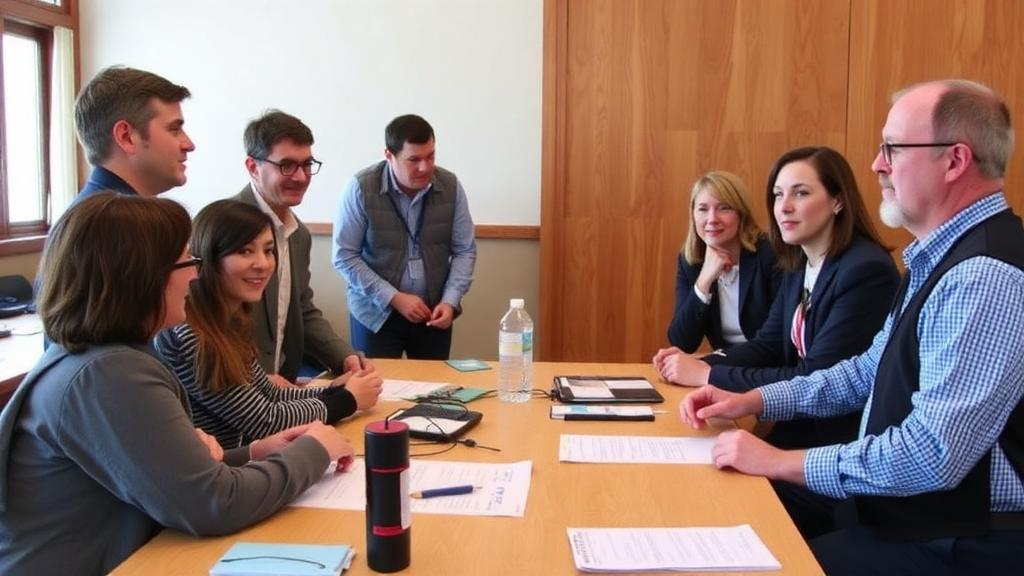
When infectious disease outbreaks strike, mathematical models often sit at the center of the response, projecting how epidemics might unfold and what interventions could slow them. Yet the people who build those models and the people who use them to make decisions have long operated in separate professional worlds, with different vocabularies, different incentives, and different understandings of what a model can realistically deliver. A workshop held this August in Vermont set out to confront that divide directly, gathering researchers and practitioners in the same room for three days of structured conversation about how epidemiological modeling and public health practice can finally work as one enterprise.
The Workshop on Public Health Policy, Risk Perception, and Infectious Disease took place from August 10 to 12, 2026, at the Essex Resort & Spa in Essex, Vermont, near Burlington. Organized around the goal of bridging the gap between public health professionals, policymakers, and disease modelers, the meeting drew approximately 30 participants, a deliberately intimate scale that organizers hoped would foster the kind of candid exchange that larger conferences rarely permit. The event was connected to a research project supported by the National Science Foundation, and its ambitions were explicitly twofold: to help public health professionals use mathematical models more effectively in their practical work, and to teach modelers how public health policies, real-world interventions, and official guidelines are actually formed and implemented on the ground.
That second objective is one that modelers frequently acknowledge but rarely get the opportunity to study up close. An epidemiological model is, at its core, a set of assumptions about how a pathogen spreads through a population and how human behavior changes in response to disease and to policy. If those assumptions misrepresent how guidelines are written, how mandates are enforced, or how communities actually respond to recommendations, the resulting projections can be technically elegant and practically useless. Conversely, public health officials who lack a grounding in what models can and cannot capture may demand certainty that no model can provide, or may dismiss modeling altogether after a single high-profile forecast misses the mark. The workshop was designed to dismantle these mutual misconceptions by identifying both the practical challenges and the mutual benefits of using epidemiological models to support public health decision-making.
One of the first hurdles participants tackled was language itself. Terms that seem interchangeable in everyday conversation carry distinct technical and administrative meanings in the worlds of modeling and governance. Participants worked to establish a shared vocabulary that clarifies the definitions and overlaps of four words that recur constantly in outbreak response: policy, intervention, guidance, and recommendation. The distinction matters because each term implies a different mechanism of action and a different degree of enforceability. A policy may carry legal weight and institutional backing, while a recommendation may rely entirely on voluntary compliance. A modeler who lumps these categories together may inadvertently simulate a level of population adherence that no real-world guidance could achieve, while a practitioner who hears a modeler refer casually to an intervention may not know whether the model assumes a mandate, a suggestion, or something in between.
Behavior occupied a central place in the discussions, reflecting a growing recognition within the modeling community that epidemics are not purely biological phenomena. Participants examined methods for incorporating flexibility when modeling different behavioral groups in response to various public health interventions. Populations are not uniform: people differ in their risk perception, their trust in institutions, their material circumstances, and their willingness to change daily habits. A model that treats the public as a single homogeneous mass will behave very differently from one that distinguishes, say, highly cautious individuals from skeptics, or essential workers who cannot isolate from those who can. Building that flexibility into models requires both better data on behavior and a conceptual framework for how behavioral groups form, shift, and interact over the course of an outbreak.
Sessions on intervention dynamics drew a sharp contrast between top-down and bottom-up approaches to public health action. Top-down structures, in which directives flow from governments or health authorities to individuals, typically offer less individual agency; people are told what to do rather than invited to decide. Bottom-up approaches, by contrast, afford more agency, allowing communities and individuals to shape their own protective behaviors. The workshop also examined the distinction between material and nonmaterial changes. Material interventions rely on physical methods, such as vaccination or mask wearing, and involve tangible actions with visible tools. Nonmaterial changes involve beliefs and social norms, the invisible scaffolding that determines whether people believe a risk is real and whether protective behavior feels socially expected. The participants considered how these two categories affect the ease or difficulty with which the public adopts protective behaviors, a question with direct consequences for how models should represent adherence and how officials should design communication campaigns.
Another recurring concern was the risk of population fractioning. When models divide a population into behavioral or demographic groups, there is a danger that the resulting picture encourages fragmented real-world responses, with different communities receiving different messages or following different rules until the collective effort loses coherence. Modeling experts and practitioners discussed interaction strategies that avoid fractioning the population into isolated groups, aiming instead to ensure a more cohesive public response to health guidelines. The issue sits at the intersection of technical modeling choices and social science: how a model partitions a population can shape how policymakers think about their constituents, and how officials segment their messaging can in turn reshape the behavioral structure that models try to capture. Breaking that feedback loop of fragmentation, participants suggested, requires deliberate attention on both sides.
Underlying all of these technical discussions was a recognition that the divide between modelers and practitioners is fundamentally relational. The group therefore advocated for more direct interactions and structured cross-training initiatives between epidemiological modelers and public health practitioners, arguing that sustained personal relationships are the most reliable way to overcome the existing challenges between the fields. Cross-training could mean modelers spending time inside health departments to see how decisions are actually made under time pressure and political constraints, or practitioners gaining enough familiarity with model structure and uncertainty to interrogate results confidently. The workshop itself served as a prototype for such exchange, with its small size and mixed attendance encouraging conversations that neither community could have had alone.
The meeting was not without lighter moments. Two performing artists from Event Rap composed and performed rap songs about the days’ discussions, translating dense technical debates into verse. The workshop also premiered what organizers describe as the world’s first rap music video sponsored by the National Science Foundation, created to fulfill the research grant’s Broader Impacts mandate, the program requirement that funded projects demonstrate benefits to society beyond academic publications. The choice of medium was more than entertainment; science communication researchers have long argued that creative formats can carry technical content to audiences, including policymakers and community members, who might never read a journal article or attend a seminar.
The conversation is intended to continue. Following the workshop, participants plan to extend the discussion to include international collaborators and other nonacademic groups, widening the circle beyond the roughly 30 researchers and practitioners who gathered in Vermont. For a field still digesting the lessons of recent pandemic responses, the stakes of that continued dialogue are considerable. Models will inevitably remain central to outbreak planning, and public health agencies will inevitably remain the institutions that translate projections into action. The Vermont workshop’s contribution was to begin building the shared vocabulary, behavioral realism, and personal relationships that could make that translation smoother the next time a new pathogen emerges.
Subject of Research: Bridging epidemiological modeling and public health policy practice for infectious disease response
Article Title: Experts convene to bridge the gap between epidemiological modeling and public health practice
Article References: Experts convene to bridge the gap between epidemiological modeling and public health practice. (n.d.). Original publication
Image Credits: AI Generated
DOI: Not provided
Keywords: epidemiological modeling, public health policy, infectious disease, risk perception, workshop, National Science Foundation, behavioral groups, intervention dynamics, science communication, cross-training, policy implementation, Vermont
Cite Scienmag News
Phoebe Ingram. (October 11, 2026). Modelers and Public Health Officials Meet in Vermont to Close a Persistent Communication Gap. Scienmag. https://scienmag.com/modelers-and-public-health-officials-meet-in-vermont-to-close-a-persistent-communication-gap/
Phoebe Ingram. "Modelers and Public Health Officials Meet in Vermont to Close a Persistent Communication Gap." Scienmag, 11 October 2026, https://scienmag.com/modelers-and-public-health-officials-meet-in-vermont-to-close-a-persistent-communication-gap/. Accessed 11 October 2026.
Phoebe Ingram. "Modelers and Public Health Officials Meet in Vermont to Close a Persistent Communication Gap." Scienmag. October 11, 2026. https://scienmag.com/modelers-and-public-health-officials-meet-in-vermont-to-close-a-persistent-communication-gap/


