


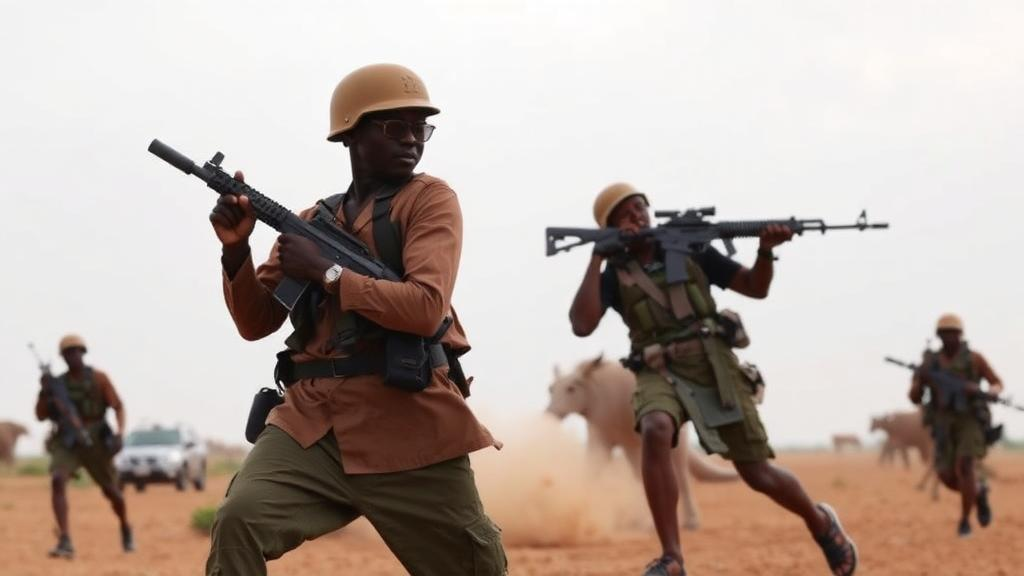
A new study argues that the decisive variable in Africa’s intensifying great power rivalry is not the size of armies, the sophistication of their weapons, or even the volume of foreign aid they receive, but something far harder to measure: the will to fight. Writing in the open-access journal SN Social Sciences, political scientist Chick Edmond of Old Dominion University presents a comparative analysis of four African contexts—the Sahel, Mali, Cameroon, and the Horn of Africa—showing that a state’s political legitimacy, civil-military cohesion, and societal commitment to national defense determine whether it can deter coercion, remain strategically open, and ultimately win without going to war. The findings arrive at a moment when external powers compete for influence across the continent through arms sales, training missions, infrastructure financing, and information operations rather than direct confrontation, making the pre-conflict foundations of resolve more consequential than ever.
The puzzle Edmond sets out to solve is a persistent paradox in African security. States that receive large quantities of external military assistance often fail to deter threats or preserve their autonomy, while states with far fewer resources demonstrate resilience and strategic flexibility. Conventional explanations focus on institutional weakness, governance deficits, and state capacity, and these variables matter. But they cannot account for cases in which armed forces with superior numbers, foreign training, and modern equipment collapse rapidly under pressure. Drawing on Stephen Biddle’s demonstration that force employment and morale can outweigh numerical superiority, the study argues that materialist explanations miss the political and social dimensions of fighting power: the willingness of soldiers to fight, of civilians to support them, and of leaders to pursue national rather than regime interests.
The concept of will to fight has deep roots in military theory. Carl von Clausewitz identified moral factors—courage, unity, and purpose—as sometimes more important than numerical or technological superiority, and modern scholarship from Shils and Janowitz’s wartime cohesion studies to Anthony King’s work on the combat soldier has confirmed that resolve is socially and politically produced rather than an individual psychological trait. What Edmond adds is a reframing: instead of treating will to fight as an explanation of battlefield performance, he positions it as a pre-conflict strategic variable that shapes deterrence credibility, alliance durability, and a state’s capacity to keep its options open before the first shot is fired. In deterrence terms, resolve is the social and political foundation of a credible threat; without it, no quantity of material capability makes a threat believable.
The study’s central claims follow from this reframing. First, will to fight is essential for maintaining what Edmond calls strategic openness—the ability of a state to engage with multiple external partners without becoming dependent on any one of them or surrendering sovereignty. States lacking political legitimacy and civil-military cohesion increasingly trade sovereignty for short-term regime survival, outsourcing security to coercive external providers and watching their strategic options shrink. Second, great power competition in Africa is facilitated by weak will to fight rather than overcome by material superiority: external actors exploit it by offering regime-centric security solutions such as private military companies, surveillance technology, and personal protection that undermine long-term deterrence and institutional resilience. Third, authoritarian fragmentation and transnational threats create a self-reinforcing cycle in which regimes that prioritize internal control erode the societal foundations needed to resist those very threats, deepening external dependency.
The comparative cases illustrate the argument’s two directions. The Sahel presents the most visible erosion of will to fight in contemporary Africa. Counterterrorism operations initially framed as national defense gradually became regime-specific security projects that lost legitimacy with their own populations. In Mali, Burkina Faso, and Niger, politicized chains of command, corruption, and coup-proofing strategies—parallel security units loyal to individuals rather than the state, promotions based on loyalty rather than merit—hollowed out institutional cohesion and morale. The result was desertions, mutinies, and battlefield withdrawals by numerically superior forces, followed by rapid strategic realignment. Mali, once considered a showcase of international security assistance, collapsed under the combined pressure of insurgency and political crisis; its successive coups, the study argues, reflected institutional failure rather than military strength. As domestic will to fight declined, the regime abandoned multilateral partnerships for individualized security agreements, trading long-term independence for short-term survival.
Cameroon occupies an intermediate position that sharpens the analytical contrast. Its armed forces remain operational against Boko Haram in the Far North and separatists in the Anglophone regions, but their will to fight is uneven and tied closely to regime survival rather than state legitimacy. Elite units demonstrate cohesion while broader institutional trust remains low, and operations framed as defense of regime stability limit societal buy-in. This partial will to fight sustains baseline deterrence against insurgents but constrains strategic openness: Cameroon maintains diverse external partnerships, yet these are defined by the security needs of the regime rather than by institutional reforms that would broaden legitimacy. The country is resilient enough to remain stable but not legitimate enough to convert resolve into strategic autonomy.
The Horn of Africa, and Ethiopia in particular, demonstrates the opposite logic. Despite insurgency, conflict, and intense external pressure in a strategically coveted region, Ethiopia has engaged multiple partners—including the United States, China, and Gulf states—without becoming wholly dependent on any of them. Edmond attributes this to a comparatively strong will to fight built on three sources: a narrative of national sovereignty shared across ethnic and regional lines, a military identity anchored in historical memory of resistance such as the Battle of Adwa, and a leadership that, while authoritarian, has framed security policy in terms of national defense rather than purely regime preservation. External actors, recognizing the costs of coercion, adjust their strategies accordingly. The Horn cases show that even under severe structural constraints, will to fight can function as a strategic asset that shapes the outcomes of competition.
Beyond the African cases, the study proposes a framework with general applicability, subject to three scope conditions: competition must be indirect rather than a direct great power war, transnational threats must be testing state legitimacy, and states must retain sufficient capacity for meaningful strategic choice. Edmond points to India as an illustrative non-African case, where democratic legitimacy, professional civil-military relations, and social cohesion have preserved strategic openness despite material disadvantages relative to China. He also offers defense planners a practical toolkit for assessing will to fight before conflict erupts, organized into political indicators such as public trust and whether security strategy protects the nation or the ruling party; institutional indicators such as meritocratic promotion, professional military independence, and the presence of parallel loyalist forces; and societal indicators such as civilian support for national defense and the extent of ethnic or regional exclusion. Data observable only during conflict—actual combat performance, leadership resilience under duress—should be treated as hypotheses to be tested through continued engagement rather than certainties.
The policy implications are pointed. Security force assistance, the study argues, must be understood as a political enterprise rather than a technical one; training and equipment that ignore legitimacy and civil-military cohesion produce hollow forces that perform in controlled environments but fail under sustained pressure, as the Sahel and Mali demonstrate. Deterrence in Africa rests on resilience rather than dominance, and supporting a partner’s political endurance signals that coercion will be resisted over time regardless of an adversary’s advantages. The study further recommends differentiating between partners capable of reform and those whose security institutions are structurally oriented toward regime preservation, treating credible state narratives linking security operations to national purpose as a deterrent function rather than a public affairs task, and integrating security assistance with development and humanitarian policy so that counterterrorism operations do not undermine the legitimacy they depend upon. Strategic openness, on this view, is an outcome to be supported, not assumed.
The study’s broader conclusion reframes what winning means in an era of indirect competition. In peripheral theaters like Africa, contests are decided not by decisive battles or formal alliances but by the ability of states and societies to maintain the resolve to resist coercion and protect their autonomy. Where will to fight is strong, competition is mediated by institutionalized domestic capabilities, and external actors must negotiate and accept limits; where it is weak, competition becomes extractive and destabilizing, accelerating fragmentation and dependence. The most important contests, Edmond concludes, occur before the first shot is fired—and for the states and external powers alike, will to fight must be assessed, developed, and protected with the same seriousness accorded to force structure and technology.
Subject of Research: The role of will to fight in African state deterrence, strategic openness, and great power competition
Article Title: Winning without war in Africa: the will to fight, strategic openness, and great power rivalry
Article References: Edmond, C. (2026). Winning without war in Africa: the will to fight, strategic openness, and great power rivalry. SN Social Sciences, 6(10), Article 521. https://doi.org/10.1007/s43545-026-01814-w
Image Credits: AI Generated
DOI: 10.1007/s43545-026-01814-w
Keywords: will to fight, great power competition, Africa security, deterrence, strategic openness, Sahel, Mali, Cameroon, Horn of Africa, civil-military relations, security assistance, transnational threats
Cite Scienmag News
Courtney Benton. (October 11, 2026). Will to Fight, Not Weapons, Decides Who Wins Without War in Africa. Scienmag. https://scienmag.com/will-to-fight-not-weapons-decides-who-wins-without-war-in-africa/
Courtney Benton. "Will to Fight, Not Weapons, Decides Who Wins Without War in Africa." Scienmag, 11 October 2026, https://scienmag.com/will-to-fight-not-weapons-decides-who-wins-without-war-in-africa/. Accessed 11 October 2026.
Courtney Benton. "Will to Fight, Not Weapons, Decides Who Wins Without War in Africa." Scienmag. October 11, 2026. https://scienmag.com/will-to-fight-not-weapons-decides-who-wins-without-war-in-africa/


