


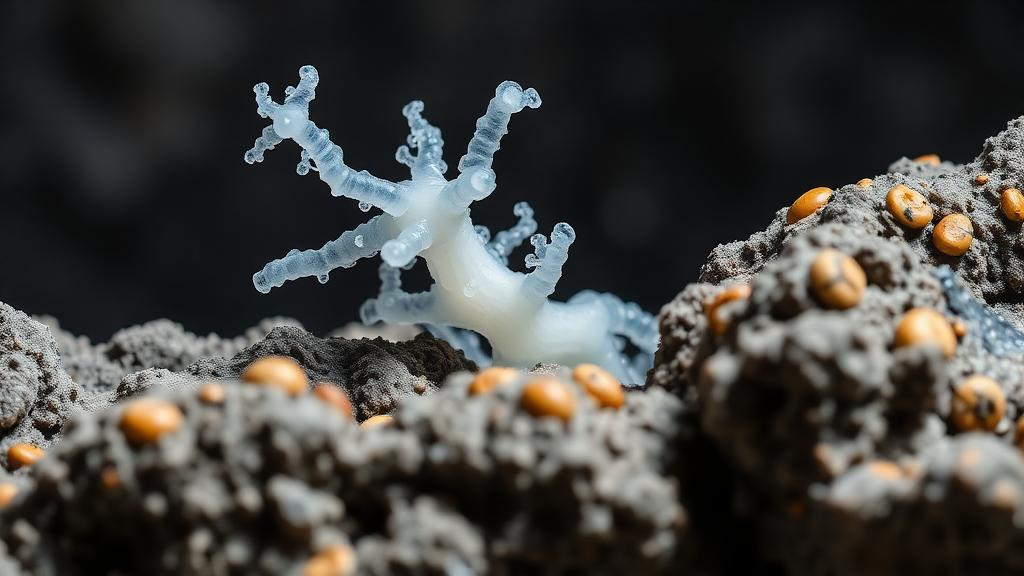
Potassium is one of the three macronutrients every crop needs, yet most of the world’s potassium reserves locked inside soil minerals are chemically inaccessible to plant roots. Farmers compensate with mined potash fertilizers, an energy-intensive resource concentrated in only a handful of countries. A new study published in PLOS One by Zihan Dong, Lei Zhang, Yue Miao, Yun Chen, Lihong Liu, and Lufan Qiu offers a detailed biochemical explanation of how certain soil bacteria can unlock that trapped potassium, providing what the authors describe as a comprehensive structural framework for microbe-driven nutrient mobilization. Their work focuses on a single bacterial strain, designated S1 and classified in the genus Burkholderia, and follows its attack on biotite, a potassium-rich mica mineral common in many agricultural soils.
The research addresses a long-standing gap in soil microbiology. Potassium solubilizing bacteria, often abbreviated KSB, have been known for decades to enhance the bioavailability of potassium by dissolving K-bearing minerals, thereby facilitating nutrient cycling in the rhizosphere. What has remained only partially understood is the multifaceted biochemistry behind that weathering. Different mechanisms have been proposed over the years, including acidification, chelation of metal ions by organic ligands, and direct physical contact between cells and mineral surfaces, but disentangling the relative contributions of each process has proven difficult. The new study tackles this problem by combining careful kinetic monitoring of potassium release with chemical analysis of the metabolites the bacteria produce and microscopic examination of the mineral surfaces they erode.
The headline result is striking in its magnitude. Over an incubation period of thirty days, strain S1 achieved a maximum soluble potassium ion concentration of 39.8 milligrams per liter, representing a 4.5-fold increase over abiotic controls in which the same mineral was incubated without bacteria. That figure matters because it demonstrates that the release of potassium is not a passive leakage from the mineral lattice but an actively driven process requiring living cells and their metabolism. The comparison with sterile controls allows the authors to attribute the extra potassium specifically to bacterial activity rather than to background hydrolysis or experimental artifacts, a critical distinction in mineral weathering studies where abiotic dissolution can be substantial on its own.
At the heart of the mechanism, the researchers identified what they call a synergistic dual-attack strategy. The first arm of the attack is continuous acidification. Over the course of the experiment, the pH of the culture medium fell from 6.42 to 3.82, a shift the authors link to proton-driven release of potassium ions from the biotite structure. In aluminosilicate minerals, hydrogen ions can exchange with interlayer cations and destabilize the negatively charged silicate sheets that hold potassium in place. The sustained drop in pH means this proton attack was not a one-time event but a persistent chemical pressure maintained by the bacterial community throughout the incubation, steadily prying potassium loose from the mineral’s interlayer sites.
The second arm of the attack is ligand-mediated complexation, and here the study makes a particularly interesting observation about which molecules the bacteria actually deploy. Metabolite analysis revealed that the dominant secretions were citric acid and malic acid, two low-molecular-weight organic acids well known in soil chemistry for their ability to bind metal cations. By chelating structural cations such as aluminum and iron from the biotite framework, these ligands pull essential building blocks out of the crystal lattice, destabilizing the aluminosilicate structure from within. This complexation works in concert with the proton attack: while acidity loosens the electrostatic grip holding potassium between the silicate sheets, the organic acids corrode the framework itself, making the mineral progressively easier to dismantle.
Beyond the two-pronged chemical assault, the study uncovered a third, subtler layer of regulation involving amino acids. The researchers observed a temporal accumulation of polar and acidic amino acids in the culture over the incubation period, and they propose that these compounds served as biogenic regulators of the bacteria-mineral interface. Amino acids with charged side chains can alter local surface chemistry, enhance bacterial adhesion to mineral surfaces, and strengthen the interactions occurring at the cell-mineral boundary. In practical terms, this means the bacteria were not merely floating in the medium releasing chemicals at random; they appear to have actively engineered their microenvironment to keep themselves in close contact with the very surface they were dissolving, concentrating their chemical arsenal where it would do the most work.
Direct visual evidence supports this chemical picture. Scanning electron microscopy of the biotite particles after incubation revealed extensive surface etch pits and edge exfoliation, the kind of morphological damage expected when a layered mineral is being chemically excavated from its exterior and along its sheet edges. Etch pits form where dissolution is locally accelerated, often at defect sites or where cells and their extracellular products are in intimate contact with the crystal, while exfoliation at edges reflects the separation of the mineral’s silicate layers as interlayer potassium and structural cations are removed. These microscopic scars corroborate the solution chemistry, tying the measured potassium release to visible, physical degradation of the mineral structure.
Taken together, the findings suggest that mineral weathering by potassium solubilizing bacteria is not the product of any single mechanism but of a coordinated, synergistic interaction among proton attack, ligand-mediated chelation, and amino acid-assisted micro-environment regulation. Each process reinforces the others. Acidification increases the solubility of the mineral and the mobility of metal ions; chelation removes those ions from equilibrium, driving further dissolution by Le Chatelier-type feedback; and interfacial regulation by amino acids ensures that the reacting bacteria remain anchored to the dissolution front. This systems-level view helps explain why single-factor experiments, which test acid production or chelation in isolation, have historically underestimated the weathering power of living bacterial cultures.
The agricultural implications are considerable. Potassium deficiency affects crops across vast regions of the world, and conventional potash fertilization is costly, geographically concentrated, and subject to price volatility. If strains like Burkholderia S1, or the mechanisms they embody, can be harnessed in bio-fertilizer formulations, farmers could tap the enormous reservoir of structural potassium already present in their soils’ mineral fractions. The authors explicitly highlight this potential, positioning Burkholderia as an efficient candidate for bio-fertilizer development aimed at potassium-deficient soils. The kinetic data, showing sustained release over a thirty-day period, are particularly relevant here, because a bio-fertilizer must deliver nutrients on a timescale that matches crop demand rather than in a single pulse.
There remain, of course, substantial steps between a well-characterized laboratory culture and a field-ready inoculant. Real soils present competing mineral phases, variable pH, fluctuating moisture, and native microbial communities that may facilitate or suppress an introduced strain. The authors’ contribution is to supply the mechanistic blueprint: a defined set of chemical levers, acidification, citrate and malate chelation, and amino-acid-mediated adhesion, whose combined action can be measured, optimized, and eventually engineered. By unraveling the biochemical and kinetic mechanisms of potassium solubilization from biotite, the study transforms potassium solubilizing bacteria from a promising but opaque phenomenon into a process with identifiable, quantifiable components, a necessary foundation for any serious effort to deploy microbial potassium mining at agricultural scale.
Subject of Research: Mechanisms of potassium solubilization from biotite by potassium solubilizing bacteria
Article Title: Unraveling the biochemical and kinetic mechanisms of potassium solubilization from biotite by a Burkholderia strain
Article References: Dong, Z., Zhang, L., Miao, Y., Chen, Y., Liu, L., & Qiu, L. (2026). Unraveling the biochemical and kinetic mechanisms of potassium solubilization from biotite by a Burkholderia strain. PLOS One, 21(10), e0360380. https://doi.org/10.1371/journal.pone.0360380
Image Credits: AI Generated
DOI: 10.1371/journal.pone.0360380
Keywords: potassium solubilizing bacteria, Burkholderia, biotite, mineral weathering, citric acid, malic acid, organic acids, soil potassium, bio-fertilizer, scanning electron microscopy, aluminosilicate dissolution, rhizosphere
Cite Scienmag News
Morgan Morrow. (October 11, 2026). Potassium-Mining Bacteria Unveiled: How Burkholderia Cracks Open Biotite With a Dual Chemical Assault. Scienmag. https://scienmag.com/potassium-mining-bacteria-unveiled-how-burkholderia-cracks-open-biotite-with-a-dual-chemical-assault/
Morgan Morrow. "Potassium-Mining Bacteria Unveiled: How Burkholderia Cracks Open Biotite With a Dual Chemical Assault." Scienmag, 11 October 2026, https://scienmag.com/potassium-mining-bacteria-unveiled-how-burkholderia-cracks-open-biotite-with-a-dual-chemical-assault/. Accessed 11 October 2026.
Morgan Morrow. "Potassium-Mining Bacteria Unveiled: How Burkholderia Cracks Open Biotite With a Dual Chemical Assault." Scienmag. October 11, 2026. https://scienmag.com/potassium-mining-bacteria-unveiled-how-burkholderia-cracks-open-biotite-with-a-dual-chemical-assault/


