


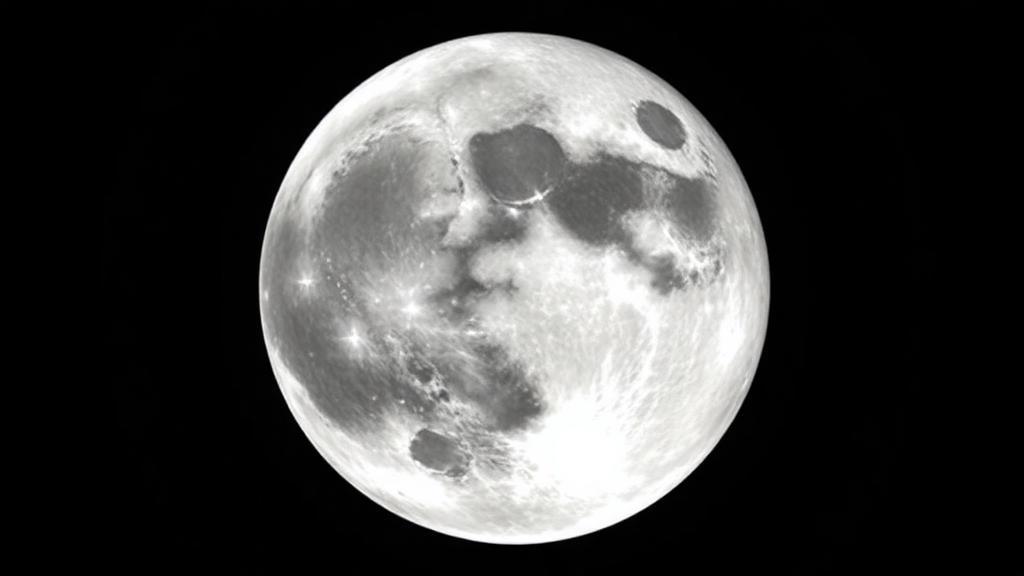
For more than two decades, the dominant scientific story of how our Moon came to be has rested on a single dramatic event: a collision between the young Earth and a Mars-sized protoplanet often called Theia. That scenario, developed through increasingly sophisticated computer simulations, elegantly explained many of the defining characteristics of the Earth-Moon system, from the Moon’s relatively large size to its low iron content. Yet a new study led by scientists at the Southwest Research Institute, conducted in collaboration with researchers at the University of Arizona and published in The Astrophysical Journal Letters, suggests that the field has been missing a crucial ingredient all along. By incorporating the material strength of the colliding bodies into state-of-the-art impact simulations for the first time in this context, the team found that the outcome of the giant impact depends far more sensitively on the geologic and thermal conditions inside the proto-Earth and Theia than anyone had previously assumed.
The foundational giant impact models, including a landmark 2001 study by Dr. Robin Canup of SwRI and Dr. Erik Asphaug of the University of Arizona, treated the colliding planets essentially as fluids. At the enormous energies involved in a planetary-scale collision, researchers had long assumed that the intrinsic strength of rock, its resistance to deformation and fracture, would be negligible compared with the crushing pressures and temperatures generated during impact. That assumption simplified the calculations and produced the now-canonical picture: Theia strikes the young Earth, is largely destroyed, and sheds a massive disk of molten and vaporized debris into orbit around the planet. Over time, material in that protolunar disk coalesces, and the Moon assembles from the wreckage. It is a compelling narrative, and one that has shaped textbooks, museum displays, and countless scientific papers.
Dr. Adeene Denton, formerly a NASA Postdoctoral Program fellow at SwRI and now a postdoctoral researcher in the institute’s Solar System Science and Exploration Division, led the new effort to test whether that simplification could be justified. Modern computational methods, she noted, have already demonstrated that material strength matters enormously in collisions between smaller bodies such as asteroids, and in her previous work modeling the formation of the Pluto-Charon system. The open question was whether strength would matter at the vastly larger scale of the Moon-forming impact. The answer, according to the new simulations, is an emphatic yes. When the Earth and Theia are modeled as geologically realistic bodies with temperature-dependent strength, the way the Moon emerges from the collision changes in fundamental ways.
The key physical insight is deceptively simple: hotter bodies are weaker than colder ones. Rock that is close to its melting point deforms readily under stress, behaving more like a fluid, while cooler rock retains genuine strength and can resist fragmentation and flow. Because protoplanets begin their lives hot, heated by accretion, radioactive decay, and the energy of formation, and then cool gradually over tens of millions of years, the internal temperature of the Earth and Theia at the moment of impact serves as a kind of geological clock. The team’s simulations show that Moon formation is acutely sensitive to those temperatures, and that the thermal state of the colliding bodies effectively encodes information about when in solar system history the collision took place.
The consequences are striking. In some scenarios, corresponding to hotter, earlier, and therefore weaker colliding planets, the impact destroys Theia and generates the familiar massive debris disk around Earth, from which the Moon gradually accretes. But when Denton and her colleagues ran a simulation using the same parameters as the original impact modeling, including matching the temperature structures inside both bodies, an intact Moon emerged within roughly five hours of the collision. Rather than being shredded and reassembled from disk material over years or centuries, the Moon in this colder, later scenario survives the impact as a coherent body, captured into orbit essentially whole. Intact Moon outcomes had been glimpsed in earlier simulations, but this work is the first to demonstrate that material strength and temperature play a central role in determining whether the Moon forms intact or is assembled from processed disk material.
The implications extend well beyond the mechanics of the collision itself. If the Moon formed intact, its initial composition, thermal state, and internal structure could differ substantially from those of a Moon assembled from a hot, well-mixed debris disk. Dr. Robin Canup, vice president of SwRI’s Solar System Science and Exploration Division in Boulder, Colorado, who was not involved in the study but co-authored the foundational 2001 work, described the results as surprising and exciting, noting that they imply a potential connection between the physical properties of the Moon today, including perhaps its volatile content, and the thermal state of the Earth and Theia at the time of the giant impact. In other words, the water, carbon, and other volatile elements that scientists measure in lunar samples today may carry a chemical memory of how hot the colliding worlds were billions of years ago.
That connection, if it can be pinned down, offers planetary scientists a genuinely new tool. The Moon’s volatile inventory is one of the most intensively studied aspects of lunar science, informed by the Apollo samples and by ongoing analysis of data from modern lunar missions. If the abundance and distribution of those volatiles can be linked to a specific thermal scenario for the giant impact, researchers may be able to constrain the timing of the Moon-forming event itself, one of the most consequential dates in the history of the solar system. A colder Earth and Theia would point to a later collision, after the planets had had time to radiate away their primordial heat, while a hotter, more fluid outcome would suggest an earlier, more violent epoch.
One long-standing puzzle remains stubbornly unresolved, however: the remarkably close compositional similarity between the Earth and the Moon. Isotopic measurements of elements such as oxygen, titanium, and silicon show that the Earth and its satellite are nearly identical in makeup, far more alike than two randomly assembled planetary bodies should be, particularly if the Moon is largely built from the remains of Theia. Mars, by contrast, is compositionally distinct from both. One possible explanation, which the new study does not overturn, is that Theia and the proto-Earth formed from a common region of the protoplanetary disk, sharing the same raw materials, while Mars formed farther out in the solar system under different conditions. Denton offered an evocative analogy: because Earth and Mars formed in the same neighborhood of the solar system, they are like siblings, whereas the Moon and Earth are more like fraternal twins, born of the same event but assembled from different parents.
The technical achievement underlying these results lies in the simulation methods themselves. The study employed giant impact modeling techniques developed at the University of Bern and the University of Arizona, extended to incorporate temperature-dependent geologic strength for the first time in the Moon-formation context. This means the code tracks not only the hydrodynamic flow of molten and vaporized material during the collision but also the ability of cooler rock to resist deformation, fracture, and shear. That additional physics changes how energy is dissipated, how the impacting body breaks apart or holds together, and how much material ends up in orbit versus falling back onto the planets. The difference between a disk-forming outcome and an intact-capture outcome, the simulations show, can hinge entirely on whether the colliding interiors are modeled as strengthless fluids or as real, thermally evolving geology.
What emerges from this work is a richer and more contingent picture of the Moon’s birth. Rather than a single canonical scenario, there is now a family of plausible pathways, each tied to the thermal histories of the two colliding worlds and each leaving a potentially distinct fingerprint on the Moon we see today. The intact-Moon scenario, in particular, invites a re-examination of assumptions baked into decades of lunar science, from models of the early lunar magma ocean to interpretations of the Moon’s internal structure. As researchers begin to compare the predictions of strength-inclusive simulations against the growing body of lunar geochemical and geophysical data, the giant impact hypothesis is entering a new phase, one in which the preexisting geology of the colliding planets, long considered an afterthought, may hold the key to understanding both when the Moon formed and what it is made of.
Subject of Research: Computational modeling of the Moon-forming giant impact incorporating material strength and temperature
Article Title: SwRI-led modeling identifies new scenarios for Moon formation
Article References: SwRI-led modeling identifies new scenarios for Moon formation. (n.d.). Original publication
Image Credits: AI Generated
DOI: Not provided
Keywords: Moon formation, giant impact, Theia, Southwest Research Institute, material strength, protolunar disk, planetary science, The Astrophysical Journal Letters, Earth-Moon system, lunar volatiles, computer simulations, protoplanets
Cite Scienmag News
Grant Pearson. (October 11, 2026). New Simulations Reveal the Moon May Have Formed Intact in Just Hours. Scienmag. https://scienmag.com/new-simulations-reveal-the-moon-may-have-formed-intact-in-just-hours/
Grant Pearson. "New Simulations Reveal the Moon May Have Formed Intact in Just Hours." Scienmag, 11 October 2026, https://scienmag.com/new-simulations-reveal-the-moon-may-have-formed-intact-in-just-hours/. Accessed 11 October 2026.
Grant Pearson. "New Simulations Reveal the Moon May Have Formed Intact in Just Hours." Scienmag. October 11, 2026. https://scienmag.com/new-simulations-reveal-the-moon-may-have-formed-intact-in-just-hours/


