


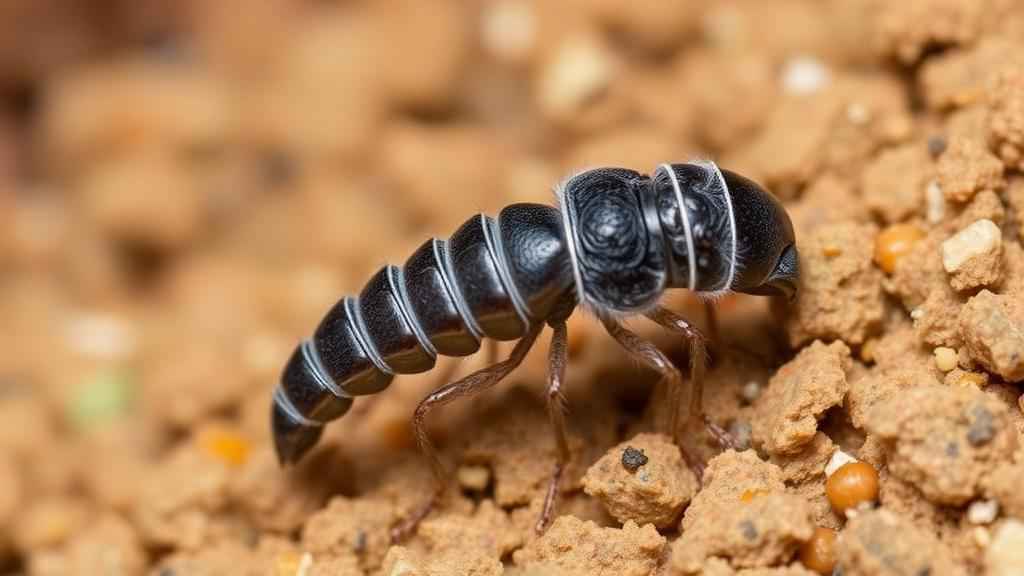
In the harsh desert shrublands of northern Xinjiang, China, a quiet chemical and biological war is unfolding around a humble salt-tolerant shrub called Lycium ruthenicum, the black goji berry plant prized both for its antioxidant-rich fruit and its role as a keystone species holding fragile desert soils together. A new study published in Ecology and Evolution has, for the first time, systematically mapped the intricate three-way relationships linking this plant, the gall-inducing insects that attack it, and the parasitoid wasps that hunt those herbivores from within. The findings include a globally first-of-its-kind discovery: a moth species confirmed as the first member of its genus ever documented to induce galls, along with a parasitoid community far richer and stranger than scientists expected.
Galls are abnormal plant growths triggered by the feeding or egg-laying of insects and mites, which manipulate host tissue into forming protective shelters around their developing young. On L. ruthenicum, two gall makers were already known: the goji gall mite Aceria pallida, which deforms leaves and flower buds, and an undetermined gall midge, Contarinia sp., whose larvae transform flower buds into lantern-shaped structures that never produce fruit. But researchers working in the deserts near Wujiaqu City and Manas County noticed a third, highly concealed phenomenon: swollen, club-shaped galls on tender stems. Through careful morphological and anatomical analysis, the team identified the culprit as Scrobipalpa erichiodes, a small gelechiid moth whose gall-inducing behavior had never been officially documented anywhere in the world.
The biology of this newly recognized stem-galler proved remarkable. Overwintering adults lay eggs beneath the bark of tender shoots in late April, and hatching larvae bore into the stems, provoking tissue hypertrophy that produces hollow, club-shaped galls. Histological sections revealed that while the gall’s epidermis looks unremarkable, the pith cells inside undergo continuous differentiation into dense, small nutritive cells that the larvae consume. This process carves out a single central chamber and provides strong empirical support for the long-standing Nutrition Hypothesis, which holds that gall insects reprogram plant development to build nutrient-rich feeding sinks. The pattern mirrors strategies seen in related gelechiid genera, suggesting that constructing a high-nutrient microenvironment is a convergent evolutionary tactic among gall-inducing moths.
Detailed life-history work showed that S. erichiodes completes three generations per year in the region. Peak gall formation occurs in mid-to-late May, and adult emergence follows a distinctive trimodal pattern, with a strong first peak in early June, a weaker second peak from late July to early August, and a nearly negligible third peak. By contrast, the gall mite A. pallida is multivoltine, producing more than ten overlapping generations annually and sheltering in branch crevices and axillary buds through the winter, while Contarinia sp. runs through five generations, overwintering as mature larvae in the soil. These divergent phenologies set the stage for a complex seasonal choreography between herbivores and their enemies.
To capture that choreography, the team sampled galls every ten days from April through October 2023, splitting each collection between destructive dissection and non-destructive rearing in glass tubes held at controlled temperatures. The rearing effort yielded a striking result: thirteen parasitoid species from eight families emerged from the three gall types, and twelve of them represent entirely new host records. Each gall inducer is regulated by its own dominant natural enemy. The braconid wasp Pholetesor teresitergum dominates the moth guild, the eulophid Cirrospilus pictus dominates the mite guild with a striking 66.39 percent dominance, and the torymid Pseudotorymus jaapiellae dominates the midge guild.
The most surprising ecological finding concerns C. pictus. This wasp has historically been documented as a primary ectoparasitoid of leaf-mining insects across moths, beetles, and flies. Its success as the dominant enemy of a gall-inducing mite represents a remarkable cross-guild host shift. The authors suggest that leaf mines and leaf galls share structural parallels: both offer a concealed, shallow endophytic microhabitat that protects parasitoid larvae while remaining physically accessible to an adult female’s ovipositor. In the resource-poor desert environment, strong selective pressures appear to favor opportunistic foraging and host plasticity. Apart from this one exception, the network showed near-perfect host exclusivity, with zero species overlap among the three parasitoid guilds, underscoring how finely partitioned these desert food webs are.
The study also documented intimate parasitoid biology. P. teresitergum females locate host larvae by drumming on the gall surface with their antennae before inserting their ovipositors into the unilocular chamber; the hatching larva attaches externally to the moth larva and drains its hemolymph, eventually chewing a circular exit hole through the gall wall. P. jaapiellae paralyzes multiple midge larvae before feeding and, notably, does not always eliminate every host in a multi-larva gall, since both parasitoid and host adults were sometimes reared from the same flower bud. Emergence timing was finely synchronized with host phenology: parasitoids of the stem-galler peaked in June and again in late summer, the mite guild emerged continuously from May to October, and the midge guild peaked from July to September.
Perhaps the most consequential results concern heat. When the team measured adult longevity across constant temperatures from 15 to 30 degrees Celsius, all three dominant parasitoids suffered severe lifespan compression at the highest temperature, with survival roughly halved in some cases, and Kaplan-Meier analyses confirmed statistically significant thermal effects for every species tested. The gall-inducing herbivores, by contrast, tolerated broader thermal windows, with the moth peaking in longevity at 25 degrees and the mite and midge faring best at cooler temperatures but remaining functional longer. The researchers attribute this mismatch to the buffering power of gall tissue, which acts as a microclimatic refuge shielding internal feeders from desert heat and desiccation, while free-living adult parasitoids face the hostile low-humidity environment directly.
This thermal sensitivity mismatch carries a warning for the future. As summer temperatures in arid zones increasingly exceed 30 degrees, shortened parasitoid lifespans narrow the window for host searching and egg-laying, potentially desynchronizing parasitoid attack from the periods when herbivores are most vulnerable and raising the risk of pest outbreaks. The authors caution that their constant-temperature assays may overestimate field impacts, because natural desert diurnal temperature fluctuations can offer nocturnal thermal recovery windows that mitigate daytime damage. Still, the baseline data point clearly toward vulnerability in the top-down regulation that keeps gall populations in check.
The practical implications extend to the rapidly expanding monoculture plantations of black goji in Xinjiang, where the loss of ecological balance has triggered frequent gall inducer outbreaks that cause leaf malformation, flower bud abortion, and branch dieback. The study’s authors recommend releasing natural enemies during milder early summer periods, selecting heat-tolerant parasitoid strains, and deploying microclimate manipulation such as canopy shading and strategic micro-irrigation to prolong parasitoid survival in the field. With twelve new host-parasitoid associations catalogued, a novel gall-inducing moth formally documented, and a versatile wasp revealed as a potential ally against mite pests, the research provides both a scientific foundation and a cautionary tale: in warming deserts, the invisible guardians of plant health may be the first casualties of the heat.
Subject of Research: Tritrophic interactions among gall-inducing herbivores, their host plant Lycium ruthenicum, and parasitoid wasps in arid desert ecosystems of northern Xinjiang, China
Article Title: Tritrophic Interactions and Parasitoid Community Structure of Gall‐Inducing Herbivores in Arid Desert Ecosystems of Northern Xinjiang, China
Article References: Yu, G., Nie, Y., Gao, C., & Hu, H. (2026). Tritrophic Interactions and Parasitoid Community Structure of Gall‐Inducing Herbivores in Arid Desert Ecosystems of Northern Xinjiang, China. Ecology and Evolution, 16(10), Article e74408. https://doi.org/10.1002/ece3.74408
Image Credits: AI Generated
DOI: 10.1002/ece3.74408
Keywords: gall inducers, parasitoid wasps, Lycium ruthenicum, Scrobipalpa erichiodes, Aceria pallida, Contarinia, tritrophic interactions, desert ecology, biological control, thermal stress, Xinjiang, host specificity
Cite Scienmag News
Gavin Prescott. (October 11, 2026). Desert Gall Mystery Solved: New Insect Discovery Reveals Hidden Parasitoid Wars in Xinjiang. Scienmag. https://scienmag.com/desert-gall-mystery-solved-new-insect-discovery-reveals-hidden-parasitoid-wars-in-xinjiang/
Gavin Prescott. "Desert Gall Mystery Solved: New Insect Discovery Reveals Hidden Parasitoid Wars in Xinjiang." Scienmag, 11 October 2026, https://scienmag.com/desert-gall-mystery-solved-new-insect-discovery-reveals-hidden-parasitoid-wars-in-xinjiang/. Accessed 11 October 2026.
Gavin Prescott. "Desert Gall Mystery Solved: New Insect Discovery Reveals Hidden Parasitoid Wars in Xinjiang." Scienmag. October 11, 2026. https://scienmag.com/desert-gall-mystery-solved-new-insect-discovery-reveals-hidden-parasitoid-wars-in-xinjiang/


