


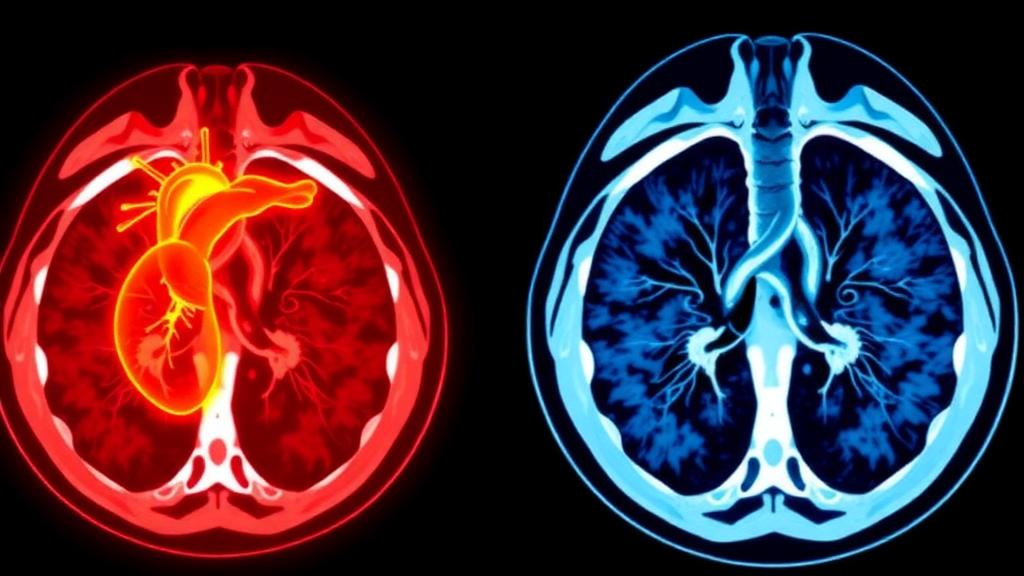
Pulmonary arterial hypertension is one of medicine’s quiet killers, a disease in which the blood vessels of the lungs slowly narrow and stiffen until the right side of the heart, exhausted by pumping against relentless resistance, begins to fail. Its early symptoms, breathlessness and fatigue, are so nonspecific that patients are often misdiagnosed with asthma, deconditioning, or anxiety for years. The definitive test, right heart catheterization, involves threading a catheter through the venous system into the pulmonary arteries to measure pressures directly. It is accurate but invasive, costly, and unavailable in many hospitals, which means countless patients wait far too long for answers. Now a team of researchers in China has shown that three simple measurements taken from an ordinary CT scan of the chest may identify the disease with remarkable accuracy, potentially transforming the diagnostic journey for thousands of people.
The study, published in the journal iScience, was a retrospective multicenter effort led by Huaxin Yuan and colleagues, including senior author Yanli Zhou, spanning the First Affiliated Hospital of Nanjing Medical University along with Gansu Provincial People’s Hospital and Sichuan Provincial People’s Hospital. The researchers enrolled 301 patients suspected of having pulmonary hypertension, all of whom underwent both computed tomography pulmonary angiography, or CTPA, and right heart catheterization within fourteen days of each other. This tight timing window ensured that the imaging findings and the hemodynamic measurements captured the same physiological state. Right heart catheterization served as the gold standard, with group 1 pulmonary arterial hypertension defined by the modern criteria established at the Sixth World Symposium on Pulmonary Hypertension: a mean pulmonary artery pressure above 20 mmHg, a pulmonary capillary wedge pressure of 15 mmHg or less, and a pulmonary vascular resistance exceeding 2 Wood units at rest.
The cohort was split into a training set of 203 patients, of whom 80 had confirmed pulmonary arterial hypertension, and an independent validation set of 98 patients, of whom 48 had the disease. The researchers extracted an extensive panel of measurements from the CTPA images: the diameters and cross-sectional areas of the main, left, and right pulmonary arteries; the dimensions and areas of all four cardiac chambers; the thickness of the right ventricular wall and the interventricular septum; the angle of the septum; and the severity of contrast reflux into the inferior vena cava and hepatic veins. All measurements were performed by a senior cardiovascular radiologist blinded to the catheterization results, with each parameter measured three times and averaged to reduce random error.
The differences between the two groups were striking. Patients with pulmonary arterial hypertension had markedly enlarged pulmonary arteries, with median main pulmonary artery diameters of 35.8 millimeters in the training cohort compared with 28.1 millimeters in controls, and even more pronounced differences in the validation cohort. Their right ventricles were dilated and their right ventricular walls thickened, reflecting the chronic pressure overload the chamber endures. Their right atria were larger, their left ventricles smaller and compressed, and the interventricular septum, the muscular wall separating the two ventricles, was bowed toward the left side of the heart, a hallmark of severe pulmonary hypertension that flattens the normal circular cross-section of the left ventricle into a characteristic D shape.
From this rich panel of candidate variables, the researchers used multivariable logistic regression and least absolute shrinkage and selection operator, or LASSO, regression to distill the predictors that carried independent diagnostic weight. Three emerged: the interventricular septal angle, the interventricular septal thickness, and the thickness of the right ventricular outflow tract wall. Each captures a distinct facet of how the right ventricle adapts to elevated afterload. The septal angle quantifies the geometric distortion imposed by the pressure-overloaded right ventricle as it pushes the shared septum leftward. The outflow tract wall thickness reflects hypertrophy of the muscular region that ejects blood into the pulmonary artery, a direct consequence of sustained pressure overload. The septal thickness, intriguingly, showed a paradoxical negative association, being slightly thinner in patients with the disease, which the authors attribute to left ventricular disuse atrophy and fibrosis, age-related remodeling in the older control group, and measurement plane distortion caused by the D-shaped deformation of the left ventricle.
When these three parameters were combined into a predictive model and translated into a nomogram, a simple graphical scoring tool that clinicians can use at the bedside, the performance was exceptional. The area under the receiver operating characteristic curve, a standard measure of diagnostic discrimination, reached 0.964 in the training cohort and 0.969 in the validation cohort, with sensitivity above 90 percent and specificity above 93 percent. Bootstrap resampling with one thousand iterations confirmed that the high performance was genuine rather than a statistical artifact: the optimism-corrected area under the curve was 0.960, the shrinkage coefficient was 0.993, and the Brier score, which measures overall prediction accuracy, was a low 0.062. Calibration curves showed that predicted probabilities closely matched observed outcomes, and decision curve analysis demonstrated that the nomogram delivered meaningful clinical net benefit across a realistic range of diagnostic thresholds.
The model also proved robust across demographic subgroups. In the validation cohort, it achieved an area under the curve of 0.981 in patients younger than sixty and 0.877 in those sixty or older, a difference that was not statistically significant, and it performed nearly identically in men and women. This consistency suggests that the model’s power derives from pathophysiological imaging features rather than demographic characteristics. Sensitivity analyses revealed another important finding: adding the classic vascular measurements of main pulmonary artery diameter and the ratio of that diameter to the aortic arch, parameters long used as radiological signs of pulmonary hypertension, provided no significant incremental diagnostic value over the three ventricular parameters alone. The heart’s adaptive response to pressure overload, it appears, tells the diagnostic story more completely than the size of the vessels themselves.
The clinical implications are considerable. Because CTPA is already performed routinely to exclude pulmonary embolism and evaluate unexplained breathlessness, the new approach imposes essentially no additional burden on patients or health systems. The authors are careful to position the tool as a complement rather than a replacement for the conventional diagnostic pathway, which begins with electrocardiography and transthoracic echocardiography. Echocardiography remains the cornerstone of noninvasive screening, but it is limited by acoustic windows and operator dependence, and in a meaningful fraction of patients the key Doppler measurement of tricuspid regurgitation velocity simply cannot be obtained. In precisely those scenarios, when electrocardiographic findings are nonspecific, echocardiographic windows are inadequate, or access to catheterization is restricted, the CTPA-based nomogram offers a rapid, quantitative, and interpretable estimate of disease probability that can guide referral decisions.
The study has limitations that the authors acknowledge candidly. Its retrospective design may introduce selection bias, all imaging came from a single CT vendor, and all measurements were made by a single observer, which ensures internal consistency but does not reflect the variability of real-world multi-reader practice. The model’s performance in distinguishing pulmonary arterial hypertension from other pulmonary hypertension subtypes, such as chronic thromboembolic disease, remains untested. External validation in multi-center, multi-vendor, multi-ethnic prospective cohorts with multiple observers will be essential before widespread adoption. Yet the vision articulated by the team is compelling: manual measurements today, automated artificial intelligence segmentation tomorrow, with these three ventricular parameters serving as an interpretable baseline for future intelligent diagnostic pipelines. For a disease whose prognosis depends so heavily on how early it is caught, a tool that turns an already-acquired CT scan into a near-definitive screening test could mean the difference between late-stage heart failure and timely, life-extending therapy.
Subject of Research: A predictive model and nomogram using CTPA-derived cardiac parameters to identify group 1 pulmonary arterial hypertension noninvasively
Article Title: Development of a predictive model and nomogram using CTPA parameters for the identification of group 1 pulmonary arterial hypertension
Article References: Development of a predictive model and nomogram using CTPA parameters for the identification of group 1 pulmonary arterial hypertension. (n.d.). Original publication
Image Credits: AI Generated
DOI: Not provided
Keywords: pulmonary arterial hypertension, CTPA, right heart catheterization, nomogram, interventricular septal angle, right ventricular hypertrophy, predictive model, diagnostic imaging, pulmonary vascular resistance, cardiac remodeling, LASSO regression, noninvasive diagnosis
Cite Scienmag News
Ophelia Keating. (October 10, 2026). Three Heart Measurements on a Routine CT Scan Could Reveal Hidden Lung Hypertension. Scienmag. https://scienmag.com/three-heart-measurements-on-a-routine-ct-scan-could-reveal-hidden-lung-hypertension/
Ophelia Keating. "Three Heart Measurements on a Routine CT Scan Could Reveal Hidden Lung Hypertension." Scienmag, 10 October 2026, https://scienmag.com/three-heart-measurements-on-a-routine-ct-scan-could-reveal-hidden-lung-hypertension/. Accessed 10 October 2026.
Ophelia Keating. "Three Heart Measurements on a Routine CT Scan Could Reveal Hidden Lung Hypertension." Scienmag. October 10, 2026. https://scienmag.com/three-heart-measurements-on-a-routine-ct-scan-could-reveal-hidden-lung-hypertension/


