


Silicon has long tantalized battery researchers as the anode material that could finally push lithium-ion cells beyond the limits of graphite. With a theoretical capacity of 3579 mAh g⁻¹—nearly ten times that of graphite’s 372 mAh g⁻¹—silicon promises a dramatic leap in energy density for electric vehicles and portable electronics. Yet silicon’s Achilles heel is equally famous: it swells enormously during lithiation, pulverizing particles and draining capacity within cycles. Silicon suboxide, or SiOx, offers a clever compromise, embedding silicon in an oxide matrix that buffers volume changes and preserves structural integrity. But unlocking SiOx’s full potential requires a delicate thermal transformation, and a new study published in Advanced Science shows that machine learning, guided by human expertise, can find that transformation’s sweet spot with unprecedented efficiency.
The challenge lies in what chemists call carbothermal reduction. When SiOx is heated in the presence of carbon, the carbon strips oxygen from the silicon oxide, generating electrochemically active low-valence silicon species that serve as reversible lithiation sites. Simultaneously, gas evolution in the form of carbon monoxide and carbon dioxide carves out internal pores that accommodate volume expansion during cycling. Conventional furnace-based annealing accomplishes this, but at a punishing cost: temperatures above 800 °C sustained for more than twelve hours, during which unwanted surface re-oxidation creeps in and undermines the careful control of the material’s oxygen-to-silicon ratio. The result is a slow, energy-hungry process with limited controllability.
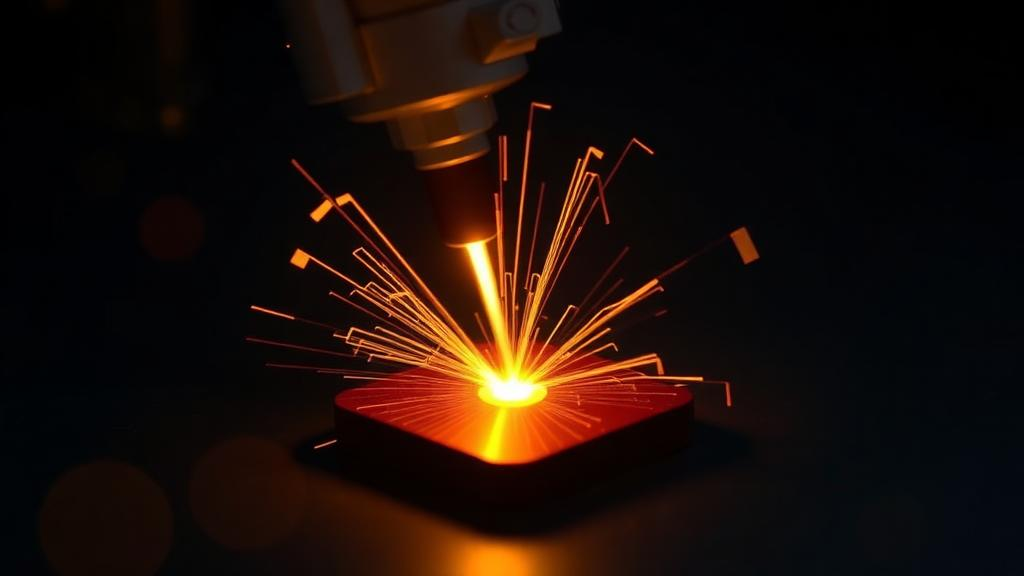
Laser-induced photothermal annealing offers a striking alternative. By concentrating optical energy into a confined region, a laser can drive thermochemical reactions with ultrafast heating and cooling cycles and precise spatial control. In previous work, the research team demonstrated that a two-step irradiation sequence could first carbonize the binder into a conductive framework and then uniformly reduce the SiOx active material while forming mesopores, yielding a specific capacity of 2139 mAh g⁻¹ at a mass loading of 6.6 mg cm⁻². The catch was throughput: maximizing performance demanded many irradiation passes, and finding the minimum effective recipe through empirical trial-and-error meant navigating a parameter space of roughly twenty-five million possible combinations of laser power, scan speed, and pass counts across two sequential scans.
To tame this combinatorial explosion, the team developed an empirical-aided active learning framework, or EAAL, that fuses probabilistic machine learning with laboratory intuition. At the heart of the approach sits Gaussian process regression, a statistical technique that builds a surrogate model of the parameter space from a handful of experiments and quantifies its own uncertainty. Rather than betting on a single model, the researchers ran four in parallel, combining two kernel functions—the radial basis function and the Matérn kernel—with two hyperparameter optimization schemes, maximum likelihood estimation and maximum a posteriori inference. Each model proposed three candidate conditions per iteration, and a human expert then filtered the twelve suggestions down to six for experimental testing.
The kernel choice matters more than it might first appear. The RBF kernel assumes infinitely smooth behavior, predicting gradual, nearly convex transitions between data points—an appropriate picture for diffusion-dominated processes where capacity shifts gently as laser power changes. The Matérn kernel, by contrast, tolerates rougher landscapes with abrupt changes, better suited to phenomena like sudden phase transitions or defect formation. Meanwhile, maximum likelihood estimation relies purely on the experimental data, while the maximum a posteriori approach folds in prior knowledge, regularizing the hyperparameters toward more stable estimates of both predictions and their uncertainty. Running all four variants simultaneously hedged against the risk that any single modeling assumption would mislead the search.
The optimization unfolded over four iterations using just 26 experimental data points. In the first round, the MAP-based models suggested fast scan speeds around 762 to 787 mm s⁻¹ paired with moderate laser powers of 3.6 to 3.9 W, and one of those samples, designated S7, immediately hit 97% of the target initial discharge capacity. The MLE-based models, however, recommended slower scans at higher power, and all three of those samples failed physically, damaged by excessive photothermal energy. Rather than contaminating the training data with these failures, the team excluded them and let the expert filter act as a physical constraint boundary, steering the algorithm away from regimes prone to thermal overdose—a pragmatic stand-in for the mathematically formal constrained Bayesian optimization that remains a goal for future fully automated systems.
By the third iteration, samples S15 and S20 exceeded the 95% capacity target, and the acquisition function analysis told a coherent story: expected improvement spiked early as the models explored uncertain territory, then declined as the surrogate’s accuracy sharpened around the high-performance region. Benchmarking against alternative strategies in a virtual black-box environment confirmed the framework’s advantage. The EAAL trajectory outperformed random search, space-filling Latin hypercube sampling, pure Bayesian optimization, and even single-kernel expert-aided optimization, demonstrating that the ensemble of surrogates combined with expert filtering was genuinely more than the sum of its parts. Among all tested models, the MLE Matérn configuration proved the most accurate, achieving the lowest root mean squared error and mean absolute error in leave-one-out cross-validation.
Perhaps the most scientifically valuable outcome was interpretability. Permutation importance analysis, which measures how much model predictions degrade when an input variable is randomly shuffled, revealed that the second scan speed dominated the electrochemical response with an importance score of 0.843, followed by the first scan speed at 0.234. Spectroscopic validation explained why. X-ray photoelectron spectroscopy showed that at the fastest second scan speeds, insufficient photothermal energy left the material under-reduced, with low-valence silicon species limited to 8.1 atomic percent. At slower speeds, reduction deepened—until excessive thermal input triggered disproportionation and surface re-oxidation, raising the Si⁴⁺ fraction and pushing interfacial resistance to 17.7 ohms. The optimal window sat squarely in between, where low-valence silicon peaked and impedance stayed stable.
The practical payoff is compelling. The EAAL-optimized anode, requiring only two laser irradiation passes, retained 91.9% of the initial discharge capacity and 96.3% of the initial Coulombic efficiency of an anode optimized through laborious trial-and-error that demanded five passes. It matched the long-term cycling stability completely, and impedance analysis showed a lower SEI resistance of 3.3 ohms versus 4.6 ohms, suggesting that reduced cumulative irradiation actually suppressed progressive surface re-oxidation. Raman spectroscopy added a subtle twist: the five-pass sample showed more graphitized carbon but also more defects, degrading electrolyte wettability and charge-transfer kinetics, while the two-pass recipe preserved a healthier carbon scaffold with a higher sp²-to-sp³ carbon ratio.
Beyond the immediate gains for SiOx anode manufacturing, the study delivers a broader message about how machine learning should enter materials science. Purely algorithmic optimization ignored the physical realities that a trained experimentalist recognizes instantly—a laser power and pass count combination guaranteed to destroy a sample. Purely empirical optimization, meanwhile, could never efficiently chart a twenty-five-million-point space or quantify which variables matter most. The EAAL framework shows that the two approaches are complementary, not competing: algorithms propose, experts dispose, and the resulting data-efficient, physically interpretable workflow offers a scalable template for optimizing not just battery electrodes but virtually any laser-based materials process where experiments are expensive and parameter spaces are vast.
Subject of Research: Human-guided Bayesian optimization of laser annealing conditions for mesoporous SiOx lithium-ion battery anodes
Article Title: Human‐Guided Bayesian Optimization Enables High‐Throughput Laser Annealing of Mesoporous SiOx Anodes for Lithium‐Ion Batteries
Article References: Park, C., Lee, Y., Jeong, S., & Lee, E. (2026). Human‐Guided Bayesian Optimization Enables High‐Throughput Laser Annealing of Mesoporous SiO x Anodes for Lithium‐Ion Batteries. Advanced Science, 13(56), Article e76607. https://doi.org/10.1002/advs.76607
Image Credits: AI Generated
DOI: 10.1002/advs.76607
Keywords: lithium-ion batteries, silicon suboxide anodes, Bayesian optimization, Gaussian process regression, laser annealing, carbothermal reduction, machine learning, energy storage, electrochemical performance, active learning, mesoporous materials, anode materials
Cite Scienmag News
Faith Mcneil. (October 10, 2026). AI-Guided Laser Annealing Cuts Battery Anode Processing to Just Two Passes. Scienmag. https://scienmag.com/ai-guided-laser-annealing-cuts-battery-anode-processing-to-just-two-passes/
Faith Mcneil. "AI-Guided Laser Annealing Cuts Battery Anode Processing to Just Two Passes." Scienmag, 10 October 2026, https://scienmag.com/ai-guided-laser-annealing-cuts-battery-anode-processing-to-just-two-passes/. Accessed 10 October 2026.
Faith Mcneil. "AI-Guided Laser Annealing Cuts Battery Anode Processing to Just Two Passes." Scienmag. October 10, 2026. https://scienmag.com/ai-guided-laser-annealing-cuts-battery-anode-processing-to-just-two-passes/


