


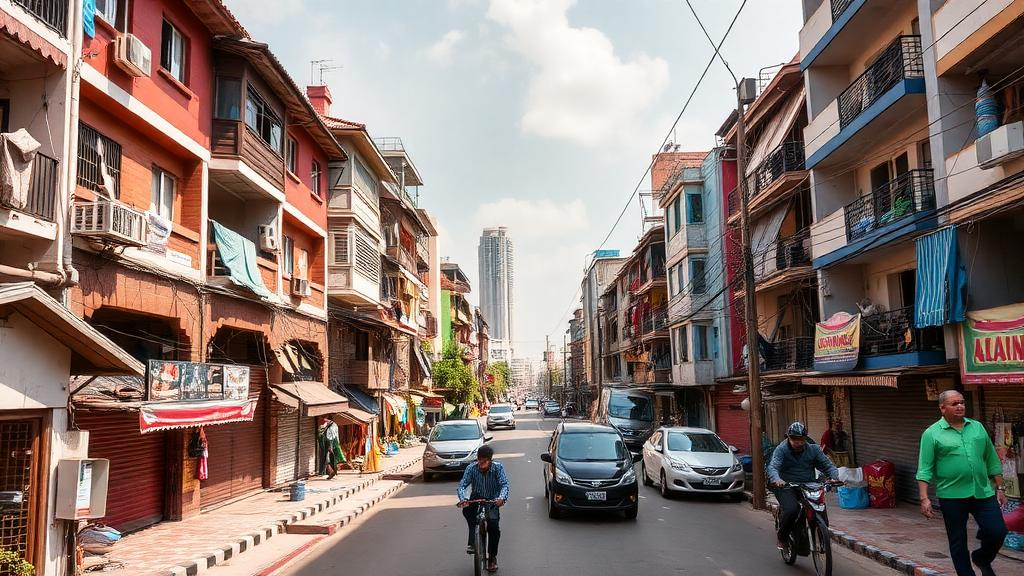
The sweltering streets of rapidly growing cities in the Global South are often described as an environmental problem to be solved with trees, reflective paint, and better building design. A new essay published in PLOS Climate argues that this framing is dangerously incomplete. Researchers Ansar Khan, Rafiq Hamdi, Tarek Ahmed, Dev Niyogi, Hashem Akbari, and Mattheos Santamouris contend that urban heat should be understood as a structural development challenge, one that emerges from the interaction of planetary warming, breakneck urbanization, uneven governance capacity, and political-economic forces that determine who gets to stay cool and who does not. Their argument reframes the debate over hot cities, shifting attention away from purely local fixes and toward the deeper financial and institutional conditions that increasingly constrain them.
The technical case for concern is well established. Cities amplify heat through the urban heat island effect, a phenomenon in which concrete, asphalt, and dark roofing absorb solar radiation during the day and release it slowly at night, keeping urban temperatures several degrees higher than surrounding rural areas. Reduced ventilation in densely built street canyons, waste heat from vehicles and air conditioners, and the loss of vegetated, moisture-retaining surfaces all compound the effect. As global temperatures climb, the baseline against which these local amplifications operate keeps rising, so the hottest nights and longest heat waves in a growing city become more extreme with every passing year. The authors emphasize that adaptation measures are being implemented against this backdrop of accelerating planetary warming, and that this backdrop fundamentally changes what local action can achieve.
Conventional responses remain firmly technological and municipal. Urban greening programs plant trees and restore parks to provide shade and evaporative cooling. Cool roofs raise albedo so that rooftops reflect more sunlight instead of absorbing it, and super cool materials push reflectivity and thermal emittance even higher, lowering roof surface temperatures dramatically. Building retrofits and passive design strategies reduce indoor heat gain through insulation, shading, ventilation, and reflective envelopes, cutting the need for energy-hungry mechanical cooling. These interventions demonstrably work at the scale of a block, a building, or a neighborhood, and the authors do not dispute their value. Instead, they make a more uncomfortable point: local interventions alone cannot overcome the broader climatic and structural conditions that increasingly limit their effectiveness and scalability.
The reasons are as much financial as physical. Many of the fastest-warming, fastest-growing cities sit in countries facing heavy debt burdens, narrow fiscal capacity, and limited access to climate finance. Greening a city at scale requires land, water, maintenance budgets, and trained staff over decades, not a single planting season. Retrofitting informal settlements demands capital that municipal governments in the Global South often simply do not have, while the upfront costs of cool roofing and passive design fall hardest on low-income households least able to pay them. International climate funds, designed for nation-scale mitigation projects, are frequently slow, competitive, and poorly matched to the granular, multi-year needs of municipal heat action. The result, the essay argues, is a persistent gap between the scale of the heat problem and the resources available to address it.
Beneath the fiscal constraints lies an even sharper issue of justice. Heat risks are not distributed evenly within cities, and neither is the capacity to respond. Wealthier residents can afford air conditioning, well-insulated housing, shaded neighborhoods, and private vehicles, while poorer residents often work outdoors or in unventilated workshops, live in heat-trapping informal housing, and lack reliable electricity for cooling. The authors describe a widening mismatch between those facing the greatest heat burdens and those possessing the greatest ability to cope. This unequal exposure is not accidental; it is shaped by political-economic processes that determine where people live, what their housing is made of, and which neighborhoods receive infrastructure investment. Heat, in this view, is a mirror of existing inequality, amplified by warming air.
The essay draws on evidence from urban climate science, adaptation research, development studies, and the climate justice literature to build this case, and it makes a careful conceptual distinction that gives the argument much of its force. Climate change mitigation, the reduction of greenhouse gas emissions, and local urban heat reduction perform distinct but complementary functions. Planting trees or coating roofs lowers local temperatures regardless of what happens to global emissions, but it cannot stop the planetary warming that raises the baseline. Conversely, global mitigation protects future generations from catastrophic warming but does little for a resident of a hot informal settlement during this decade. Neither can substitute for the other, yet most governance arrangements treat them as separate problems managed by separate institutions at separate scales, leaving the interaction between them unaddressed.
That institutional fragmentation is where governance enters the argument. The authors call for a shift away from predominantly local and technocratic approaches toward integrated strategies that combine mitigation, equitable climate finance, enhanced fiscal capacity, and multi-level governance. In practical terms, this means municipal heat action plans linked to national emission commitments, direct and simplified access to international climate finance for city governments, and fiscal reforms that give fast-growing cities the revenue to maintain infrastructure over decades. It also means recognizing that informal settlements, where a large share of future urban population growth will occur, cannot be cooled by demonstration projects alone; they require structural investment in housing, water, electricity, and public space.
The stakes of getting this wrong are measured in lives and in long-term habitability. Extreme heat is among the deadliest climate hazards, and its mortality toll is often undercounted because it kills through cardiovascular and respiratory stress rather than as a direct cause of death. Nighttime heat is particularly dangerous, since it prevents the human body from recovering between hot days, and urban heat islands are strongest after dark. In cities where electricity grids falter during heat waves, cooling becomes not just uncomfortable but lethal. As heat intensifies, labor productivity falls, outdoor work becomes hazardous, and the economics of entire urban regions come under pressure, turning heat from a seasonal nuisance into a structural drag on development itself.
What makes the essay striking is its refusal to let cities off the hook or to blame them unfairly. The authors acknowledge the genuine power of urban greening, cool and super cool roofs, and passive design, tools championed for years by researchers including Santamouris and Akbari, whose work on reflective roofing helped launch the cool surfaces movement. Their claim is about framing: heat reduction measures should be embedded within strategies that also confront debt, finance, governance, and equity, rather than offered as stand-alone technical solutions. A city that plants a million trees while its poorest districts remain unbondable and unbanked has treated a symptom; the disease is the arrangement of money and power that left those districts exposed in the first place.
The broader lesson extends well beyond any single metropolis. Most of the world’s urban growth this century will occur in cities of Africa and South Asia, places where climate change, population pressure, and fiscal stress collide most sharply. Whether those cities remain livable will depend less on the ingenuity of individual cooling technologies than on whether the international system can deliver resources and authority to the governments closest to the problem. Reframing urban heat as a structural development challenge, the authors conclude, provides a more comprehensive framework for addressing climate justice, resilience, and long-term urban habitability under a warming climate. In other words, the future of the hot city will be decided not only in its streets and rooftops, but in its budgets, its banks, and its bargaining position in a warming world.
Subject of Research: Urban heat as a structural development challenge in rapidly growing Global South cities
Article Title: Urban heat as a structural development challenge in rapidly growing cities
Article References: Khan, A., Hamdi, R., Ahmed, T., Niyogi, D., Akbari, H., & Santamouris, M. (2026). Urban heat as a structural development challenge in rapidly growing cities. PLOS Climate, 5(10), e0001010. https://doi.org/10.1371/journal.pclm.0001010
Image Credits: AI Generated
DOI: 10.1371/journal.pclm.0001010
Keywords: urban heat island, climate adaptation, Global South cities, climate justice, cool roofs, urban greening, climate finance, governance, rapid urbanization, PLOS Climate, extreme heat, passive design
Cite Scienmag News
Sloane Callahan. (October 10, 2026). Urban Heat Is a Development Crisis, Not Just a Weather Problem, Scientists Warn. Scienmag. https://scienmag.com/urban-heat-is-a-development-crisis-not-just-a-weather-problem-scientists-warn/
Sloane Callahan. "Urban Heat Is a Development Crisis, Not Just a Weather Problem, Scientists Warn." Scienmag, 10 October 2026, https://scienmag.com/urban-heat-is-a-development-crisis-not-just-a-weather-problem-scientists-warn/. Accessed 10 October 2026.
Sloane Callahan. "Urban Heat Is a Development Crisis, Not Just a Weather Problem, Scientists Warn." Scienmag. October 10, 2026. https://scienmag.com/urban-heat-is-a-development-crisis-not-just-a-weather-problem-scientists-warn/


