


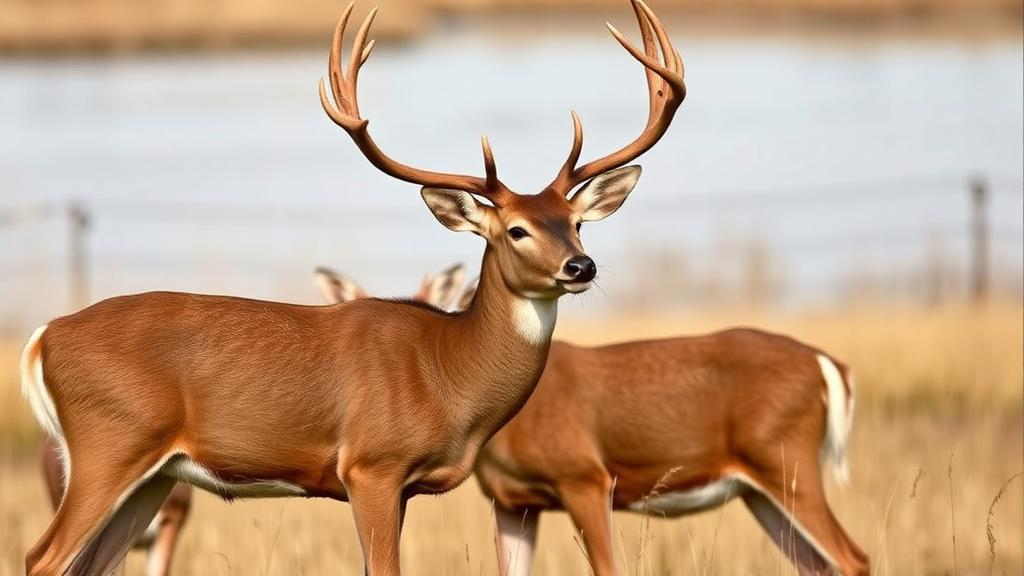
Every autumn, as the rut grips North America’s deer country, male cervids abandon their usual caution. They travel farther, fight, court, scent-mark, and congregate at predictable places on the landscape. A new study in Ecology and Evolution suggests that this seasonal recklessness carries a hidden cost: it concentrates chronic wasting disease (CWD) exposure risk at a handful of shared sites, turning ordinary stock tanks and white-tailed deer scrapes into potential engines of prion transmission across an entire multi-host cervid community.
CWD is a fatal, transmissible prion disease that affects mule deer, white-tailed deer, elk, and moose. Infected animals shed infectious prions in saliva, urine, and feces, and those misfolded proteins can persist in soil and on surfaces for years. Transmission happens in two ways: directly, through animal-to-animal contact such as grooming or sparring, and indirectly, through contact with contaminated environments. Because sympatric cervid species rarely touch one another, scientists have long suspected that indirect, environmental exposure at so-called local infectious zones — places where prions accumulate and animals congregate — is the main bridge for transmission between species.
A research team led by Rebecca M. Windell of the U.S. Department of Agriculture’s National Wildlife Research Center, working with colleagues at Colorado State University and the Nebraska Game and Parks Commission, set out to quantify that risk during the mating season. Their study area was the Wildcat Hills of western Nebraska, roughly 9,100 square kilometers of buttes, canyons, ponderosa pine, and shortgrass prairie where CWD has been enzootic since it was first detected in 2000. Prevalence in mule deer in the surrounding management unit has hovered around 15 percent over the past decade, making the region an ideal natural laboratory for studying how a multi-host community shares — or fails to share — a prion disease.
Between October 16 and December 7, 2023, the researchers deployed 38 camera traps at three kinds of sites: eight cattle-style water tanks, eleven white-tailed deer scrape sites marked by overhanging branches and pawed soil, and nineteen reference sites representing background deer activity such as game trails and agricultural edges. The cameras recorded ten-second videos whenever motion triggered them, capturing a total of 1,837 videos of antlered male mule deer, white-tailed deer, and elk. From this footage, the team built an ethogram of contact behaviors — drinking, foraging, investigating, scraping, thrashing, urinating, courting, and sparring — and measured exactly how many seconds each species spent performing them at each site type.
The results were striking. Male mule deer spent an average of 142 seconds engaged in environmental contact behaviors at water tanks and 105 seconds at scrape sites, compared with just 20 seconds at reference sites. White-tailed deer spent 104 seconds at scrapes versus 19 seconds at reference sites. Elk, remarkably, engaged in environmental contact behaviors only at water tanks, where they averaged 201 seconds — nearly three and a half minutes of drinking and investigating per encounter. Across the whole study, males logged 96.8 minutes of environmental exposure behaviors and 22.9 minutes of direct contact behaviors such as courting and sparring.
Spatial overlap told a complementary story. Mule deer were the only species that overlapped with both of the others, and the probability of overlap spiked at the local infectious zones: the odds of mule deer and white-tailed deer co-occurring were 7.6 times higher at scrape sites than at reference sites, and the odds of mule deer and elk overlapping were 8.7 times higher at water tanks. All three species appeared together at one water tank. Crucially, whenever two species overlapped, their environmental contact behaviors occurred exclusively at these shared sites — no interspecific exposure was recorded at reference locations at all.
To translate behavior into risk, the team calculated environmental exposure risk as the product of uptake behaviors, host competence, and shedding behaviors, drawing on a systematic literature review to estimate species-specific prevalence as a proxy for competence: roughly 15 percent for mule deer, 8 percent for white-tailed deer, and 3.3 percent for elk in comparable sympatric systems. Statistical models using Tweedie-distributed errors showed that mule deer intraspecific and total environmental exposure risk was more than 100 times higher at water tanks and scrapes than at reference sites, while white-tailed deer risk at scrapes was 6 to 15 times higher. Direct exposure risk, by contrast, showed no clear differences across site types, suggesting these hotspots matter mainly for environmental transmission.
The assumptions about host competence changed the picture in revealing ways. If all species were assumed equally competent, prions deposited by elk constituted the majority of mule deer’s environmental exposure risk at shared water tanks. But when the researchers used realistic prevalence-based competence values, most risk to both mule deer and elk traced back to mule deer themselves — positioning mule deer as the central node in the community’s transmission network. Because mule deer overlap heavily with both other species at local infectious zones and carry the highest prevalence, the authors argue they are both the main contributors to environmental transmission and the most vulnerable hosts, a conclusion consistent with the community epidemiology framework recently formalized by Atle Mysterud.
The findings carry immediate management implications. In areas where CWD spillover to elk is a concern, excluding cervids from shared water tanks or seasonally disinfecting metal tank surfaces — prions are known to bind to sediments and galvanized steel — could reduce emergence risk. Where mule deer populations are declining, managing densities and aggregation points may slow amplification, especially where white-tailed deer are abundant. The authors caution that host competence remains poorly understood and that their camera-trap window captured elk in post-rut recovery, but the approach itself is broadly applicable: any multi-host system with a horizontally transmitted pathogen and differential host competence could be dissected the same way, one behavior and one shared site at a time.
Subject of Research: Chronic wasting disease exposure risk to male cervids at shared environmental sites during the mating season
Article Title: Chronic Wasting Disease Exposure Risk to Male Cervids During the Mating Season in A Multi‐Host Community
Article References: Windell, R. M., Malmberg, J. L., Bailey, L. L., Fesmire, S., Simpson, S., Roundtree, M. K., & Titcomb, G. C. (2026). Chronic Wasting Disease Exposure Risk to Male Cervids During the Mating Season in A Multi‐Host Community. Ecology and Evolution, 16(10), Article e74463. https://doi.org/10.1002/ece3.74463
Image Credits: AI Generated
DOI: 10.1002/ece3.74463
Keywords: chronic wasting disease, prions, mule deer, white-tailed deer, elk, mating season, camera traps, host competence, environmental transmission, Nebraska, wildlife disease, scrape sites
Cite Scienmag News
Drew Townsend. (October 10, 2026). Mating Season Turns Water Tanks and Scrapes into Prion Hotspots for Male Deer. Scienmag. https://scienmag.com/mating-season-turns-water-tanks-and-scrapes-into-prion-hotspots-for-male-deer/
Drew Townsend. "Mating Season Turns Water Tanks and Scrapes into Prion Hotspots for Male Deer." Scienmag, 10 October 2026, https://scienmag.com/mating-season-turns-water-tanks-and-scrapes-into-prion-hotspots-for-male-deer/. Accessed 10 October 2026.
Drew Townsend. "Mating Season Turns Water Tanks and Scrapes into Prion Hotspots for Male Deer." Scienmag. October 10, 2026. https://scienmag.com/mating-season-turns-water-tanks-and-scrapes-into-prion-hotspots-for-male-deer/


