


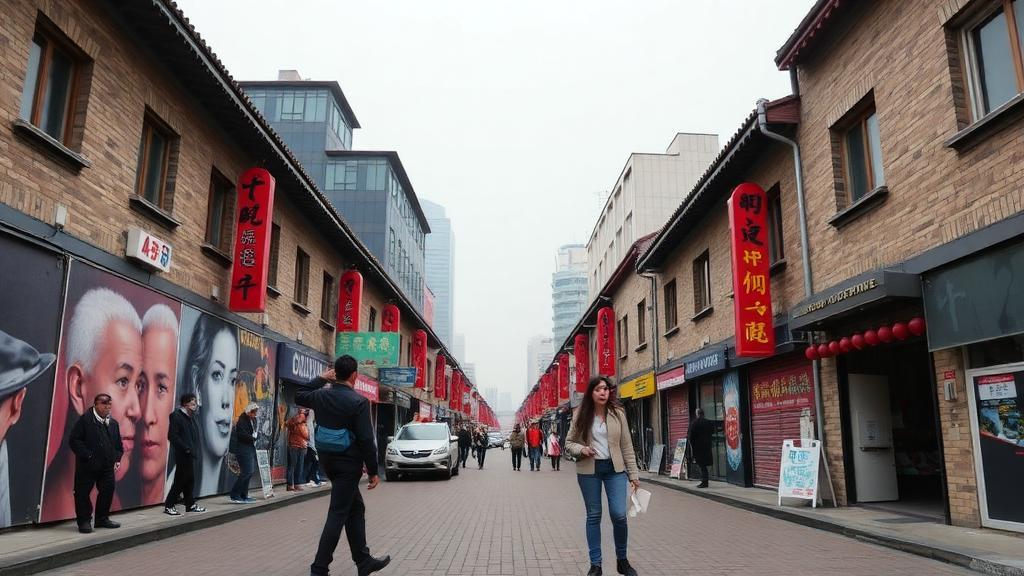
A single study has sifted through nearly thirty thousand social media posts to answer a question that has long hovered over China’s booming art districts: what does the public actually think of them? The research, published in Humanities and Social Sciences Communications by Dong Hao of the China Academy of Art in Hangzhou, analyzed 28,661 user-generated posts about three of the country’s best-known creative districts—Beijing’s 798 Art Zone, the Xiangshan Art Commune in Hangzhou, and Taoxichuan in Jingdezhen. By combining computational text mining with cultural theory, the study offers one of the most granular portraits to date of how visitors and residents perceive the transformation of industrial and heritage sites into contemporary cultural spaces.
The methodological core of the study rests on three complementary computational techniques. Semantic network analysis mapped the relationships between words and concepts across the posts, revealing which themes dominated public conversation and how they connected to one another. Latent Dirichlet Allocation, or LDA, a widely used topic-modeling algorithm, was deployed to uncover latent thematic structures hidden within the enormous volume of text, grouping posts into coherent topics without any predefined categories. Finally, an irony-aware sentiment analysis pipeline classified the emotional tone of each post—a crucial refinement, since sarcastic commentary about commercialization or gentrification can easily fool conventional sentiment classifiers into reading criticism as praise.
The results are striking for how sharply they diverge across the three sites. In Hangzhou, the Xiangshan Art Commune, a newer addition to the city’s cultural map, left 40 percent of respondents entirely neutral—suggesting that the district has yet to inspire strong feelings in either direction among the online public. In Jingdezhen, the historic porcelain capital that has reinvented itself through the Taoxichuan development, sentiment swung decisively positive: 63.8 percent of posts expressed support for the revitalization of the city’s ceramic heritage. Beijing’s 798, by contrast, drew the sharpest criticism, with 31.2 percent of respondents explicitly opposing what they perceived as the over-commercialization of the iconic former factory complex.
These numbers tell a story about the different life stages of cultural districts and how audiences respond to them. Jingdezhen’s success appears rooted in the way Taoxichuan has woven contemporary creative energy into a deep historical identity—the city has produced porcelain for over a millennium, and the sentiment data suggest the public reads its redevelopment as continuity rather than rupture. Beijing’s 798, once celebrated as a gritty, artist-led enclave in decommissioned military factories, now generates a measurable backlash against commercial saturation, with a substantial minority of online voices framing the district’s popularity as a betrayal of its creative origins.
The technical challenge at the heart of the analysis is one that plagues all sentiment research on social media: irony. Chinese-language posts about art districts frequently deploy sarcasm—praising a district’s endless cafes and souvenir shops in terms that clearly mean the opposite. Standard sentiment analysis models, which rely on lexical cues and patterns learned from training data, systematically misclassify such posts. By building irony detection into the sentiment pipeline, the study aimed to separate genuine enthusiasm from barbed mockery, producing sentiment estimates that better reflect what posters actually meant. The integration of this step with topic modeling allowed the researcher to link emotional positions to specific themes, such as commercialization, heritage, architecture, and artistic production.
On the theoretical side, the study proposes what it calls a dynamic equilibrium theory, an extension of Henri Lefebvre’s influential spatial triad. Lefebvre, the French Marxist philosopher and sociologist, famously argued that space is produced through the interplay of three dimensions: spatial practice, the everyday routines and material flows of a place; representations of space, the planned and conceptual visions of planners and designers; and representational spaces, the lived, symbolic, and imagined space experienced by inhabitants. The study advances this framework to describe how successful cultural districts must continuously negotiate balance among these dimensions—balancing economic growth against heritage preservation, and designed spectacle against authentic lived experience.
Applied to the Chinese context, the dynamic equilibrium framework helps explain the divergent sentiment patterns the data revealed. Where the triad falls out of balance—when commercial representations of space overwhelm lived, symbolic attachments to a place—public sentiment turns negative, as the 798 data demonstrate. Where redevelopment reinforces rather than erodes historical identity, as in Jingdezhen, the equilibrium holds and sentiment tilts positive. The neutral response to Hangzhou’s newer Xiangshan Art Commune may reflect a district still searching for its symbolic identity, producing neither the resonance that sustains affection nor the dissonance that provokes opposition. The theory thus offers urban planners a conceptual compass for managing cultural redevelopment over time, rather than a static judgment of success or failure.
Beyond its findings on China, the study is notable as an example of the digital humanities in action—bringing large-scale computational analysis to questions that cultural geographers and urban sociologists have traditionally addressed through interviews, ethnography, and site observation. Social media posts function here as a vast, continuous, and unsolicited public consultation: millions of spontaneous judgments about place, rendered in text and ripe for mining. For cities considering their own creative district projects, the approach suggests a new feedback mechanism, one in which public sentiment can be monitored quantitatively as redevelopment unfolds, rather than gauged only through periodic surveys or protests.
The work also speaks to a broader international debate about participatory placemaking in the digital era. Cultural districts have become a near-universal urban strategy, from Tate Modern’s transformation of a London power station to loft galleries in Detroit and creative clusters in Seoul. Yet the tension the study documents—between the economic imperatives that fund cultural redevelopment and the authenticity that makes such places meaningful—is not uniquely Chinese. By grounding that tension in measurable sentiment data and connecting it to a fifty-year-old theoretical tradition, the research demonstrates how computational social science and humanistic theory can reinforce one another rather than compete.
The study, received in May 2025 and accepted in September 2026, arrives at a moment when Chinese cities are rethinking how cultural space should be developed and managed. Its central lesson is deceptively simple: the public is paying attention, and it keeps score. Whether a district is celebrated as a living continuation of heritage or condemned as a shopping mall with art on the walls is not a matter of chance but of balance—and, thanks to the growing flood of user-generated content, that balance can now be read directly from the words of the people who visit, inhabit, and love these spaces. The research was conducted without specific external funding, and the author reports no competing interests.
Subject of Research: Public perception of Chinese art districts analyzed through social media text mining
Article Title: Analyzing the cultural landscape of Chinese art districts through online social media: a text mining and theoretical interpretation using user-generated content
Article References: Analyzing the cultural landscape of Chinese art districts through online social media: a text mining and theoretical interpretation using user-generated content. (n.d.). https://doi.org/10.1038/s41599-026-09316-z
Image Credits: AI Generated
DOI: 10.1038/s41599-026-09316-z
Keywords: art districts, social media analysis, text mining, sentiment analysis, LDA topic modeling, Lefebvre spatial triad, urban redevelopment, cultural heritage, digital humanities, Beijing 798, Jingdezhen Taoxichuan, placemaking
Cite Scienmag News
Courtney Benton. (October 10, 2026). Social Media Posts Reveal How the Public Really Feels About China’s Art Districts. Scienmag. https://scienmag.com/social-media-posts-reveal-how-the-public-really-feels-about-chinas-art-districts/
Courtney Benton. "Social Media Posts Reveal How the Public Really Feels About China’s Art Districts." Scienmag, 10 October 2026, https://scienmag.com/social-media-posts-reveal-how-the-public-really-feels-about-chinas-art-districts/. Accessed 10 October 2026.
Courtney Benton. "Social Media Posts Reveal How the Public Really Feels About China’s Art Districts." Scienmag. October 10, 2026. https://scienmag.com/social-media-posts-reveal-how-the-public-really-feels-about-chinas-art-districts/


